
The U.S. Department of Justice (DoJ) on Wednesday indicted[1]
three suspected North Korean hackers for allegedly conspiring to
steal and extort over $1.3 billion in cash and cryptocurrencies
from financial institutions and businesses.
The three defendants — Jon Chang Hyok, Kim Il, and Park Jin Hyok
— are said to be members of the Reconnaissance General Bureau, a
military intelligence division of North Korea, also known as the
Lazarus group[2], Hidden Cobra[3], or Advanced Persistent
Threat 38 (APT 38).
Accusing them of creating and deploying multiple malicious
cryptocurrency applications, developing and fraudulently marketing
a blockchain platform, the indictment expands on the 2018 charges brought against Park[4], one of the alleged
nation-state hackers previously charged in connection with the 2014
cyberattack on Sony Pictures Entertainment.
A Wide-Ranging Scheme to Commit Cyberattacks and Financial
Crimes
“North Korea’s operatives, using keyboards rather than guns,
stealing digital wallets of cryptocurrency instead of sacks of
cash, are the world’s leading bank robbers,” said Assistant
Attorney General John C. Demers of the Justice Department’s
National Security Division.
“The Department will continue to confront malicious nation state
cyber activity with our unique tools and work with our fellow
agencies and the family of norms abiding nations to do the
same.”
The latest indictment is yet another sign of how the Lazarus
Group relies on cyber cryptocurrency heists and cybertheft against
businesses and critical infrastructure in order to fund a country
that’s been heavily hit by economic sanctions.
The group, which earned a place in the U.S. government’s
sanctions list[5]
in 2019, has been linked into a wide array of criminal cyber
activities, both in the U.S. and abroad, including the destructive
WannaCry ransomware[6]
outbreak of 2017, the SWIFT attacks[7]
on banks and ATM networks to steal more than $1.2 billion,
conducting spear-phishing campaigns, and carrying out
cryptocurrency thefts amounting to at least $112 million.
Interestingly, the indictment also details the defendants’ plans
to create their own crypto-token called Marine Chain in 2017-18,
which would let users purchase stakes in shipping vessels, but in
reality, was a money-making initiative aimed at secretly obtaining
funds for the government while evading international sanctions.
“AppleJeus” Backdoor to Steal Cryptocurrency
Also undertaken by the conspiracy is a scheme that involved
creating malicious applications that masqueraded as legitimate
cryptocurrency trading platforms, only to use them as a backdoor to
transfer money to their accounts fraudulently.
Calling the backdoor “AppleJeus[8],” the U.S. Cybersecurity
and Infrastructure Security Agency (CISA) said it discovered at
least seven different versions of the malware since 2018, with the
Lazarus Group banking on a mix of phishing, social networking, and
social engineering techniques as initial infection vectors to trick
users into downloading it.
The rogue applications identified by CISA comprises of
Ants2Whale, Celas Trade Pro, CoinGo Trade, CryptoNeuro Trader,
Dorusio, iCryptoFx, Kupay Wallet, Union Crypto Trader, and
WorldBit-Bot.
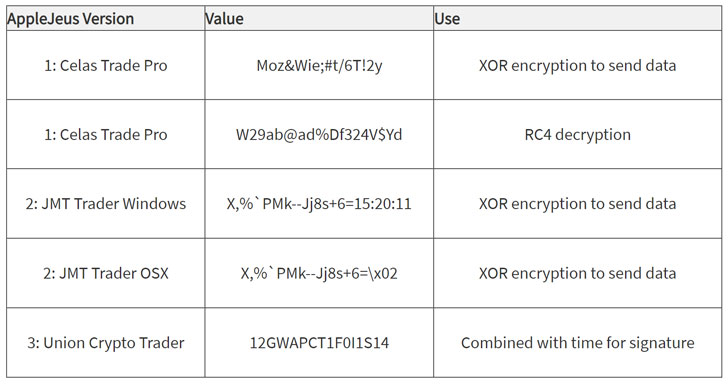
Energy, finance, government, industry, technology, and
telecommunications sectors were the prominent focus of the attacks,
the agency detailed, adding AppleJeus targets both Windows and Mac
operating systems, echoing a previous August 2018 report[9]
from cybersecurity firm Kaspersky.
Canadian-American Citizen Charged for Money Laundering
U.S. prosecutors said the three men were stationed by the North
Korean government in other countries such as China and Russia with
the goal of furthering the strategic and financial interests of the
Kim Jong Un-led regime. The DoJ, however, did not elaborate on
whether threat actors from either country collaborated with the
North Korean operatives on these attacks.
In a related development, the U.S. Federal Bureau of
Investigation (FBI) obtained warrants to seize cryptocurrencies
totaling approximately $1.9 million that were allegedly plundered
from an unnamed financial services company in New York and held at
two cryptocurrency exchanges.
A second case that was also unsealed yesterday concerned a
Canadian-American citizen named Ghaleb Alaumary, who pled guilty in
a money-laundering scheme and admitted to carrying out ATM
“cash-out” operations and a cyber-enabled bank heist orchestrated
by North Korean hackers.
Although the individuals are unlikely to be extradited and
brought to trial, Jon, Kim, and Park are charged with one count of
conspiracy to commit computer fraud and abuse and one count of
conspiracy to commit wire fraud and bank fraud. Alaumary has been
charged with one count of conspiracy to commit money laundering,
which carries a maximum sentence of 20 years in prison.
“The scope of the criminal conduct by the North Korean hackers
was extensive and long-running, and the range of crimes they have
committed is staggering,” said Acting U.S. Attorney Tracy L.
Wilkison for the Central District of California. “The conduct
detailed in the indictment are the acts of a criminal nation-state
that has stopped at nothing to extract revenge and obtain money to
prop up its regime.”
References
- ^
indicted
(www.justice.gov) - ^
Lazarus
group (thehackernews.com) - ^
Hidden
Cobra (thehackernews.com) - ^
2018
charges brought against Park
(www.justice.gov) - ^
sanctions list
(thehackernews.com) - ^
WannaCry
ransomware (thehackernews.com) - ^
SWIFT
attacks (thehackernews.com) - ^
AppleJeus
(us-cert.cisa.gov) - ^
August
2018 report (securelist.com)