One of the first malware samples tailored to run natively on
Apple’s M1 chips has been discovered, suggesting a new development
that indicates that bad actors have begun adapting malicious
software to target the company’s latest generation of Macs powered
by its own processors.
While the transition to Apple silicon has necessitated
developers to build new versions of their apps to ensure better
performance and compatibility, malware authors are now undertaking
similar steps to build malware that are capable of executing
natively on Apple’s new M1 systems, according to macOS Security
researcher Patrick Wardle.
Wardle detailed a Safari adware extension called GoSearch22 that
was originally written to run on Intel x86 chips but has since been
ported to run on ARM-based M1 chips. The rogue extension, which is
a variant of the Pirrit advertising malware, was first seen in the
wild on November 23, 2020, according to a sample uploaded[1]
to VirusTotal on December 27.
“Today we confirmed that malicious adversaries are indeed
crafting multi-architecture applications, so that their code will
natively run on M1 systems,” said[2]
Wardle in a write-up published yesterday. “The malicious GoSearch22
application may be the first example of such natively M1 compatible
code.”
While M1 Macs can run x86 software with the help of a dynamic
binary translator called Rosetta[3], the benefits of native
support mean not only efficiency improvements but also the
increased likelihood of staying under the radar without attracting
any unwanted attention.
First documented[4]
in 2016, Pirrit[5]
is a persistent Mac adware family notorious for pushing intrusive
and deceptive advertisements to users that, when clicked, downloads
and installs unwanted apps that come with information gathering
features.
The heavily obfuscated GoSearch22[6]
adware disguises itself as a legitimate Safari browser extension
when in fact, it collects browsing data and serves a large number
of ads such as banners and popups, including some that link to
dubious websites to distribute additional malware.
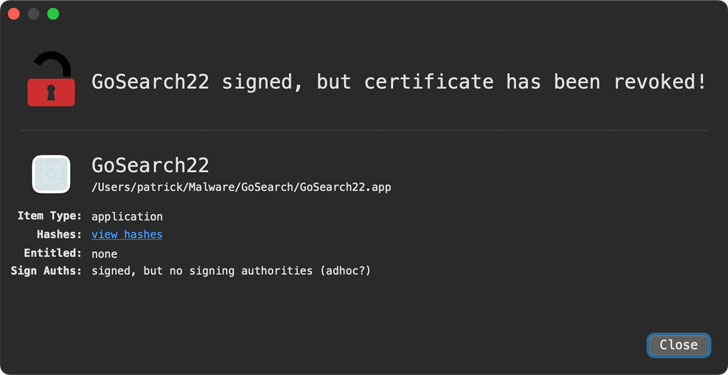
Wardle said the extension was signed with an Apple Developer ID
“hongsheng_yan” in November to conceal its malicious content
further, but it has since been revoked, meaning the application
will no longer run on macOS unless attackers re-sign it with
another certificate.
Although the development highlights how malware continues to
evolve in direct response to both hardware changes, Wardle warned
that “(static) analysis tools or antivirus engines may struggle
with arm64 binaries,” with detections from industry-leading
security software dropping by 15% when compared to the Intel x86_64
version.
GoSearch22’s malware capabilities may not be entirely new or
dangerous, but that’s beside the point. If anything, the emergence
of new M1-compatible malware signals this is just a start, and more
variants are likely to crop up in the future.