Security researchers have uncovered nine vulnerabilities
affecting four TCP/IP stacks impacting more than 100 million
consumer and enterprise devices that could be exploited by an
attacker to take control of a vulnerable system.
Dubbed “NAME:WRECK[1]” by Forescout and JSOF,
the flaws are the latest in series of studies undertaken as part of
an initiative called Project Memoria to study the security of
widely-used TCP/IP stacks that are incorporated by various vendors
in their firmware to offer internet and network connectivity
features.
“These vulnerabilities relate to Domain Name System (DNS)
implementations, causing either Denial of Service (DoS) or Remote
Code Execution (RCE), allowing attackers to take target devices
offline or to take control over them,” the researchers said.
The name comes from the fact that parsing of domain names can
break (i.e., “wreck”) DNS implementations in TCP/IP stacks, adding
to a recent uptick in vulnerabilities such as SigRed[2], SAD DNS[3], and DNSpooq[4]
that leverage the “phonebook of the internet” as an attack
vector.
They also mark the fifth time security weaknesses have been
identified in the protocol stacks that underpin millions of
internet-connected devices —
Specifically, the latest research offers a closer look at the
“message compression[5]” scheme used in the DNS
protocol that “eliminates the repetition of domain names in a
message” with the intent of reducing the size of messages,
uncovering multiple flaws in FreeBSD (12.1), IPnet (VxWorks 6.6),
Nucleus NET (4.3), and NetX (6.0.1) stacks.
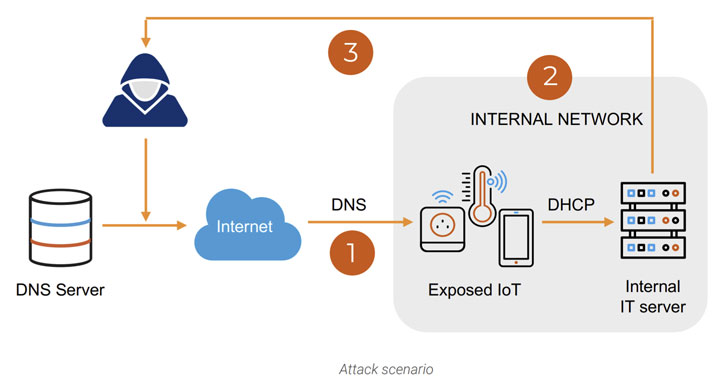
In a plausible real-world attack scenario, adversaries can
exploit these flaws to find their way into an organization’s
network via an internet-facing device that issues DNS requests to a
server and exfiltrate sensitive information, or even use them as a
stepping stone to sabotage critical equipment.
With the exception of IPnet, FreeBSD[6], Nucleus NET[7], and NetX[8]
have all released patches, requiring device vendors using
vulnerable versions of the software to ship an updated firmware to
their customers.
But as with the previous flaws, there are several hurdles to
applying the fixes, what with the lack of information regarding the
TCP/IP stack that runs on a device, the difficulty in delivering
patches because the devices are not centrally managed, or they
cannot be taken offline due to their central role in
mission-critical processes like healthcare and industrial control
systems.
In other words, besides the effort required to identify all the
vulnerable devices, it could take a considerable amount of time
before the security patches trickle down from the stack vendor to
the firmware of the device.
Even worse, in some cases, it may never be feasible to push a
patch, as a result of which many of the impacted devices will most
likely remain exposed to attacks for years to come or until they
are decommissioned.
While a quick fix may not be in sight, the bright spot in the
findings is that there are mitigations that make it easier to
detect attempts to take advantage of these flaws. For a start,
Forescout has released an open-source script[9]
to detect devices running the affected stacks. In addition, the
researchers also recommend enforcing network segmentation controls
until the patches are in place and monitoring all network traffic
for malicious packets that attempt to exploit flaws targeting DNS,
mDNS, and DHCP clients.
The study is also expected to be presented at the Black Hat Asia 2021[10] conference on May 6,
2021.
“NAME:WRECK is a case where bad implementations of a specific
part of an RFC can have disastrous consequences that spread across
different parts of a TCP/IP stack and then different products using
that stack,” the researchers said.
“It is also interesting that simply not implementing support for
compression (as seen for instance in lwIP) is an effective
mitigation against this type of vulnerability. Since the bandwidth
saving associated with this type of compression is almost
meaningless in a world of fast connectivity, we believe that
support for DNS message compression currently introduces more
problems than it solves.”
References
- ^
NAME:WRECK
(www.forescout.com) - ^
SigRed
(thehackernews.com) - ^
SAD
DNS (thehackernews.com) - ^
DNSpooq
(thehackernews.com) - ^
message
compression (tools.ietf.org) - ^
FreeBSD
(www.freebsd.org) - ^
Nucleus
NET (cert-portal.siemens.com) - ^
NetX
(github.com) - ^
open-source script
(github.com) - ^
Black
Hat Asia 2021 (www.blackhat.com)