
Microsoft has warned organizations of a “unique” attack campaign
that abuses contact forms published on websites to deliver
malicious links to businesses via emails containing fake legal
threats, in what’s yet another instance of adversaries abusing
legitimate infrastructure to mount evasive campaigns that bypass
security protections.
“The emails instruct recipients to click a link to review
supposed evidence behind their allegations, but are instead led to
the download of IcedID, an info-stealing malware,” the company’s
threat intelligence team said[1]
in a write-up published last Friday.
IceID[2]
is a Windows-based banking trojan that’s used for reconnaissance
and exfiltration of banking credentials, alongside features that
allow it to connect to a remote command-and-control (C2) server to
deploy additional payloads such as ransomware and malware capable
of performing hands-on-keyboard attacks, stealing credentials, and
moving laterally across affected networks.
Microsoft researchers said the attackers might have used an
automated tool to deliver the emails by abusing the enterprises’
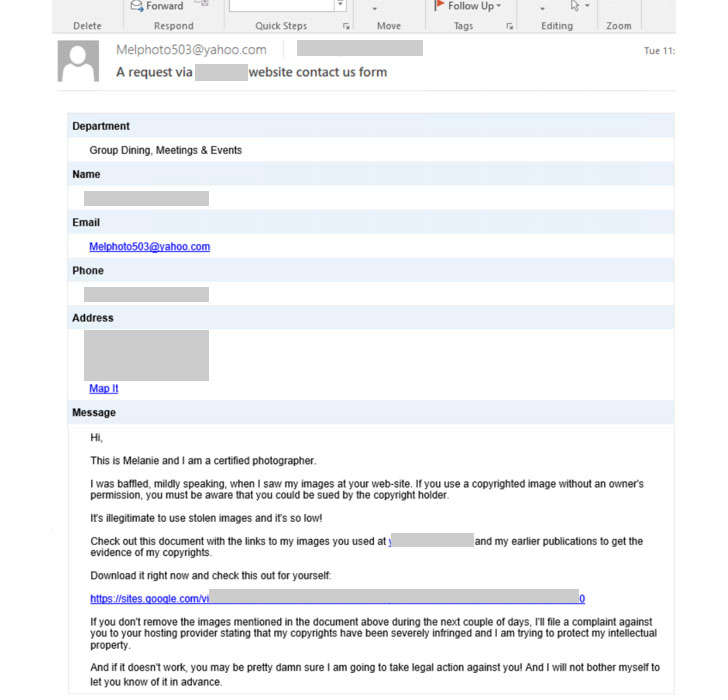
contact forms while circumventing CAPTCHA protections. The emails
themselves employ legal threats to intimidate victims, claiming
that the recipients “allegedly used their images or illustrations
without their consent, and that legal action will be taken against
them.”
By invoking a sense of urgency, the idea is to lead the victim
into revealing sensitive information, click a sketchy link, or open
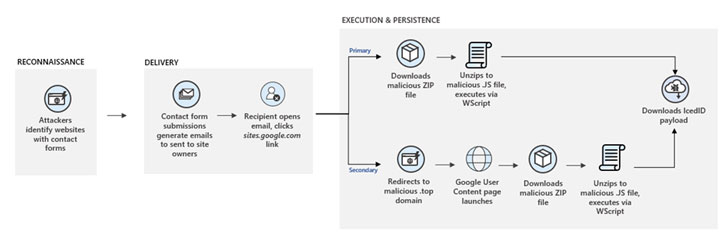
a malicious file. In this infection chain, it’s a link to a
sites.google.com page, which requires users to sign in with their
Google credentials, following which a ZIP archive file is
automatically downloaded.
The ZIP file contains a heavily obfuscated JavaScript file that
downloads the IcedID malware. What’s more, the malicious code has
the capacity to download secondary implants like Cobalt Strike,
potentially putting affected victims at further risk.
The novel intrusion route notwithstanding, the attacks are yet
another sign of how threat actors constantly tweak their social
engineering tactics to target companies with an intent to
distribute malware while evading detection.
“The scenarios […] offer a serious glimpse into how
sophisticated attackers’ techniques have grown, while maintaining
the goal of delivering dangerous malware payloads such as IcedID,”
the researchers said. “Their use of submission forms is notable
because the emails don’t have the typical marks of malicious
messages and are seemingly legitimate.”