
In its April slate of patches, Microsoft rolled out fixes for a
total of 114 security flaws[1], including an actively
exploited zero-day and four remote code execution bugs in Exchange
Server.
Of the 114 flaws[2], 19 are rated as
Critical, 88 are rated Important, and one is rated Moderate in
severity.
Chief among them is CVE-2021-28310[3], a privilege escalation
vulnerability in Win32k that’s said to be under active
exploitation, allowing attackers to elevate privileges by running
malicious code on a target system.
Cybersecurity firm Kaspersky, which discovered and reported the
flaw to Microsoft in February, linked the zero-day exploit to a
threat actor named Bitter APT, which was found exploiting a similar
flaw (CVE-2021-1732[4]) in attacks late last
year.
“It is an escalation of privilege (EoP) exploit that is likely
used together with other browser exploits to escape sandboxes or
get system privileges for further access,” Kaspersky researcher
Boris Larin said[5].
NSA Found New Bugs Affecting Exchange Server
Microsoft also said four additional vulnerabilities were
publicly known at the time of release but not exploited —
- CVE-2021-28458 – Azure ms-rest-nodeauth Library Elevation of
Privilege Vulnerability - CVE-2021-27091 – RPC Endpoint Mapper Service Elevation of
Privilege Vulnerability - CVE-2021-28437 – Windows Installer Information Disclosure
Vulnerability - CVE-2021-28312 – Windows NTFS Denial of Service
Vulnerability
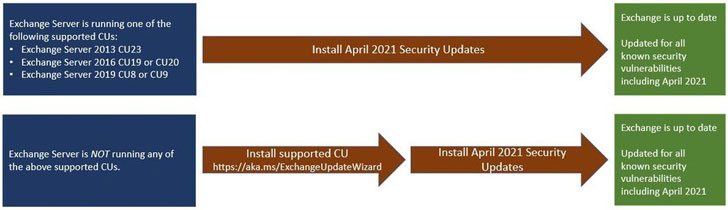
Also fixed by Microsoft are four remote code execution (RCE)
flaws (CVE-2021-28480 through CVE-2021-28483) affecting on-premises Exchange Servers[6] 2013, 2016, and 2019
that were reported to the company by the U.S. National Security
Agency (NSA). Two of the code execution bugs are unauthenticated
and require no user interaction, and carry a CVSS score of 9.8 out
of a maximum of 10.
While the Windows maker said it had found no evidence of any
active exploits in the wild, it’s recommended that customers
install these updates as soon as possible to secure the
environment, in light of the widespread Exchange Server hacks last
month and new findings that attackers are attempting to leverage
the ProxyLogon[7]
exploit to deploy malicious cryptominers[8] onto Exchange Servers,
with the payload being hosted on a compromised Exchange Server.
FBI Removed Backdoors From Hacked MS Exchange servers
What’s more, the U.S. Federal Bureau of Investigation (FBI)
carried out a “successful action” to “copy and remove” web shells
planted by adversaries on hundreds of victim computers using the
ProxyLogon flaws. “The FBI conducted the removal by issuing a
command through the web shell to the server, which was designed to
cause the server to delete only the web shell (identified by its
unique file path),” the Justice Department said[9]
in a statement detailing the court-authorized operation.
The U.S. Cybersecurity and Infrastructure Security Agency (CISA)
has also revised[10] the emergency directive
it issued last month, stating “these vulnerabilities pose an
unacceptable risk to the Federal enterprise and require an
immediate and emergency action,” while cautioning that the
underlying flaws can be weaponized by reverse-engineering the patch
to create an exploit.
Software Patches From Other Vendors
In addition, April’s Patch Tuesday update also addresses a
whopping 27 RCE flaws in Remote Procedure Call (RPC) runtime, a
Hyper-V security feature bypass vulnerability (CVE-2021-28444), and
multiple privilege escalation flaws in Windows Speech Runtime,
Windows Services and Controller App, Windows Secure Kernel Mode,
Windows Event Tracing, and Windows Installer.
Besides Microsoft, a number of other vendors have also released
a slew of patches on Tuesday —
References
- ^
114
security flaws (msrc-blog.microsoft.com) - ^
114
flaws (msrc.microsoft.com) - ^
CVE-2021-28310
(msrc.microsoft.com) - ^
CVE-2021-1732
(thehackernews.com) - ^
said
(securelist.com) - ^
on-premises Exchange Servers
(techcommunity.microsoft.com) - ^
ProxyLogon
(thehackernews.com) - ^
deploy
malicious cryptominers (news.sophos.com) - ^
said
(www.justice.gov) - ^
revised
(us-cert.cisa.gov)
Read more http://feedproxy.google.com/~r/TheHackersNews/~3/s2V5STIU49k/nsa-discovers-new-vulnerabilities.html