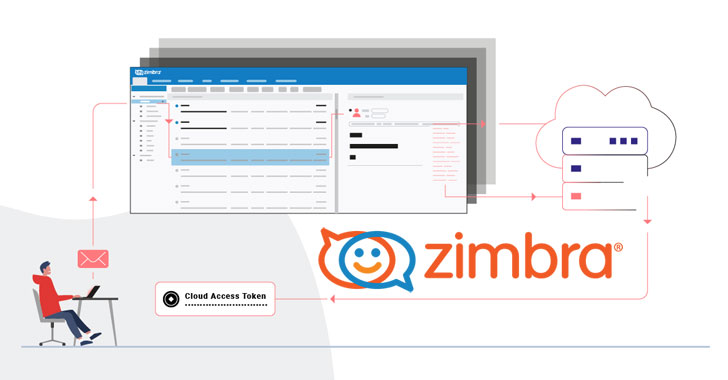
Cybersecurity researchers have discovered multiple security
vulnerabilities in Zimbra email collaboration software that could
be potentially exploited to compromise email accounts by sending a
malicious message and even achieve a full takeover of the mail
server when hosted on a cloud infrastructure.
The flaws — tracked as CVE-2021-35208 and
CVE-2021-35208 — were discovered and reported in Zimbra
8.8.15 by researchers from code quality and security solutions
provider SonarSource in May 2021. Mitigations have since been
released[1]
in Zimbra versions 8.8.15 Patch 23 and 9.0.0 Patch 16.
- CVE-2021-35208[2]
(CVSS score: 5.4) – Stored XSS Vulnerability in
ZmMailMsgView.java - CVE-2021-35209[3]
(CVSS score: 6.1) – Proxy Servlet Open Redirect Vulnerability
“A combination of these vulnerabilities could enable an
unauthenticated attacker to compromise a complete Zimbra webmail
server of a targeted organization,” said[4]
SonarSource vulnerability researcher, Simon Scannell, who
identified the security weaknesses. “As a result, an attacker would
gain unrestricted access to all sent and received emails of all
employees.”
Zimbra is a cloud-based email, calendar, and collaboration suite
for enterprises and is available both as an open-source version and
a commercially supported version with additional features such as a
proprietary connector API to synchronize mail, calendar, and
contacts to Microsoft Outlook, among others. It’s used[5] by over 200,000
businesses across 160 countries.
CVE-2021-35208 concerns a cross-site scripting (XSS[6]) vulnerability in the
Calendar Invite component that can be triggered in a victim’s
browser upon viewing a specially-crafted email message containing a
JavaScript payload that, when executed, grants access to the
target’s entire inbox as well as the web client session, which can
then be abused to launch further attacks.

The problem stems from the fact that the Zimbra web clients — an
Ajax-based desktop client, a static HTML client, and a
mobile-optimized client — perform the sanitization of the HTML
content of incoming emails on the server-side and in a manner that
enables a bad actor to inject rogue JavaScript code.
“The downside of using server-side sanitization is that all
three clients may transform the trusted HTML of an email afterwards
to display it in their unique way,” Scannell said. “Transformation
of already sanitized HTML inputs can lead to corruption of the HTML
and then to XSS attacks.”
On the other hand, CVE-2021-35208 relates to a server side
request forgery (SSRF[7]) attack wherein an
authenticated member of an organization can chain the flaw with the
aforementioned XSS issue to redirect the HTTP client used by Zimbra
to an arbitrary URL and extract sensitive information from the
cloud, including Google Cloud API access tokens and IAM credentials
from AWS, leading to its compromise.
“Zimbra would like to alert its customers that it is possible
for them to introduce an SSRF security vulnerability in the Proxy
Servlet,” the company noted[8]
in its advisory. “If this servlet is configured to allow a
particular domain (via zimbraProxyAllowedDomains[9] configuration setting),
and that domain resolves to an internal IP address (such as
127.0.0.1), an attacker could possibly access services running on a
different port on the same server, which would normally not be
exposed publicly.”
References
Read more http://feedproxy.google.com/~r/TheHackersNews/~3/1m_T-2HPMA8/new-bug-could-let-attackers-hijack.html