
Cybersecurity researchers on Tuesday disclosed nine security
vulnerabilities affecting three open-source projects — EspoCRM[1], Pimcore[2], and Akaunting[3]
— that are widely used by several small to medium businesses and,
if successfully exploited, could provide a pathway to more
sophisticated attacks.
All the security flaws in question, which impact EspoCRM v6.1.6,
Pimcore Customer Data Framework v3.0.0, Pimcore AdminBundle v6.8.0,
and Akaunting v2.1.12, were fixed within a day of responsible
disclosure, researchers Wiktor Sędkowski of Nokia and Trevor
Christiansen of Rapid7 noted. Six of the nine flaws were uncovered
in the Akaunting project.
EspoCRM is an open-source customer relationship management (CRM)
application, while Pimcore is an open-source enterprise software
platform for customer data management, digital asset management,
content management, and digital commerce. Akaunting, on the other
hand, is an open-source and online accounting software designed for
invoice and expense tracking.
The list of issues is as follows –
- CVE-2021-3539 (CVSS score: 6.3) – Persistent
XSS flaw in EspoCRM v6.1.6 - CVE-2021-31867 (CVSS score: 6.5) – SQL
injection in Pimcore Customer Data Framework v3.0.0 - CVE-2021-31869 (CVSS score: 6.5) – Pimcore
AdminBundle v6.8.0 - CVE-2021-36800 (CVSS score: 8.7) – OS command
injection in Akaunting v2.1.12 - CVE-2021-36801 (CVSS score: 8.5) –
Authentication bypass in Akaunting v2.1.12 - CVE-2021-36802 (CVSS score: 6.5) –
Denial-of-service via user-controlled ‘locale’ variable in
Akaunting v2.1.12 - CVE-2021-36803 (CVSS score: 6.3) – Persistent
XSS during avatar upload in Akaunting v2.1.12 - CVE-2021-36804 (CVSS score: 5.4) – Weak
Password Reset in Akaunting v2.1.12 - CVE-2021-36805 (CVSS score: 5.2) – Invoice
footer persistent XSS in Akaunting v2.1.12
Successful exploitation of the flaws could enable an
authenticated adversary to execute arbitrary JavaScript code,
commandeer the underlying operating system and use it as a
beachhead to launch additional nefarious attacks, trigger a
denial-of-service via a specially-crafted HTTP request, and even
change the company associated with a user account sans any
authorization.
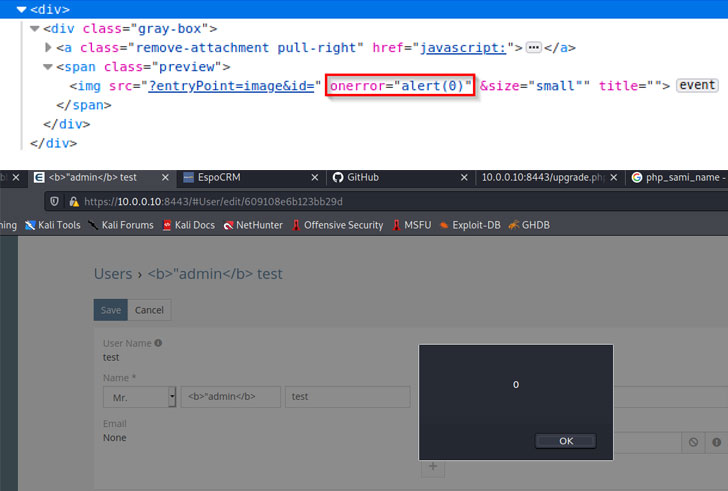 |
| EspoCRM |
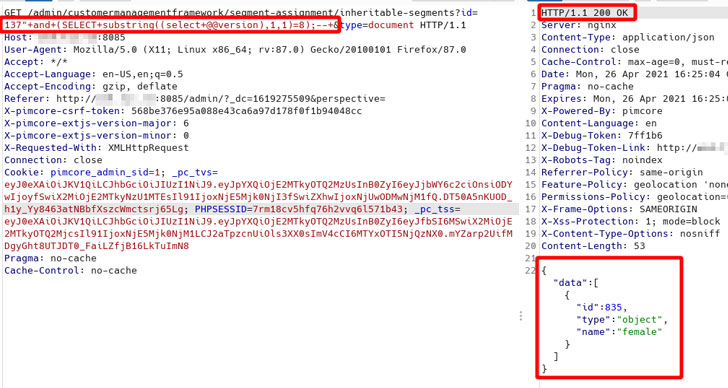 |
| Pimcore Customer Data Framework |
Also addressed in Akaunting is a weak password reset
vulnerability where the attacker can abuse the “I forgot my
password” functionality to send a phishing email from the
application to a registered user containing a malicious link that,
when clicked, delivers the password reset token. The bad actor can
then use the token to set a password of their choice.
“All three of these projects have real users, real customers of
their attendant support services and cloud-hosted versions, and are
undoubtedly the core applications supporting thousands of small to
medium businesses running today,” the researchers noted.
“For all of these issues, updating to the latest versions of the
affected applications will resolve them. If updating is difficult
or impossible due to external factors or custom, local changes,
users of these applications can limit their exposure by not
presenting their production instances to the internet directly —
instead, expose them only to trusted internal networks with trusted
insiders.”