The massive state-sponsored espionage campaign[1]
that compromised software maker SolarWinds also targeted Microsoft,
as the unfolding investigation into the hacking spree reveals the
incident may have been far more wider in scope, sophistication, and
impact than previously thought.
News of Microsoft’s compromise was first reported by Reuters[2], which also said
Microsoft’s own products were then used to strike other victims by
leveraging its cloud offerings, citing people familiar with the
matter.
The Windows maker, however, denied the threat actor had
infiltrated its production systems to stage further attacks against
its customers.
In a statement to The Hacker News via email, the company said
—
“Like other SolarWinds customers, we have been actively looking
for indicators of this actor and can confirm that we detected
malicious SolarWinds binaries in our environment, which we isolated
and removed. We have not found evidence of access to production
services or customer data. Our investigations, which are ongoing,
have found absolutely no indications that our systems were used to
attack others.”
Characterizing the hack as “a moment of reckoning,” Microsoft
president Brad Smith said[3]
it has notified over 40 customers located in Belgium, Canada,
Israel, Mexico, Spain, the UAE, the UK, and the US that were
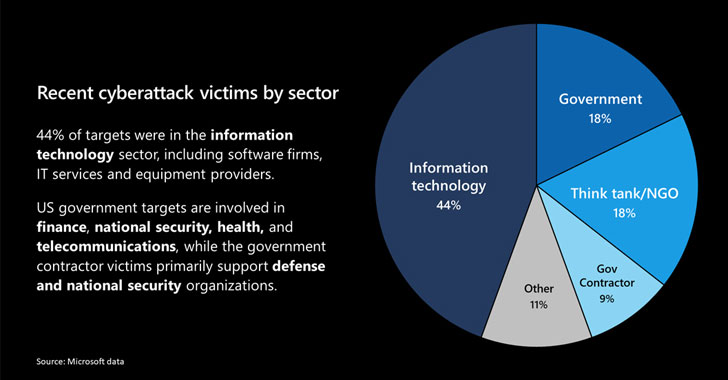
singled out by the attackers. 44% of the victims are in the
information technology sector, including software firms, IT
services, and equipment providers.
CISA Issues New Advisory
The development comes as the US Cybersecurity and Infrastructure
Security Agency (CISA) published a fresh advisory[4], stating the “APT actor
[behind the compromises] has demonstrated patience, operational
security, and complex tradecraft in these intrusions.”
“This threat poses a grave risk to the Federal Government and
state, local, tribal, and territorial governments as well as
critical infrastructure entities and other private sector
organizations,” it added.
But in a twist, the agency also said it identified additional
initial infection vectors, other than the SolarWinds Orion
platform, that have been leveraged by the adversary to mount the
attacks, including a previously stolen key to circumvent Duo’s
multi-factor authentication (MFA) to access the mailbox of a user
via Outlook Web App (OWA) service.
Digital forensics firm Volexity[5], which tracks the actor
under the moniker Dark Halo, said the MFA bypass was one of the
three incidents between late 2019 and 2020 aimed at a US-based
think tank.
The entire intrusion campaign came to light earlier this week
when FireEye disclosed[6]
it had detected a breach that also pilfered its Red Team
penetration testing tools.
Since then, a number[7]
of agencies[8]
have been found[9]
to be attacked, including the US departments of Treasury, Commerce,
Homeland Security, and Energy, the National Nuclear Security
Administration (NNSA), and several state department networks.
While many details continue to remain unclear, the revelation
about new modes of attack raises more questions about the level of
access the attackers were able to gain across government and
corporate systems worldwide.
Microsoft, FireEye, and GoDaddy Create a Killswitch
Over the last few days, Microsoft, FireEye, and GoDaddy seized control[10] over one of the main
GoDaddy domains — avsvmcloud[.]com — that was used by the hackers
to communicate with the compromised systems, reconfiguring it to
create a killswitch[11] that would prevent the
SUNBURST malware from continuing to operate on victims’
networks.
For its part, SolarWinds has not yet disclosed how exactly the
attacker managed to gain extensive access to its systems to be able
to insert malware into the company’s legitimate software
updates.
Recent evidence, however, points to a compromise[12] of its build and
software release system. An estimated 18,000 Orion customers[13] are said to have
downloaded the updates containing the back door.
The hacks are believed to be the work of APT29, a Russian threat
group also known as Cozy Bear, which has been linked to a series of breaches[14] of critical US
infrastructure over the past year.
The latest slew of intrusions has also led CISA, the US Federal
Bureau of Investigation (FBI[15]), and the Office of the
Director of National Intelligence (ODNI[16]) to issue a joint
statement, stating the agencies are gathering intelligence in order
to attribute, pursue, and disrupt the responsible threat
actors.
Calling for stronger steps to hold nation-states accountable for
cyberattacks, Smith said the attacks represent “an act of
recklessness that created a serious technological vulnerability for
the United States and the world.”
“In effect, this is not just an attack on specific targets, but
on the trust and reliability of the world’s critical infrastructure
in order to advance one nation’s intelligence agency,” he
added.
References
- ^
espionage campaign
(thehackernews.com) - ^
Reuters
(www.reuters.com) - ^
said
(blogs.microsoft.com) - ^
advisory
(us-cert.cisa.gov) - ^
Volexity
(www.volexity.com) - ^
disclosed
(thehackernews.com) - ^
number
(www.politico.com) - ^
agencies
(www.bloomberg.com) - ^
found
(theintercept.com) - ^
seized
control (thehackernews.com) - ^
create
a killswitch (krebsonsecurity.com) - ^
compromise
(thehackernews.com) - ^
18,000
Orion customers (thehackernews.com) - ^
series
of breaches (us-cert.cisa.gov) - ^
FBI
(www.fbi.gov) - ^
ODNI
(www.dni.gov)