Three dozen journalists working for Al Jazeera had their iPhones
stealthily compromised via a zero-click exploit to install spyware
as part of a Middle East cyberespionage campaign.
In a new report[1]
published yesterday by University of Toronto’s Citizen Lab,
researchers said personal phones of 36 journalists, producers,
anchors, and executives at Al Jazeera, and a journalist at
London-based Al Araby TV were infected with Pegasus malware via a
now-fixed flaw in Apple’s iMessage.
Pegasus is developed by Israeli private intelligence firm NSO
Group and allows an attacker to access sensitive data[2]
stored on a target device — all without the victim’s knowledge.
“The shift towards zero-click attacks by an industry and
customers already steeped in secrecy increases the likelihood of
abuse going undetected,” the researchers said.
“It is more challenging […] to track these zero-click attacks
because targets may not notice anything suspicious on their phone.
Even if they do observe something like ‘weird’ call behavior, the
event may be transient and not leave any traces on the device.”
The findings came to light after one of the victims, Al Jazeera
investigative journalist Tamer Almisshal, suspected his iPhone may
have been hacked and consented to have his network traffic
monitored by Citizen Lab researchers using a VPN app earlier this
January.

The internet watchdog found that the attacks occurred between
July and August of this year using an exploit chain it calls
KISMET, a zero-day present in iOS 13.5.1 that could be used to
break Apple’s security protections.
Citizen Lab said the 36 phones in question were hacked by four
distinct “clusters” or NSO operators with probable ties to the
Saudi and the United Arab Emirates governments.
A review of Almisshal’s VPN logs revealed a sudden uptick in
anomalous connections to Apple iCloud servers, which the
researchers surmise was the initial infection vector to transmit
the malicious code, followed by connections to an installation
server to fetch the Pegasus spyware.
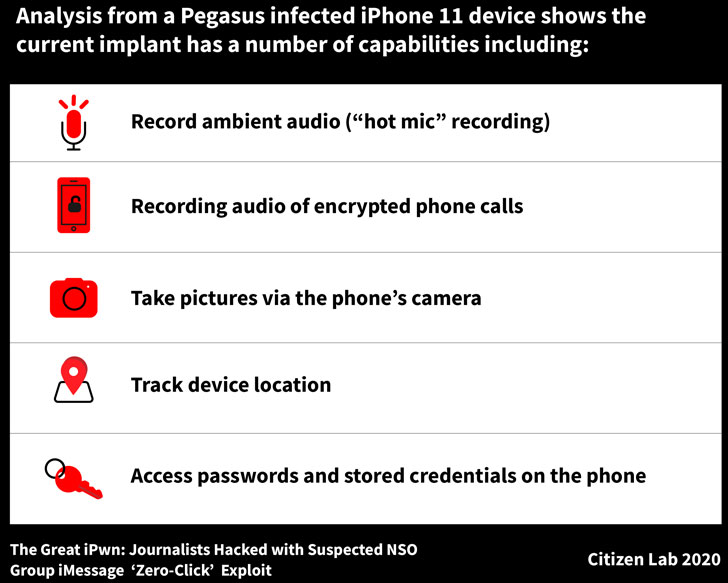
The implant comes with the capabilities to record audio from
microphone and phone calls, take photos using the phone’s camera,
access the victim’s passwords, and track the device’s location.
While NSO Group has consistently maintained that its software is
only meant to be used by law enforcement agencies to track down
terrorists and criminals, this is far from the first time the tool
has been abused[3]
by various governments[4]
to spy on critics, dissidents, politicians, and other individuals
of interest.

One of those cases involved the delivery of the hacking tool
through a previously undisclosed vulnerability in WhatsApp, which
is currently pursuing legal action[5]
against the company in a US court.
“The current trend towards zero-click infection vectors and more
sophisticated anti-forensic capabilities is part of a broader
industry-wide shift towards more sophisticated, less detectable
means of surveillance,” the researchers concluded.
“The increased targeting of the media is especially concerning
given the fragmented and often ad-hoc security
practices and cultures[6]
among journalists and media outlets, and the gap between the scale
of threats and the security resources made available to reporters
and newsrooms.”
References
- ^
report
(citizenlab.ca) - ^
access
sensitive data (thehackernews.com) - ^
abused
(thehackernews.com) - ^
governments
(thehackernews.com) - ^
pursuing
legal action (thehackernews.com) - ^
fragmented and often ad-hoc security
practices and cultures
(www.tandfonline.com)