
Organizations have been worrying about cyber security since the
advent of the technological age. Today, digital transformation
coupled with the rise of remote work has made the need for security
awareness all the more critical.
Cyber security professionals are continuously thinking about how
to prevent cyber security breaches from happening, with employees
and contractors often proving to be the most significant risk
factor for causing cyber security incidents. Proactive cyber
security professionals will find that an effective security
awareness training program can significantly reduce their risk of
getting exposed to a cyber incident.
For a security awareness training program to be successful, it
must be measurable and yield positive, actionable results over
time.
The following looks at what good security awareness looks like
and how vital phishing simulations and awareness
training is in devising effective cyber security
programs.[1][2]
The essentials of a cyber security awareness training
program
Employees represent security risks mainly because they are
unaware of how their actions and decisions cause security
incidents. To address this cause, enterprises undertake extensive
security awareness training efforts to help employees know what
they should and shouldn’t do when working digitally.
The mere act of exposing employees to security training is not
enough; a program is not effective unless it produces results in
building real skills that change employee behavior and empower them
to make the right choice in the face of a cyberattack.
To achieve this, companies must select a security awareness
training that is data-driven, adaptive per employee location, takes
into account role and behavior towards cyber training, is
continuous and high-frequency, and engages each employee at least
once a month.
Some of the key features organizations should be looking for in
a security awareness program can be divided into the following.
Continuous cyber education training and a hands-on
approach
The more employees are exposed to real-life phishing emails and
other security risks, the more likely they are to succeed in
protecting the organization and assets against phishing, malware,
and many other threats. However, with cybersecurity awareness,
theoretical knowledge becomes even more valuable when put into
practice. Therefore training must become a hands-on learning
experience with simulations and concrete action.
Identify weakest links and employ real-time
feedback
Statistically, fewer than 20 percent of employees in an
organization are responsible for most human error-induced mistakes.
To make sure all employees are properly trained, organizations must
run simulations frequently – at least once a month. This is also
where continuous feedback loops come into play. By engaging or
disengaging with the content, employees reflect on the security gap
that exists between them and the organizational risk, illustrating
the need for cybersecurity awareness training in the first place.
Moreover, when security events include real-time feedback,
employees immediately understand the missteps and how to prevent
similar situations in the future.
Culture and the scientific training
method
Cyber security awareness must be ingrained in the organization’s
daily practices without feeling like a daily grind. Organizations
should make training an engaging, effortless, and seamless part of
employees’ daily routines, regularly encouraging continuous
learning via small digestible security awareness learning
bites.[3]
Behind effective cyber security training is often a scientific
method. A next gen approach[4]
to security awareness training should focus bringing together
learning expertise, data science, and automation.
How to Measure Progress
Having a training program in place is a great start, but
organizations must ask themselves: how do I know if my security
awareness training is working?
Organizations usually rely solely at click rates (e.g. how many
employees click on phishing simulations) to measure success. And
this is precisely where they go wrong.
Companies must focus on progress over time, and not just measure
participation.
When measuring the success of a security awareness program, it’s
all about context.
Companies should look for qualitative, not simply quantitative
results. For instance, if a company sends out three phishing
simulations over a year, there is no way of knowing whether one was
sent while an employee was on vacation or if an employee clicked
because they were new to the company or whether the email went
unnoticed due to a flurry of meetings and other tasks.
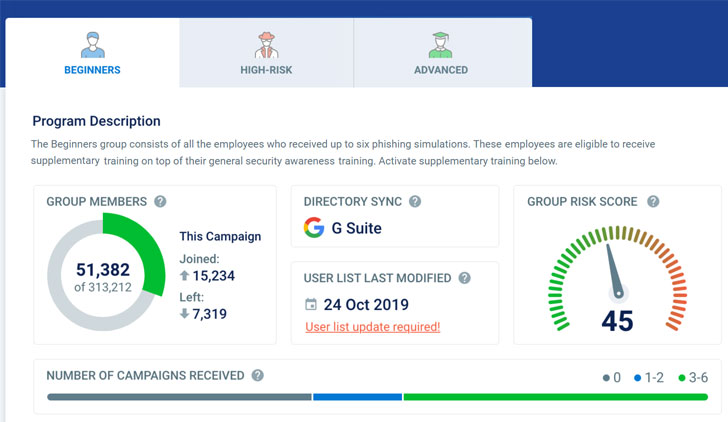 |
| Image credit: CybeReady |
When progress is measured instead of participation, teams get a
clear view of the benefits of a security awareness training
solution over time. Instead of looking at the company as one block
of employees, it would be worthwhile to approach them individually
with specific strengths and weaknesses. To evaluate the impact of
your security awareness training, you need actionable data to
identify valuable metrics such as:
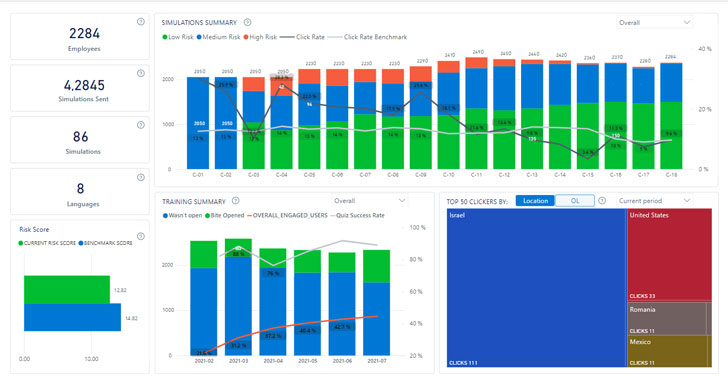
- High-risk employees: The number of employees
who fail to learn at a good pace and avoid more scams over
time. - Resilience: The level of security awareness in
the company or even within specific teams. - Meantime between failures: Proving
that employee learning is occurring and that retention is improving
over time. In machinery, MTBF is used to measure the amount of time
since the machine failed last. In the security awareness industry,
MTBF shows the resilience of an organization. If employees have
fewer simulation failures and mistakes are decreasing, the
employees are acquiring knowledge from the program, and best of all
– retaining it.
 |
| Image credit: CybeReady |
An effective security awareness program requires the right
platform
Security professionals who wish to address security risks in
their organizations need to ensure that their employees know daily
security risks. An ongoing, employee-centric, and engaging security
awareness program is one of the best ways to have vigilant
employees.
Organizations must foster security awareness to build a culture
of readiness to mitigate security risks effectively. CybeReady
addresses this by offering a fully autonomous, data-driven security
readiness platform that delivers, measures, and optimizes complete
out-of-the-box awareness training that is continuous, contextual,
and adaptive.
 |
| Image credit: CybeReady |
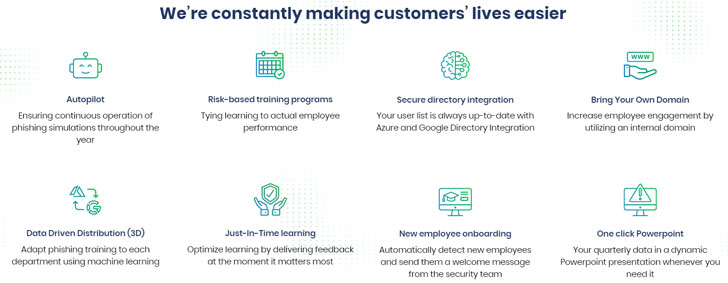
CybeReady’s Security Awareness Training platform offers key
capabilities :
- Training and simulation content is adapted based on employee
role and locale - Training and simulation content and frequency auto-adapt to
mitigate measured risks - No IT effort required
- One-click executive reporting
- Measurements provide progress improvements metrics
- Proven results :
200% higher employee engagement
400% increase in Employee Resilience Score (within 12
months)
80% reduction in high-risk group size
Final thoughts
Despite the broad adoption of first-generation security
awareness solutions, the human element continues to be a primary
catalyst for data breaches, with phishing accounting for 36% of
breaches[5]. This means that
organizations need to turn security awareness into a readiness
culture to mitigate security risks effectively.
CybeReady empowers enterprises with a comprehensive
human-centric security awareness training program that is easy to
deploy, operate and measure.
Get started with a cybersecurity[6] training program that
really works
References
- ^
phishing simulations and awareness
training (cybeready.com) - ^
cyber security programs.
(cybeready.com) - ^
security awareness learning bites.
(cybeready.com) - ^
next gen
approach (cybeready.com) - ^
phishing
accounting for 36% of breaches
(www.verizon.com) - ^
Get
started with a cybersecurity
(cybeready.com)
Read more https://thehackernews.com/2021/11/how-to-build-security-awareness.html