Nation-state operators with nexus to Iran are increasingly
turning to ransomware as a means of generating revenue and
intentionally sabotaging their targets, while also engaging in
patient and persistent social engineering campaigns and aggressive
brute force attacks.
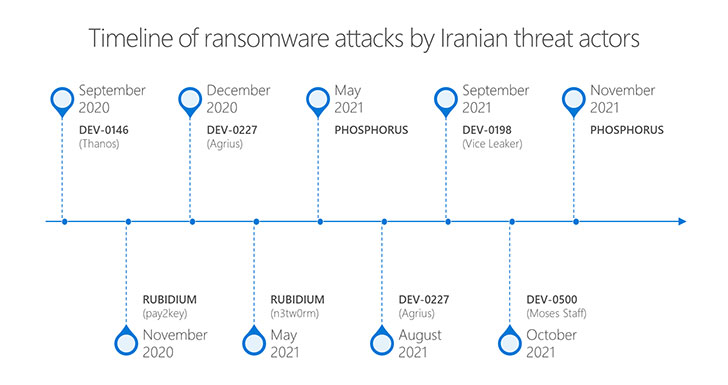
No less than six threat actors affiliated with the West Asian
country have been discovered deploying ransomware to achieve their
strategic objectives, researchers from Microsoft Threat
Intelligence Center (MSTIC) revealed[1], adding “these
ransomware deployments were launched in waves every six to eight
weeks on average.”
Of note is a threat actor tracked as Phosphorus[2]
(aka Charming Kitten or APT35), which has been found scanning IP
addresses on the internet for unpatched Fortinet FortiOS SSL VPN
and on-premises Exchange Servers to gain initial access and
persistence on vulnerable networks, before moving to deploy
additional payloads that enable the actors to pivot to other
machines and deploy ransomware.
Another tactic incorporated into the playbook is to leverage a
network of fictitious social media accounts, including posing as
attractive women, to build trust with targets over several months
and ultimately deliver malware-laced documents that allow for data
exfiltration from the victim systems. Both Phosphorus and a second
threat actor dubbed Curium have been spotted incorporating such
“patient” social engineering methods to compromise their
targets
“The attackers build a relationship with target users over time
by having constant and continuous communications which allows them
to build trust and confidence with the target,” MSTIC researchers
said. In many of the cases we have observed, the targets genuinely
believed that they were making a human connection and not
interacting with a threat actor operating from Iran.”
A third trend is the use of password spray attacks to target
Office 365 tenants targeting U.S., E.U., and Israeli defense
technology companies, details of which Microsoft publicized last month[3], while attributing it to
an emerging threat cluster DEV-0343.
Furthermore, the hacker groups have also demonstrated the
capability to adapt and shape-shift depending on their strategic
goals and tradecraft, evolving into “more competent threat actors”
proficient in disruption and information operations by conducting a
spectrum of attacks, such as cyber espionage, phishing and password
spraying attacks, employing mobile malware, wipers and ransomware,
and even carrying out supply chain attacks.
The findings are especially significant in light of a new alert
issued by cybersecurity agencies from Australia, the U.K., and
U.S., warning[4]
of an ongoing wave of intrusions carried out by Iranian
government-sponsored hacking groups by exploiting Microsoft
Exchange ProxyShell and Fortinet vulnerabilities.
“These Iranian government-sponsored APT actors can leverage this
access for follow-on operations, such as data exfiltration or
encryption, ransomware, and extortion,” the agencies said in a
joint bulletin published Wednesday.
References
- ^
revealed
(www.microsoft.com) - ^
Phosphorus
(malpedia.caad.fkie.fraunhofer.de) - ^
publicized last month
(thehackernews.com) - ^
warning
(thehackernews.com)
Read more https://thehackernews.com/2021/11/microsoft-warns-about-6-iranian-hacking.html