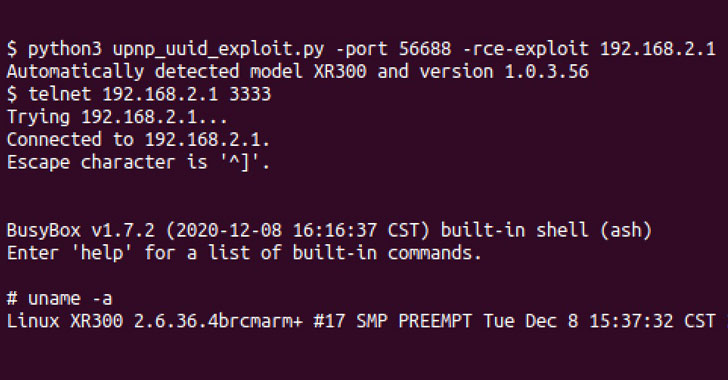
Networking equipment company Netgear has released[1]
yet another round[2]
of patches[3]
to remediate a high-severity remote code execution vulnerability
affecting multiple routers that could be exploited by remote
attackers to take control of an affected system.
Tracked as CVE-2021-34991[4]
(CVSS score: 8.8), the pre-authentication buffer overflow flaw in
small office and home office (SOHO) routers can lead to code
execution with the highest privileges by taking advantage of an
issue residing in the Universal Plug and Play (UPnP[5]) feature that allows
devices to discover each other’s presence on the same local network
and open ports needed to connect to the public Internet.
Because of its ubiquitous nature, UPnP is used by a wide variety
of devices, including personal computers, networking equipment,
video game consoles and internet of things (IoT) devices.
Specifically, the vulnerability stems from the fact that the
UPnP daemon accepts unauthenticated HTTP SUBSCRIBE and UNSUBSCRIBE
requests — which are event notification alerts that devices use to
receive notifications from other devices when certain configuration
changes, such as media sharing, happen.
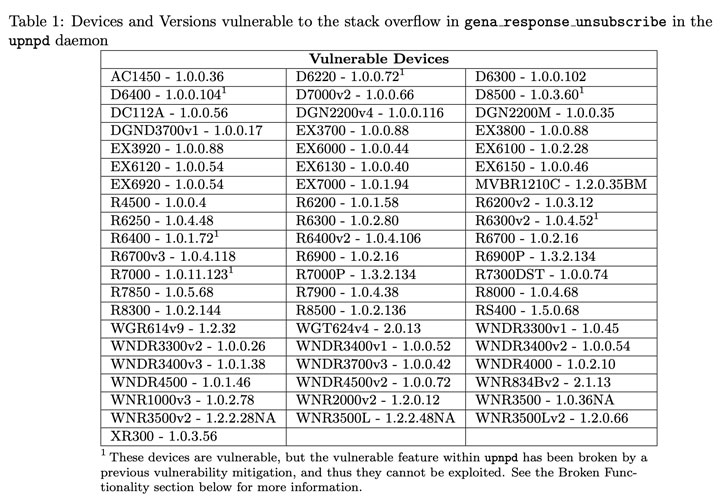
But according to GRIMM security researcher Adam Nichols, there
exists a memory stack overflow bug in the code that handles the
UNSUBSCRIBE requests, which enables an adversary to send a
specially crafted HTTP request and run malicious code on the
affected device, including resetting the administrator password and
delivering arbitrary payloads. Once the password has been reset,
the attacker can then login to the webserver and modify any
settings or launch further attacks on the webserver.
“Since the UPnP daemon runs as root, the highest privileged user
in Linux environments, the code executed on behalf of the attacker
will be run as root as well,” Nichols said[6]. “With root access on a
device, an attacker can read and modify all traffic that is passed
through the device.”
This is far from the first time vulnerable implementations of
UPnP have been uncovered in networked devices.
In June 2020, security researcher Yunus Çadirci discovered
what’s called a CallStranger[7]
vulnerability (CVE-2020-12695[8], CVSS score: 7.5)
wherein a remote, unauthenticated attacker may be able to abuse the
UPnP SUBSCRIBE capability to send traffic to arbitrary
destinations, resulting in amplified DDoS attacks and data
exfiltration. What’s more, no fewer than 45,000 routers with
vulnerable UPnP services were previously leveraged in a 2018 campaign[9]
to deploy EternalBlue and EternalRed[10] exploits on compromised
systems.
References
- ^
released
(kb.netgear.com) - ^
another
round (thehackernews.com) - ^
patches
(thehackernews.com) - ^
CVE-2021-34991
(nvd.nist.gov) - ^
UPnP
(en.wikipedia.org) - ^
said
(blog.grimm-co.com) - ^
CallStranger
(www.kb.cert.org) - ^
CVE-2020-12695
(nvd.nist.gov) - ^
2018
campaign (arstechnica.com) - ^
EternalBlue and EternalRed
(web.archive.org)
Read more https://thehackernews.com/2021/11/critical-root-rce-bug-affects-multiple.html