Magazine says that global damages will surpass $6 billion as soon as 2021[1].
Here we’ll go through some of the most frequent and emerging
causes of data breaches in 2019 and see how to address them in a
timely manner.
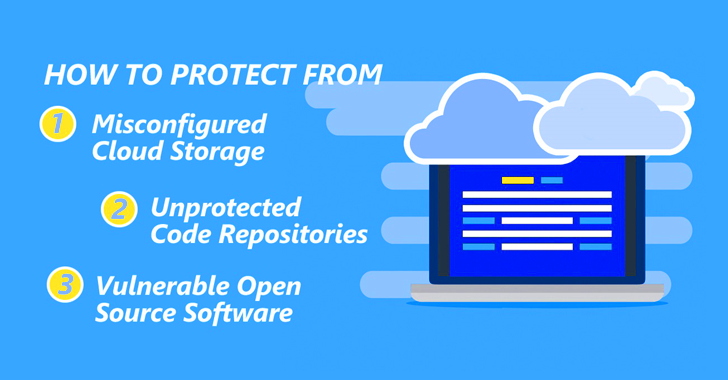
Misconfigured Cloud Storage
It’s hard to find a day without a security incident involving
unprotected AWS S3 storage, Elasticsearch, or MongoDB. A global
study from Thales and the Ponemon Institute states that only
32% of organizations[2]
believe protecting their data in a cloud is their own
responsibility. Worse, according to the same report, 51% of the
organizations still do not use encryption or tokenization to
protect sensitive data in the cloud.
McAfee confirms, claiming that 99% of cloud and IaaS
misconfigurations[3]
fall into the realm of end users’ control and remain unnoticed.
Marco Rottigni, Chief Technical Security Officer EMEA at Qualys[4], explains the problem:
“Some of the most common cloud database implementations ships with
no security or access control as standard at the start. They have
to be added on deliberately, which can be easily missed.”
With a global average cost of $3.92 million per data breach[5] in 2019, these findings
are quite alarming. Sadly, many cybersecurity and IT professionals
still candidly believe that cloud providers are responsible for
protecting their data in the cloud. Unfortunately, most of their
assumptions are not in accord with harsh legal reality.
Virtually all major cloud and IaaS providers have experienced
law firms to draft an airtight contract you won’t be able to alter
or negate in a court. Black ink clauses expressly shift financial
liability for most incidents on the clients’ shoulders and
establish limited liability for everything else, often reckoned in
pennies.
Most SME companies don’t even carefully read the terms, while in
large organizations, they are reviewed by legal advisors who are
often disconnected from the IT team. Though, one will hardly
negotiate better conditions, as otherwise, cloud business will
become so perilous and unprofitable that it will swiftly disappear.
This means that you will be the sole entity to blame and punish for
misconfigured or abandoned cloud storage and a resultant data
breach.
Unprotected Code Repositories
Research by North Carolina State University (NCSU) found that
over 100,000 GitHub repositories[6] have been leaking secret
API tokens and cryptographic keys, with thousands of new
repositories exposing secrets on a daily basis. Canadian banking
giant Scotiabank recently made news headlines by reportedly storing
internal source code, login credentials, and access keys for months
in publicly open and accessible[7] GitHub repositories.
Third-parties, especially external software developers, are
commonly the weakest link. Often their developers lack proper
training and security awareness requisite to duly safeguard their
code. Having several projects at once, tough deadlines, and
impatient clients, they ignore or forget about the very
fundamentals of security, letting their code in public domain.
Cybercriminals are well aware of this digital Ali Baba’s cave.
Cyber gangs specialized in OSINT data discovery meticulously crawl
existing and new code repositories in a continuous mode, carefully
scrapping the data. Once something of value is found, it’s sold to
cyber gangs focused on exploitation and offensive operations to get
in.
Given that such intrusions rarely trigger any red flags in
anomaly detection systems, they remain unnoticed or detected once
it is already too late. Worse, the investigation of such intrusions
is costly and almost perspectiveless. Many famous APT attacks
involved password re-use attacks with credentials found in code
repositories.
Vulnerable Open Source Software
The rapid proliferation of Open Source Software (OSS) in enterprise
systems exacerbates the cyber-threat landscape by adding even more
unknowns into the game. A recent report by ImmuniWeb found that
97 out of 100
largest banks are vulnerable[8]
and have poorly coded web and mobile apps, being riddled with
outdated and vulnerable open source components, libraries, and
frameworks. The oldest unpatched vulnerability found was known and
publicly disclosed since 2011.
OSS does save a lot of time for developers and money for
organizations but likewise provides a wide spectrum of concomitant
and largely underestimated risks. Few organizations properly track
and maintain an inventory of countless OSS and its components built
into their enterprise software. Consequently, blinded with
unknowingness, they fall victim to unknown unknowns when newly
detected OSS security flaws are aggressively exploited in the
wild.
Today, medium and large-sized organizations incrementally invest
in application security, notably in the implementation of DevSecOps
and Shift Left testing. Gartner urges the adoption of Shift Left[9]
software testing by incorporating security testing at the early
stages of the Software Development Lifecycle (SDLC) before it
becomes overly expensive and time-consuming to fix vulnerabilities.
However, a holistic and up2date inventory of your OSS is
indispensable to implement Shift Left testing; otherwise, you will
just pour your money down the drain.
How to Prevent and Remediate
Follow these five recommendations to reduce your risks in a
cost-efficient manner:
1. Maintain an up2date and holistic inventory of your digital
assets
Software, hardware, data, users, and licenses should be
continuously monitored, classified,
and risk-scored[10]. In the era of public
cloud, containers, code repositories, file-sharing services, and
outsourcing, it’s not an easy task, but without it, you may ruin
the integrity of your cybersecurity efforts and negate all previous
cybersecurity investments. Remember, you cannot protect what you
don’t see.
2. Monitor your external attack surface and risk exposure
Many organizations spend money on auxiliary or even theoretical
risks, ignoring their numerous outdated, abandoned, or simply
unknown systems accessible from the Internet. These shadow assets
are low-hanging fruit for cybercriminals. Attackers are smart and
pragmatic; they won’t assault your castle if they can silently get
in via a forgotten underground tunnel. Therefore, ascertain that
you have an ample and up2date view of your external attacks
surface[11] in a continuous manner.
3. Keep your software up2date, implement patch management and
automated patching
Most of the successful attacks do not involve the usage of
sophisticated and costly 0days but publicly disclosed
vulnerabilities often available with a working exploit. Hackers
will systematically search for the weakest
link[12] in your defense
perimeter to get in, and even a tiny outdated JS library may be a
windfall to get your crown jewels. Implement, test, and monitor a
robust patch management system for all your systems and
applications.
4. Prioritize your testing and remediation efforts based on
risks and threats
Once you have crystal-clear visibility of your digital assets and a
properly implemented patch management strategy, it’s time to ensure
that everything works as you expected. Deploy continuous security
monitoring for all your external assets, conduct in-depth testing,
including penetration
testing[13] of your
business-critical web applications and APIs. Setup monitoring for
any anomalies with rapid notifications.
5. Keep an eye on Dark Web and monitor data leaks
Most companies do not realize how many of their corporate accounts,
exposed by hacked third-party websites and services, are being sold on the
Dark Web[14]. The emerging success
of password reuse and brute-force attacks stem from it. Worse, even
legitimate websites such as Pastebin often expose a great wealth of
leaked, stolen, or lost data accessible to everyone. Continuous
monitoring and analysis of these incidents may save millions of
dollars and, most importantly, your reputation and goodwill.
Reducing Complexity and Costs
We came across an innovative offering from a Swiss company
ImmuniWeb® to tackle these issues in a simple and cost-effective
manner. We are truly impressed with its technical capabilities,
consolidated approach, and accessible price.
ImmuniWeb
Discovery[15] provides you with
superior visibility and control over your external attack surface
and risk exposure.
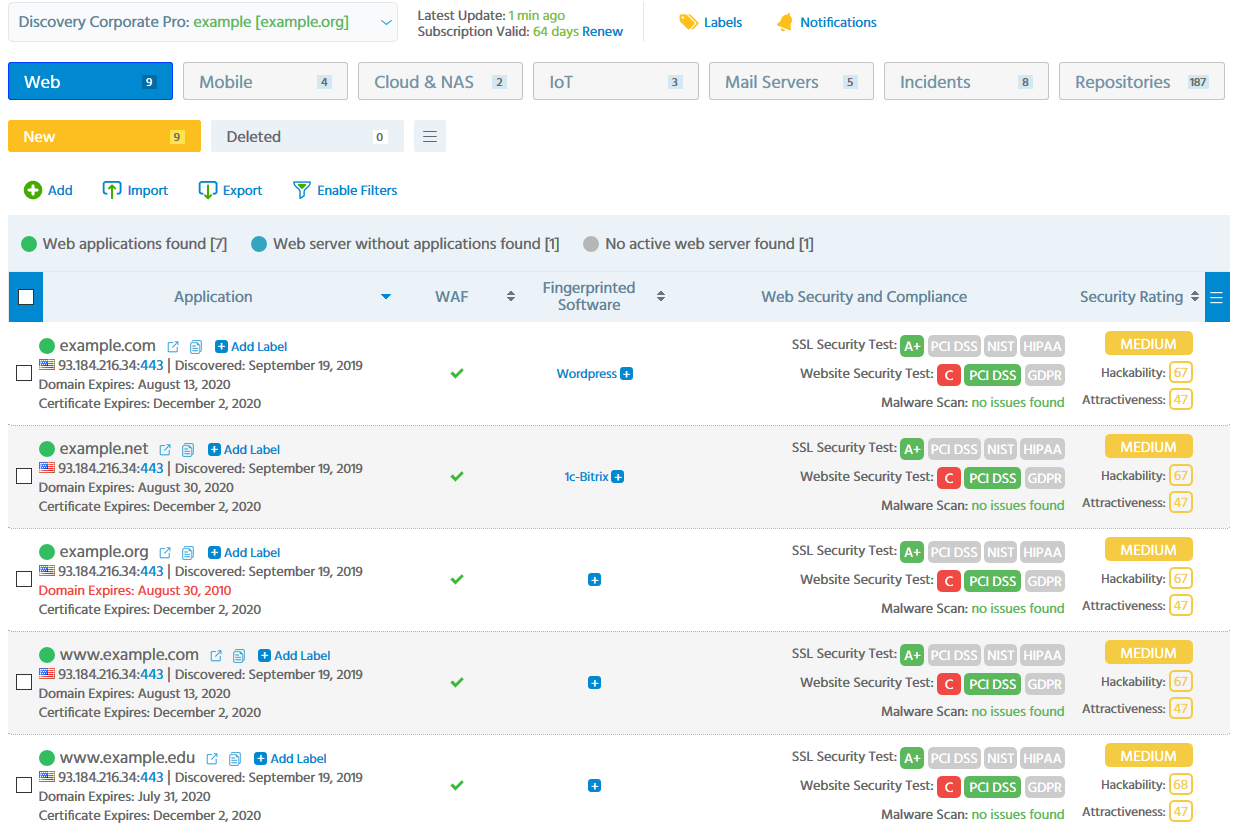
Try ImmuniWeb®
Discovery[16] for:
- Rapid discovery of your external digital assets, including
APIs, cloud storage and IoT - Actionable, data-driven security ratings of your applications’
Hackability and Attractiveness - Continuous monitoring of public code repositories for
unprotected or leaked source code - Continuous monitoring of Dark Web for exposed credentials and
other sensitive data - Production-safe Software Composition Analysis of your web and
mobile applications - Instant alerts about expiring domain names and SSL
certificates - Integration with SIEMs and other security systems via API
We hope you will avoid becoming a victim of a data breach in
2020!
References
- ^
$6
billion as soon as 2021
(cybersecurityventures.com) - ^
32% of
organizations
(www.infosecurity-magazine.com) - ^
99% of
cloud and IaaS misconfigurations
(www.cbronline.com) - ^
Qualys
(www.cbronline.com) - ^
$3.92
million per data breach
(securityintelligence.com) - ^
over
100,000 GitHub repositories
(www.ndss-symposium.org) - ^
publicly
open and accessible (www.scmagazine.com) - ^
97 out of 100 largest banks are
vulnerable (www.immuniweb.com) - ^
Shift
Left (www.gartner.com) - ^
monitored, classified, and
risk-scored (www.immuniweb.com) - ^
external attacks surface
(www.immuniweb.com) - ^
weakest link
(www.immuniweb.com) - ^
penetration testing
(www.immuniweb.com) - ^
being sold on the Dark Web
(www.immuniweb.com) - ^
ImmuniWeb Discovery
(www.immuniweb.com) - ^
ImmuniWeb® Discovery
(www.immuniweb.com)
Read more http://feedproxy.google.com/~r/TheHackersNews/~3/1PwCyQKVECk/data-breach-protection.html