
new cache poisoning attack against web caching systems that could
be used by an attacker to force a targeted website into delivering
error pages to most of its visitors instead of legitimate content
or resources.
The issue affects reverse proxy cache systems like Varnish and
some widely-used Content Distribution Networks (CDNs) services,
including Amazon CloudFront, Cloudflare, Fastly, Akamai, and
CDN77.
In brief, a Content Distribution Network (CDN) is a
geographically distributed group of servers that sit between the
origin server of a website and its visitors to optimize the
performance of the website.
A CDN service simply stores/caches static files—including HTML
pages, javascript files, stylesheets, images, and videos—from the
origin server and delivers them to visitors more quickly without
going back to the originating server again and again.
Each of the geographically distributed CDN server, known as edge
nodes, then also shares the exact copy of the cache files and serve
them to visitors based on their locations.
Generally, after a defined time or when manually purged, the CDN
servers refresh the cache by retrieving a new updated copy of each
web page from the origin server and store them for future
requests.
How Does CPDoS Attack Work Against CDNs?
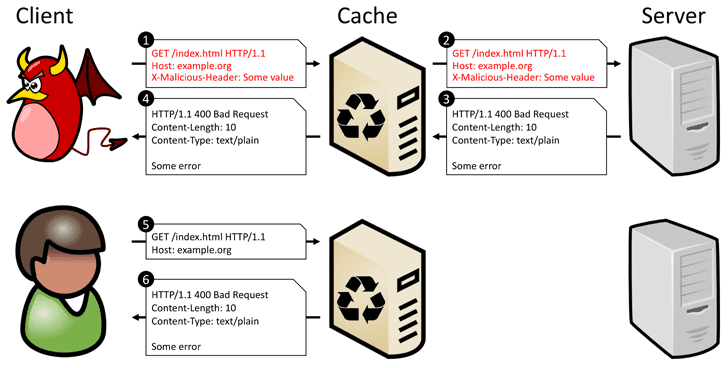
the attack resides in the way intermediate CDN servers are
incorrectly configured to cache web resources or pages with error
responses returned by the origin server.
The CPDoS attack threatens the availability of the web resources
of a website just by sending a single HTTP request containing a
malformed header, according to three German academics, Hoai Viet
Nguyen, Luigi Lo Iacono, and Hannes Federrath.
“The problem arises when an attacker can generate an HTTP
request for a cacheable resource where the request contains
inaccurate fields that are ignored by the caching system but raise
an error while processed by the origin server.”
Here’s how the CPDoS attack works:
- A remote attacker requests a web page of a target website by
sending an HTTP request containing a malformed header. - If the intermediate CDN server doesn’t have a copy of the
requested resource, it will forward the request to the origin web
server, which will get crash due to the malformed header. - As a consequence, the origin server then returns an error page,
which eventually gets stored by the caching server instead of the
requested resource. - Now, whenever legitimate visitors try to obtain the target
resource, they will be served the cached error page instead of the
original content. - The CDN server will also spread the same error page to other
edge nodes of the CDN’s network as well, rendering targeted
resources of the victim’s website unavailable.
“It is worth noting that one simple request is sufficient to
replace the genuine content in the cache by an error page. This
means that such a request remains below the detection threshold of
web application firewalls (WAFs) and DDoS protection means, in
particular, as they scan for large amounts of irregular network
traffic.”
“Moreover, CPDoS can be exploited to block, e.g., patches or
firmware updates distributed via caches, preventing vulnerabilities
in devices and software from being fixed. Attackers can also
disable important security alerts or messages on mission-critical
websites such as online banking or official governmental
websites.”
3 Ways to Launch CPDoS Attacks
To carry out this cache poisoning attacks against CDNs, the
malformed HTTP request can be of three types:
- HTTP Header Oversize (HHO) — An HTTP request containing
an oversized header that works in scenarios where a web application
uses a cache that accepts a larger header size limit than the
origin server. - HTTP Meta Character (HMC) — Instead of sending an
oversized header, this attack tries to bypass a cache with a
request header containing a harmful meta character, such as line
break/carriage return (\n), line feed (\r) or bell (\a). - HTTP Method Override (HMO) — Using HTTP override header
to bypass the security policy that prohibits DELETE requests.
CDN Services Vulnerable to CPDoS Attacks
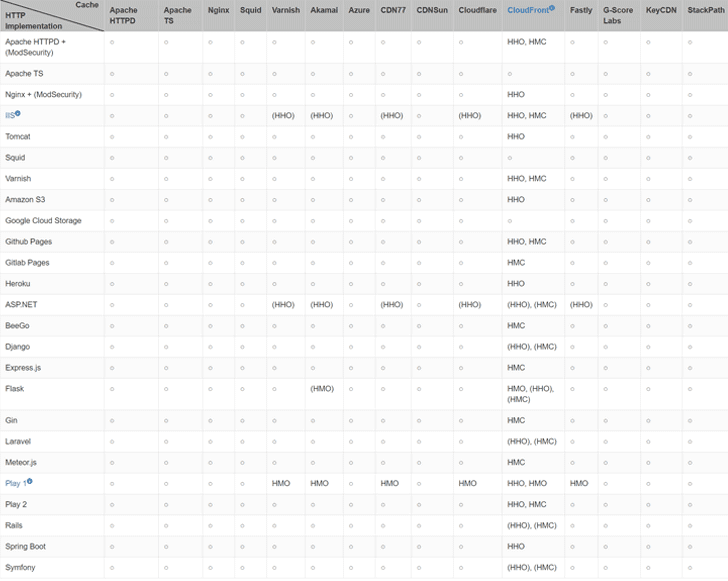
Researchers carried out three attacks against different
combinations of web caching systems and HTTP implementations and
found that Amazon’s CloudFront CDN is the most vulnerable to the
CPDoS attack.
“We analyze the caching behavior of error pages of fifteen web
caching solutions and contrast them to the HTTP specifications. We
identify one proxy cache product and five CDN services that are
vulnerable to CPDoS.”
implementation vendors and cache providers on February 19, 2019.
Amazon Web Services (AWS) team confirmed the vulnerabilities on
CloudFront and addressed the issue by prohibiting caching of error
pages with the status code 400 Bad Request by default.
Microsoft also acknowledged the reported issues and published an
update to mitigate this vulnerability, assigned as CVE-2019-0941[1], in its June 2019 monthly
security[2] updates.
Play Framework also confirmed the reported issues and patched
their product against the CPDoS attack by limiting the impact of
the X-HTTP-Method-Override header in Play Framework versions
1.5.3 and
1.4.6[3].
Other affected vendors, including Flask, were contacted multiple
times, but researchers did not receive any response from them.
For more details on this new web cache poisoning attack and its
variations, you can simply head on to the research paper [PDF[4]] titled “Your Cache Has
Fallen: Cache-Poisoned Denial-of-Service Attack.”
References
- ^
CVE-2019-0941
(portal.msrc.microsoft.com) - ^
June 2019 monthly security
(thehackernews.com) - ^
1.5.3 and 1.4.6
(github.com) - ^
PDF (cpdos.org)
Read more http://feedproxy.google.com/~r/TheHackersNews/~3/h7MeGX3-3p0/cdn-cache-poisoning-dos-attack.html