Microsoft on Wednesday shared more specifics about the tactics,
techniques, and procedures (TTPs) adopted by the attackers behind
the SolarWinds hack to stay under the radar and avoid detection, as
cybersecurity companies work towards getting a “clearer picture” of
one of the most sophisticated attacks in recent history.
Calling the threat actor “skillful and methodic operators who
follow operations security (OpSec) best practices,” the company
said the attackers went out of their way to ensure that the initial
backdoor (Sunburst[1]
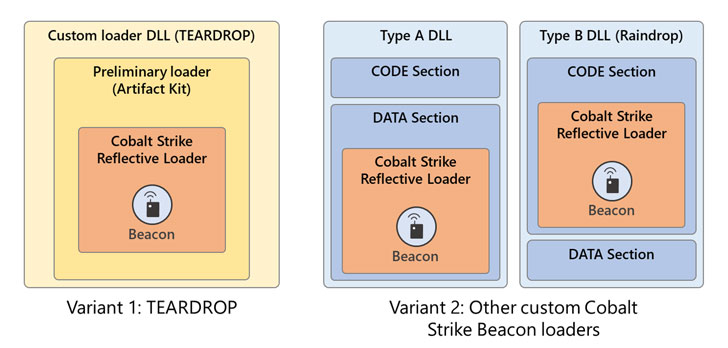
aka Solorigate) and the post-compromise implants (Teardrop[2]
and Raindrop[3]) are separated as much
as possible so as to hinder efforts to spot their malicious
activity.
“The attackers behind Solorigate are skilled campaign operators
who carefully planned and executed the attack, remaining elusive
while maintaining persistence,” researchers from Microsoft 365
Defender Research Team, Microsoft Threat Intelligence Center
(MSTIC), and Microsoft Cyber Defense Operations Center (CDOC)
said[4].
While the exact identity of the group tracked as StellarParticle[5]
(CrowdStrike), UNC2452 (FireEye), SolarStorm[6]
(Palo Alto Unit 42), and Dark Halo[7]
(Volexity) remain unknown as yet, the U.S. government earlier this
month formally tied the espionage campaign to a group likely of
Russian origin.
A Variety of Tactics to Stay Undetected
Microsoft’s timeline[8]
of the attacks shows that the fully-functional Sunburst DLL
backdoor was compiled and deployed onto SolarWinds’ Orion platform
on February 20, following which it was distributed in the form of
tampered updates sometime in late March.
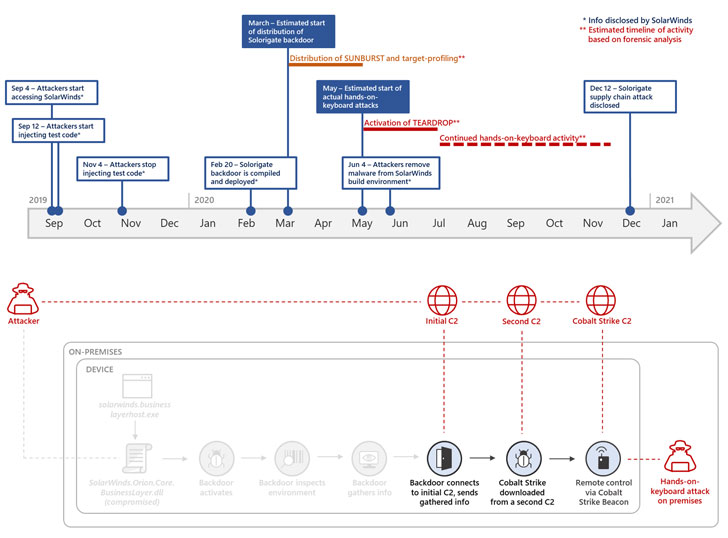
An almost two-month-long reconnaissance period to profile its
targets — something that requires a stealthy persistence to remain
undetected and collect valuable information — ultimately paved the
way for the deployment of Cobalt Strike implants on selected victim
networks in May and the removal of Sunburst from SolarWinds build
environment on June 4.
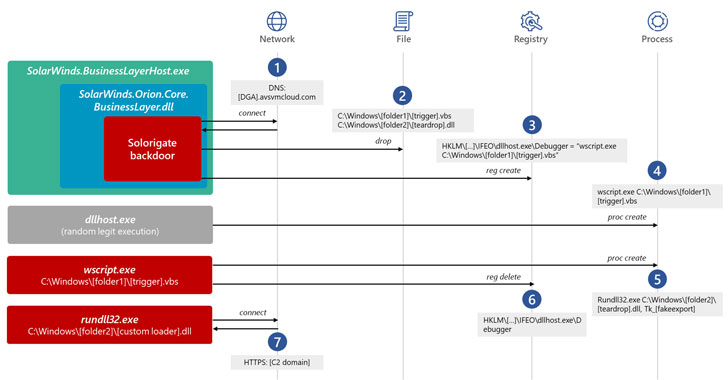
But answers as to how and when the transition from Sunburst to
Raindrop occurs has yielded little definitive clues, even if it
appears that the attackers deliberately separated the Cobalt Strike
loader’s execution from the SolarWinds process as an OpSec
measure.
The idea is that in the event the Cobalt Strike implants were
discovered on target networks, it wouldn’t reveal the compromised
SolarWinds binary and the supply chain attack that led to its
deployment in the first place.
The findings also make it clear that, while the hackers relied
on an array of attack vectors, the trojanized SolarWinds software
formed the core of the espionage operation:
- Methodic avoidance of shared indicators for each compromised
host by deploying custom Cobalt Strike DLL implants on each
system - Camouflaging malicious tools and binaries to mimic existing
files and programs already present on the compromised machine - Disabling event logging using AUDITPOL before hands-on keyboard
activity and enabling it back once complete - Creating special firewall rules to minimize outgoing packets
for certain protocols before running noisy network enumeration
activities that were later removed after the network survey - Executing lateral movement activities only after disabling
security services on targeted hosts - Allegedly using timestomping to change artifacts’ timestamps
and leveraging wiping procedures and tools to prevent discovery of
malicious DLL implants
Adopting a Zero Trust Mentality
“This attack was simultaneously sophisticated and ordinary,”
Microsoft said. “The actor demonstrated sophistication in the
breadth of tactics used to penetrate, expand across, and persist in
affected infrastructure, but many of the tactics, techniques, and
procedures (TTPs) were individually ordinary.”
To protect against such attacks in the future, the company
recommends that organizations adopt a “zero trust mentality[9]” to achieve the least
privileged access and minimize risks by enabling multi-factor
authentication.
“With Solorigate, the attackers took advantage of broad role
assignments, permissions that exceeded role requirements, and in
some cases abandoned accounts and applications which should have
had no permissions at all,” Alex Weinert, Microsoft’s director of
identity security, said.
References
- ^
Sunburst
(thehackernews.com) - ^
Teardrop
(thehackernews.com) - ^
Raindrop
(thehackernews.com) - ^
said
(www.microsoft.com) - ^
StellarParticle
(thehackernews.com) - ^
SolarStorm
(unit42.paloaltonetworks.com) - ^
Dark
Halo (www.volexity.com) - ^
timeline
(thehackernews.com) - ^
zero
trust mentality (www.microsoft.com)