
Unidentified threat actors are actively exploiting a critical
authentication bypass vulnerability to hijack home routers as part
of an effort to co-opt them to a Mirai-variant botnet used for
carrying out DDoS attacks, merely two days after its public
disclosure.
Tracked as CVE-2021-20090[1]
(CVSS score: 9.9), the weakness[2] concerns a path traversal vulnerability[3] in the web interfaces of
routers with Arcadyan firmware[4] that could allow
unauthenticated remote attackers to bypass authentication.
Disclosed by Tenable on August 3, the issue is believed to have
existed for at least 10 years, affecting at least 20 models across
17 different vendors, including Asus, Beeline, British Telecom,
Buffalo, Deutsche Telekom, Orange, Telstra, Telus, Verizon, and
Vodafone.
Successful exploitation of the could enable an attacker to
circumvent authentication barriers and potentially gain access to
sensitive information, including valid request tokens, which could
be used to make requests to alter router settings.
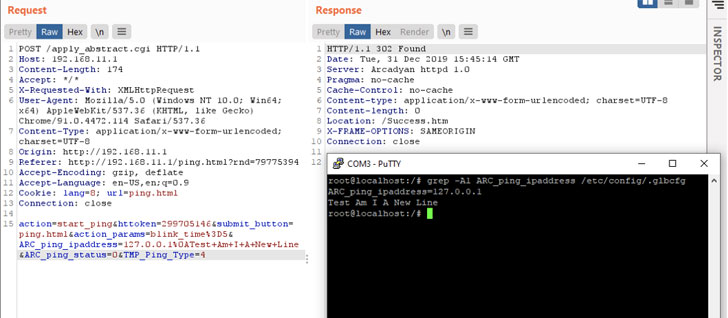
Juniper Threat Labs last week said[5]
it “identified some attack patterns that attempt to exploit this
vulnerability in the wild coming from an IP address located in
Wuhan, Hubei province, China” starting on August 5, with the
attacker leveraging it to deploy a Mirai variant on the affected
routers, mirroring similar techniques revealed[6]
by Palo Alto Networks’ Unit 42 earlier this March.
“The similarity could indicate that the same threat actor is
behind this new attack and attempting to upgrade their infiltration
arsenal with yet another freshly disclosed vulnerability,” the
researchers said.
Besides CVE-2021–20090, the threat actor carried out attacks
leveraging a number of other vulnerabilities, such as –
Unit 42’s report had previously uncovered as many as six known
and three unknown security flaws that were exploited in the
attacks, counting those targeted at SonicWall SSL-VPNs, D-Link
DNS-320 firewalls, Netis WF2419 wireless routers, and Netgear
ProSAFE Plus switches.
To avoid any potential compromise, users are recommended to
update their router firmware to the latest version.
“It is clear that threat actors keep an eye on all disclosed
vulnerabilities. Whenever an exploit PoC is published, it often
takes them very little time to integrate it into their platform and
launch attacks,” the researchers said.
References
- ^
CVE-2021-20090
(nvd.nist.gov) - ^
weakness
(www.kb.cert.org) - ^
path
traversal vulnerability (www.tenable.com) - ^
routers
with Arcadyan firmware (medium.com) - ^
said
(blogs.juniper.net) - ^
revealed
(unit42.paloaltonetworks.com)