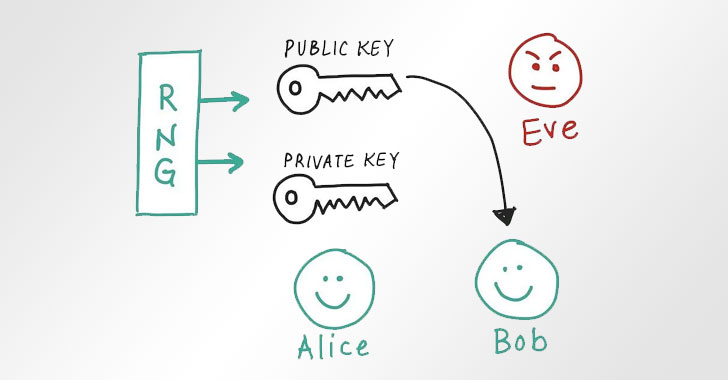
A critical vulnerability has been disclosed in hardware random
number generators used in billions of Internet of Things (IoT)
devices whereby it fails to properly generate random numbers, thus
undermining their security and putting them at risk of attacks.
“It turns out that these ‘randomly’ chosen numbers aren’t always
as random as you’d like when it comes to IoT devices,” Bishop Fox
researchers Dan Petro and Allan Cecil said[1]
in an analysis published last week. “In fact, in many cases,
devices are choosing encryption keys of 0 or worse. This can lead
to a catastrophic collapse of security for any upstream use.”
Random number generation (RNG[2]) is a crucial process[3]
that undergirds several cryptographic applications, including key
generation, nonces, and salting. On traditional operating systems,
it’s derived from a cryptographically secure pseudorandom number
generator (CSPRNG) that uses entropy obtained from a high-quality
seed source.
When it comes to IoT devices, this is supplied from a
system-on-a-chip (SoC) that houses a dedicated hardware RNG
peripheral called true random number generators (TRNG) that’s used
to capture randomness from physical processes or phenomenа.
Stating that the manner in which the peripheral is being current
invoked was incorrect, the researchers noted the lack of checks for
error code responses across the board, leading to a scenario where
the random number generated isn’t simply random, and worse,
predictable, resulting in partial entropy, uninitialized memory,
and even crypto keys containing plain zeros.
“The HAL function to the RNG peripheral can fail for a variety
of reasons, but by far the most common (and exploitable) is that
the device has run out of entropy,” the researchers noted.
“Hardware RNG peripherals pull entropy out of the universe through
a variety of means (such as analog sensors or EMF readings) but
don’t have it in infinite supply.
“They’re only capable of producing so many random bits per
second. If you try calling the RNG HAL function when it doesn’t
have any random numbers to give you, it will fail and return an
error code. Thus, if the device tries to get too many random
numbers too quickly, the calls will begin to fail.”
The problem is unique to the IoT landscape as they lack an
operating system that typically comes with a randomness API (e.g.,
“/dev/random[4]” in Unix-like OSes or
BCryptGenRandom[5]
in Windows), with the researchers highlighting the larger entropy
pool of a CSPRNG subsystem, thus removing “any single points of
failure among the entropy sources.”
Although the issues can be remediated with software updates, the
ideal solution would be for IoT device manufacturers and developers
to include a CSPRNG API that’s seeded from a set of diverse entropy
sources and ensure the code doesn’t ignore error conditions, or
fail to block calls to the RNG when no more entropy is
available.
“One of the hard parts about this vulnerability is that it’s not
a simple case of ‘you zigged where you should have zagged’ that can
be patched easily,” the researchers said, stressing the need for
implementing CSPRNG in an IoT operating system. “In order to
remediate this issue, a substantial and complex feature has to be
engineered into the IoT device.”
References
- ^
said
(labs.bishopfox.com) - ^
RNG
(en.wikipedia.org) - ^
crucial
process (www.veracode.com) - ^
/dev/random
(en.wikipedia.org) - ^
BCryptGenRandom
(docs.microsoft.com)