
A Chinese cyber espionage group has been linked to a string of
intrusion activities targeting Israeli government institutions, IT
providers, and telecommunications companies at least since
2019.
FireEye’s Mandiant threat intelligence arm attributed the
campaign to an operator it tracks as “UNC215”, a Chinese espionage
operation that’s believed to have singled out organizations around
the world dating back as far as 2014, linking the group with “low
confidence” to an advanced persistent threat (APT) widely known as
APT27[1], Emissary Panda, or Iron
Tiger.
“UNC215 has compromised organizations in the government,
technology, telecommunications, defense, finance, entertainment,
and health care sectors,” FireEye’s Israel and U.S. threat intel
teams said[2]
in a report published today.
“The group targets data and organizations which are of great
interest to Beijing’s financial, diplomatic, and strategic
objectives,” the findings reflecting a relentless appetite for
defense-related secrets among hacking groups.
Early attacks perpetrated by the collective is said to have
exploited a Microsoft SharePoint vulnerability (CVE-2019-0604) as a
stepping stone toward infiltrating government and academic networks
to deploy web shells and FOCUSFJORD[3]
payloads at targets in the Middle East and Central Asia. First
described[4]
by the NCC Group in 2018, FOCUSFJORD, also called HyperSSL and
Sysupdate, is a backdoor that’s part of an arsenal of tools put to
use by the Emissary Panda actor.
Upon gaining an initial foothold, the adversary follows an
established pattern of conducting credential harvesting and
internal reconnaissance to identify key systems within the target
network, before carrying out lateral movement activities to install
a custom implant called HyperBro[5]
that comes with capabilities such as screen capture and
keylogging.
Each phase of the attack is marked by notable efforts undertaken
to hinder detection by removing any traces of residual forensic
artifacts from compromised machines, while simultaneously improving
the FOCUSFJORD backdoor in response to security vendor reports,
concealing command-and-control (C2) infrastructure by using other
victim networks to proxy their C2 instructions, and even
incorporating false flags such as deploying a web shell called
SEASHARPEE that’s associated with Iranian APT groups in an attempt
to mislead attribution.
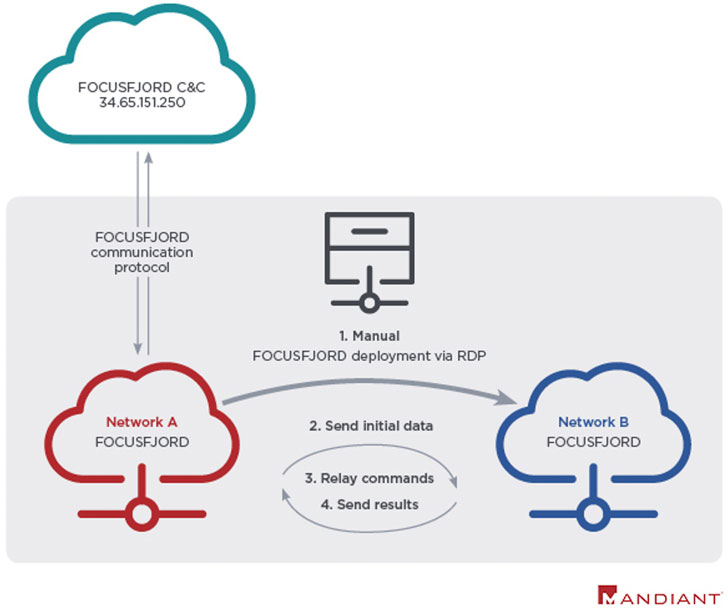
What’s more, in a 2019 operation against an Israeli government
network, UNC215 obtained access to the primary target via remote
desktop protocol (RDP) connections from a trusted third-party using
stolen credentials, abusing it to deploy and remotely execute the
FOCUSFJORD malware, the cybersecurity firm noted.
“The activity […] demonstrates China’s consistent strategic
interest in the Middle East,” the researchers concluded. “This
cyber espionage activity is happening against the backdrop of
China’s multi-billion-dollar investments related to the Belt and
Road Initiative (BRI[6]) and its interest in
Israeli’s robust technology sector.”
“China has conducted numerous intrusion campaigns along the BRI
route to monitor potential obstructions—political, economic, and
security—and we anticipate that UNC215 will continue targeting
governments and organizations involved in these critical
infrastructure projects in Israel and the broader Middle East in
the near- and mid-term,” the teams added.