In the classic children’s movie ‘The Princess Bride,’ one of the
characters utters the phrase, “You keep using that word. I do
not think it means what you think it means.”
It’s freely used as a response to someone’s misuse or
misunderstanding of a word or phrase.

“Response Automation” is another one of those phrases that have
different meanings to different people. It’s bantered around by the
security vendor community so much that its precise meaning, when
used, is unclear.
Many vendors throw the term out without explaining exactly what
they mean by the phrase. One vendor’s response automation might,
and often do, perform very differently from another vendor’s
response automation capabilities. But, hey, they have “response
automation!”
A recently published guide is meant to make sense of Response
Automation (Download here[1]). It discusses the
evolution of response automation and distinguishes five
increasingly capable levels of response automation available today.
The guide will help you understand exactly what is meant when
someone offers response automation, as well as the questions to ask
to help clear up any confusion.
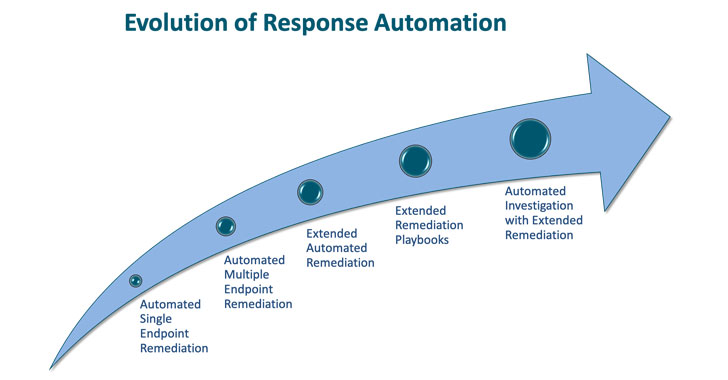 |
| The five progressive levels of response automation |
The guide also shares the types of security solutions that
provide the varying levels of response automation, including
Next-Generation Antivirus (NGAV), Endpoint Detection and Response
(EDR), Extended Detection and Response (EDR) and Security
Orchestration, Automation and Response (SOAR).
The capabilities of each solution category are quite different,
which directly impacts each’s the ability to provide sophisticated
response automation features.
The Five Levels of Response Automation
As depicted in the chart above, Cynet frames the five
increasingly capable levels of response automation, along with the
specific benefits provided by each. The most basic type of response
automation involves remediating a specific threat in response to an
alert on an endpoint. This, Cynet says, is table stakes for any
threat detection and response (TDR) solution.
The ultimate level of response automation involves moving beyond
remediation actions to include fully automated investigatory steps
to determine if a detected threat actually part of a larger attack
and, if so, uncovering related attack components. When a threat is
detected, the automated investigation uncovers the root cause of
the threat – how did the threat come to be in the environment.
As components of an attack are uncovered, an automated
investigation can search the environment to expose the full scope
of the attack. And, of course, appropriate remediation actions are
taken at every step to eradicate all attack components.
The Real Meaning of Response Automation
The security community is very aware of the talent shortage and
the ongoing pressures of “alert overload.” It only makes sense that
the more we can take off the plate of security professionals, the
better things would be. Better in what way?
First, automating repetitive and more pedestrian tasks would
free up significant time for security staff to focus on more
important items. And maybe reducing the time required to chase
alerts precludes the need for additional staff.
Second, speeding up threat response to machine time reduces the
likelihood that the threat may proliferate or cause immediate
damage. Response automation at a minimum provides a healthy head
start for security analysts in their threat response workflow.
For those of you that would welcome a tool to help improve
security while reducing manual effort – let’s turn to another
famous quote from The Princess Bride – “As you wish.”
Download the essential guide for Response Automation here[2]
References
- ^
Download
here (go.cynet.com) - ^
here
(go.cynet.com)