
A new wormable botnet that spreads via GitHub and Pastebin to
install cryptocurrency miners and backdoors on target systems has
returned with expanded capabilities to compromise web applications,
IP cameras, and routers.
Early last month, researchers from Juniper Threat Labs
documented a crypto-mining campaign called “Gitpaste-12[1],” which used GitHub to
host malicious code containing as many as 12 known attack modules
that are executed via commands downloaded from a Pastebin URL.
The attacks occurred during a 12-day period starting from
October 15, 2020, before both the Pastebin URL and repository were
shut down on October 30, 2020.
Now according to Juniper, the second wave of attacks[2]
began on November 10 using payloads from a different GitHub
repository, which, among others, contains a Linux crypto-miner
(“ls”), a file with a list of passwords for brute-force attempts
(“pass”), and a local privilege escalation exploit for x86_64 Linux
systems.
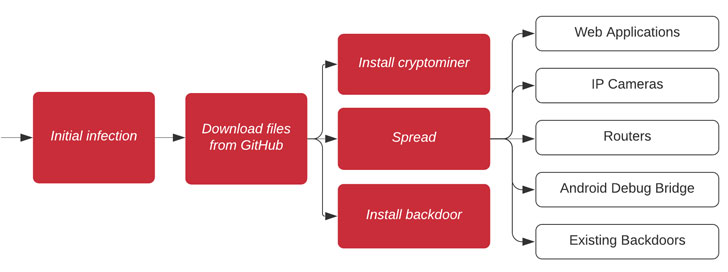
The initial infection happens via X10-unix, a binary written in
Go programming language, that proceeds to download the next-stage
payloads from GitHub.
“The worm conducts a wide-ranging series of attacks targeting
web applications, IP cameras, routers and more, comprising at least
31 known vulnerabilities — seven of which were also seen in the
previous Gitpaste-12 sample — as well as attempts to compromise
open Android Debug Bridge connections and existing malware
backdoors,” Juniper researcher Asher Langton noted in a Monday
analysis.
Included in the list of 31 vulnerabilities are remote code flaws
in F5 BIG-IP Traffic Management User Interface (CVE-2020-5902),
Pi-hole Web (CVE-2020-8816), Tenda AC15 AC1900 (CVE-2020-10987),
and vBulletin (CVE-2020-17496), and an SQL injection bug in FUEL
CMS (CVE-2020-17463), all of which came to light this year.
It’s worth noting that Ttint[3], a new variant of the
Mirai botnet, was observed in October using two Tenda router
zero-day vulnerabilities, including CVE-2020-10987, to spread a
Remote Access Trojan (RAT) capable of carrying out
denial-of-service attacks, execute malicious commands, and
implement a reverse shell for remote access.
Aside from installing X10-unix and the Monero crypto mining
software on the machine, the malware also opens a backdoor
listening on ports 30004 and 30006, uploads the victim’s external
IP address to a private Pastebin paste, and attempts to connect to
Android Debug Bridge connections on port 5555.
On a successful connection, it proceeds to download an Android
APK file (“weixin.apk”) that eventually installs an ARM CPU version
of X10-unix.
In all, at least 100 distinct hosts have been spotted
propagating the infection, per Juniper estimates.
The complete set of malicious binaries and other relevant
Indicators of Compromise (IoCs) associated with the campaign can be
accessed here[4].
References
- ^
Gitpaste-12
(blogs.juniper.net) - ^
second
wave of attacks (blogs.juniper.net) - ^
Ttint
(blog.netlab.360.com) - ^
here
(blogs.juniper.net)