
SolarWinds, the enterprise monitoring software provider who
found itself at the epicenter of the most consequential supply chain
attacks[1], said as many as 18,000
of its high-profile customers might have installed a tainted
version of its Orion products.
The acknowledgment comes as part of a new filing made by the
company to the US Securities and Exchange Commission on Monday.
The Texas-based company serves more than 300,000 customers
worldwide, including every branch of the US military and
four-fifths of the Fortune 500 companies.
The “incident was likely the result of a highly sophisticated,
targeted and manual supply chain attack by an outside nation
state,” SolarWinds said in the regulatory disclosure[2], adding it “currently
believes the actual number of customers that may have had an
installation of the Orion products that contained this
vulnerability to be fewer than 18,000.”
The company also reiterated in its security advisory[3]
that besides 2019.4 HF 5 and 2020.2 versions of SolarWinds Orion
Platform, no other versions of the monitoring software or other
non-Orion products were impacted by the vulnerability.
Specifics regarding how the hackers penetrated SolarWinds’ own
network are still fuzzy, but the company noted in its filing that
it was alerted to a compromise of its Microsoft Office 365 email
and office productivity accounts that it’s currently investigating
to determine how long it existed and if the weakness was
“associated with the attack on its Orion software build
system.”
Troublingly, according to a report[4]
from security researcher Vinoth Kumar, it also appears that a
publicly-accessible SolarWinds GitHub repository was leaking FTP
credentials of the domain “downloads.solarwinds.com,” thus allowing
an attacker to potentially upload a malicious executable disguised
as Orion software updates to the downloads portal. Even worse, the
FTP server was protected by a trivial password.
Following Kumar’s responsible disclosure last year, the company
addressed the misconfiguration on November 22, 2019.
The development comes a day after cybersecurity firm FireEye
said it identified a nine-month-long global intrusion campaign
targeting public and private entities that introduce malicious code
into legitimate software updates for SolarWinds’ Orion software to
break into the companies’ networks and install a backdoor called
SUNBURST (“SolarWinds.Orion.Core.BusinessLayer.dll”).
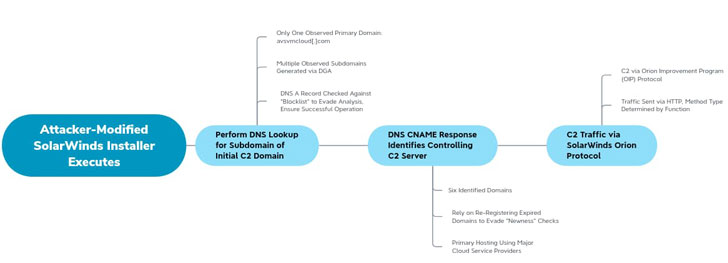
“The malicious DLL calls out to a remote network infrastructure
using the domains avsvmcloud.com. to prepare possible second-stage
payloads, move laterally in the organization, and compromise or
exfiltrate data,” Microsoft said[5]
in a write-up.
The US Department of Homeland Security was breached, as were the
departments of Commerce and Treasury, Reuters reported[6]
yesterday. The espionage campaign also included the December 8 cyberattack[7]
on FireEye, although it’s not immediately clear whether the
intrusion and exfiltration was a direct result of a rogue
SolarWinds update.
“The campaign demonstrates top-tier operational tradecraft and
resourcing consistent with state-sponsored threat actors,” said[8]
FireEye CEO Kevin Mandia. “These compromises are not
self-propagating; each of the attacks require meticulous planning
and manual interaction.”
While the fallout caused by the hacking campaign is still
unknown, fingers have been pointed at APT29, a hacking collective
affiliated with the Russian foreign intelligence service. FireEye,
which is tracking the campaign as “UNC2452,” has not linked the
attack to Russia.
For its part, SolarWinds is expected to issue a second hotfix
later today that replaces the vulnerable component and adds several
extra security enhancements.
“The SUNBURST campaign represents a uniquely distressing
intrusion event with implications for multiple industries and
network operators,” DomainTools’ Senior Security Researcher, Joe
Slowik, said[9].
“The ubiquity of SolarWinds in large networks, combined with the
potentially long dwell time of intrusions facilitated by this
compromise, mean victims of this campaign need not only recover
their SolarWinds instance, but may need to perform widespread
password resets, device recovery, and similar restoration activity
to completely evict an intruder.”
“Through continuous monitoring of network traffic and an
understanding of what hosts are communicating, defenders can
leverage attacker weaknesses and dependencies to overcome these
otherwise daunting challenges,” he added.
References
- ^
consequential supply chain attacks
(thehackernews.com) - ^
regulatory disclosure
(www.sec.gov) - ^
security
advisory (www.solarwinds.com) - ^
report
(twitter.com) - ^
said
(msrc-blog.microsoft.com) - ^
reported
(www.reuters.com) - ^
December
8 cyberattack (thehackernews.com) - ^
said
(www.fireeye.com) - ^
said
(www.domaintools.com)
Read more http://feedproxy.google.com/~r/TheHackersNews/~3/dxEDNcfysx0/nearly-18000-solarwinds-customers.html