UniCC, the biggest dark web marketplace of stolen credit and
debit cards, has announced that it’s shuttering its operations
after earning $358 million in purchases since 2013 using
cryptocurrencies such as Bitcoin, Litecoin, Ether, and Dash.
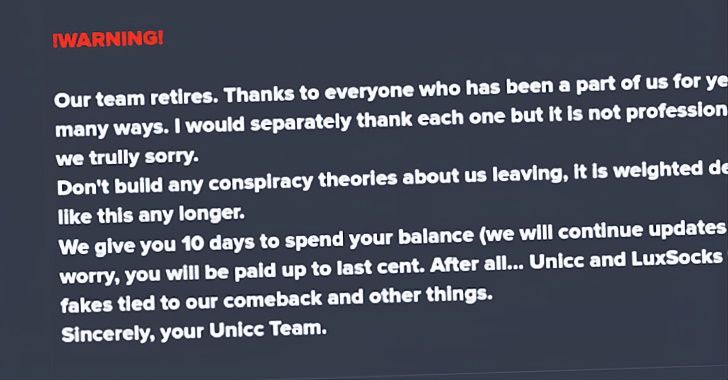
“Don’t build any conspiracy theories about us leaving,” the
anonymous operators of UniCC said in a farewell posted on dark web
carding forums, according to blockchain analytics firm Elliptic.
“It is [a] weighted decision, we are not young and our health
do[es] not allow [us] to work like this any longer.”
The UniCC team also gave its users 10 days to spend their
balances, while also warning customers to “not follow any fakes
tied to our comeback.”
Platforms such as UniCC function as an underground marketplace
wherein payment card details stolen from online retailers, banks,
and payments companies by injecting malicious skimmers[1]
are trafficked in exchange for cryptocurrency. The cards are then
used by criminal actors to purchase high-value items or gift
cards.
“This process is known as ‘carding,’ and it has become a key
part of the cybercriminal’s playbook,” Elliptic researchers
said[2]. “The technique is very
profitable in its own right, but it is also used to help launder
and cash-out cryptocurrency obtained through other types of
cybercrime.”
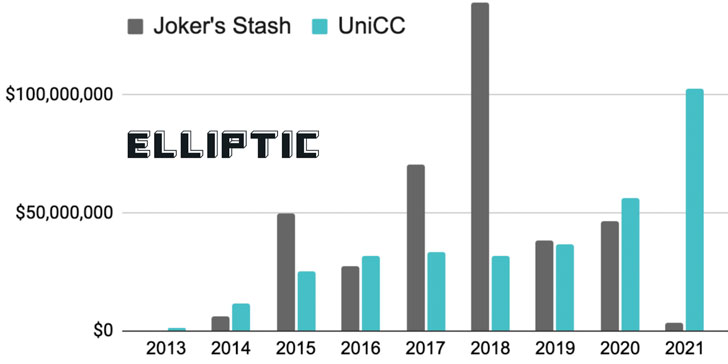
The sunsetting comes exactly a year after Joker’s Stash[3], the previous market
leader, announced its retirement in January 2021 after having
facilitated the sale of nearly $400 million in stolen cards. The
demise of Joker’s Stash worked to UniCC’s benefit, which quickly
snapped up the top spot with a 30% market share, the researchers
noted.
It’s also the latest in a growing list of criminal marketplaces
to have voluntarily closed shop over the past year, including that
of White House Market[4], Cannazon[5], and Torrez[6]. This was followed by
Monopoly Market, which became inaccessible early this month in
what’s suspected to be an exit scam.
That said, the illicit market for stolen credit card data has
become so lucrative that sales have surpassed 1.4 billion just in
Bitcoin, paving the way for new entrants to the space and quickly
filling the vacuum left by defunct criminal entities in a manner
that mirrors the ever-evolving ransomware landscape[7].
The most notable of the lot has been All World Cards[8], which emerged on the
scene in May 2021 and has since drummed up attention[9]
by leaking data for one million credit cards plundered between 2018
and 2019 on a cybercrime forum for free, with most cards[10] from the State Bank of
India, Banco Santander, and Sutton Bank.
“The wave of recent departures has potentially been a trigger
for UniCC’s retirement, as illicit actors see an opportunity in the
turbulence to either run away with users’ funds or retire to avoid
increased law enforcement attention,” the researchers said.
References
- ^
malicious skimmers
(thehackernews.com) - ^
said
(www.elliptic.co) - ^
Joker’s
Stash (thehackernews.com) - ^
White
House Market (flare.systems) - ^
Cannazon
(www.bleepingcomputer.com) - ^
Torrez
(flare.systems) - ^
ransomware landscape
(thehackernews.com) - ^
All
World Cards (www.blueliv.com) - ^
drummed
up attention (heimdalsecurity.com) - ^
cards
(blog.cyble.com)
Read more https://thehackernews.com/2022/01/dark-webs-largest-marketplace-for.html