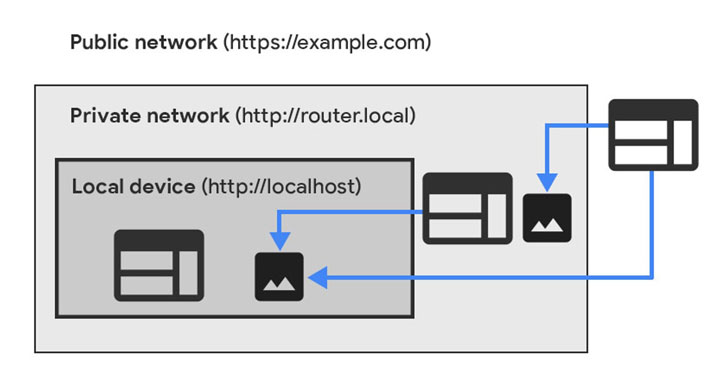
Google Chrome has announced plans to prohibit public websites
from directly accessing endpoints located within private networks
as part of an upcoming major security shakeup to prevent intrusions
via the browser.
The proposed change is set to be rolled out in two phases as
part of releases Chrome 98 and Chrome 101 scheduled in the coming
months via a newly implemented W3C specification called private
network access (PNA[1]).
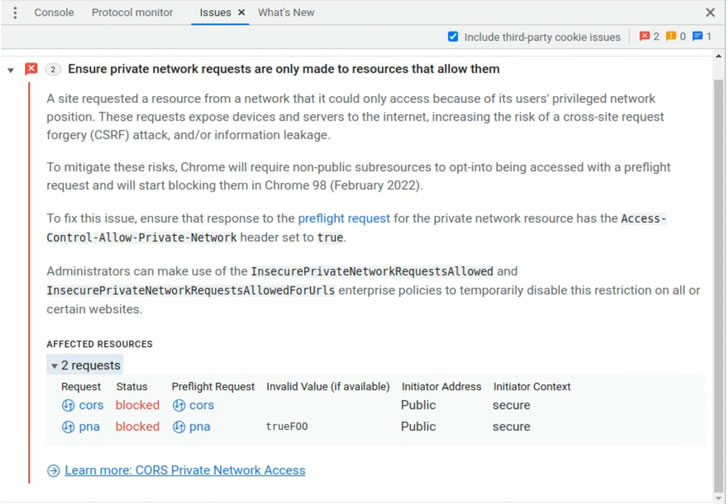
“Chrome will start sending a CORS[2]
preflight request ahead of any private network request for a
subresource, which asks for explicit permission from the target
server,” Titouan Rigoudy and Eiji Kitamura said[3]. “This preflight request
will carry a new header, Access-Control-Request-Private-Network:
true, and the response to it must carry a corresponding header,
Access-Control-Allow-Private-Network: true.”
What this means is that starting with Chrome version 101, any
website accessible via the internet will be made to seek explicit
permission from the browser before they can access internal network
resources. In other words, the new PNA specification adds a
provision inside the browser through which websites can request
servers gated behind local networks to obtain a connection.
“The specification also extends the Cross-Origin Resource
Sharing (CORS) protocol so that websites now have to explicitly
request a grant from servers on private networks before being
allowed to send arbitrary requests,” Rigoudy noted[4]
in August 2021, when it first announced plans to deprecate access
to private network endpoints from non-secure websites.
The goal, the researchers said, is to safeguard users from
cross-site request forgery (CSRF[5]) attacks targeting routers[6]
and other devices on private networks, which enable bad actors to
reroute unsuspecting users to malicious domains.
References
Read more https://thehackernews.com/2022/01/chrome-limits-websites-access-to.html