Researchers have disclosed a security shortcoming affecting
three different WordPress plugins that impact over 84,000 websites
and could be abused by a malicious actor to take over vulnerable
sites.
“This flaw made it possible for an attacker to update arbitrary
site options on a vulnerable site, provided they could trick a
site’s administrator into performing an action, such as clicking on
a link,” WordPress security company Wordfence said[1]
in a report published last week.
Tracked as CVE-2022-0215, the cross-site request forgery
(CSRF[2]) flaw is rated 8.8 on
the CVSS scale and impacts three plugins maintained by Xootix[3] —
Cross-site request forgery, also known as one-click attack or
session riding, occurs when an authenticated end-user is tricked by
an attacker into submitting a specially crafted web request. “If
the victim is an administrative account, CSRF can compromise the
entire web application,” OWASP notes[4]
in its documentation.
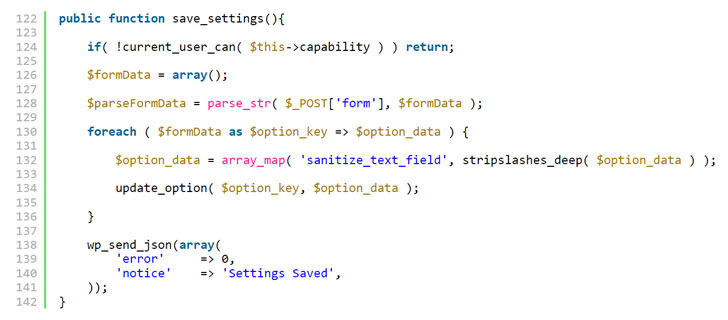
Specially, the vulnerability has its origin in a lack of
validation when processing AJAX requests[5], effectively enabling an
attacker to update[6]
the “users_can_register” (i.e., anyone can register) option on a
site to true and set the “default_role” setting (i.e., the default
role of users who register at the blog) to administrator, granting
complete control.
Login/Signup Popup is installed on over 20,000 sites, while Side
Cart Woocommerce and Waitlist Woocommerce have been installed on
more than 4,000 and 60,000 sites, respectively.
Following responsible disclosure by Wordfence researchers in
November 2021, the issue has been addressed in Login/Signup Popup
version 2.3, Side Cart Woocommerce version 2.1, and Waitlist
Woocommerce 2.5.2.
The findings come a little over a month after attackers exploited weaknesses[7]
in four plugins and 15 Epsilon Framework themes to target 1.6
million WordPress sites as part of a large-scale attack campaign
originating from 16,000 IP addresses.
“Though this Cross-Site Request Forgery (CSRF) vulnerability is
less likely to be exploited due to the fact that it requires
administrator interaction, it can have a significant impact to a
successfully exploited site and, as such, it serves as an
incredibly important reminder to remain aware when clicking on
links or attachments and to ensure that you are regularly keeping
your plugins and themes up to date,” Wordfence’s Chloe Chamberland
said.
References
Read more https://thehackernews.com/2022/01/high-severity-vulnerability-in-3.html