
The U.S. Cybersecurity and Infrastructure Security Agency (CISA)
on Tuesday released an industrial control systems (ICS) advisory
warning of seven security flaws in Dataprobe’s iBoot-PDU power
distribution unit product, mostly used in industrial environments
and data centers.
“Successful exploitation of these vulnerabilities could lead to
unauthenticated remote code execution on the Dataprobe iBoot-PDU
device,” the agency said[1]
in a notice.
Credited with disclosing the flaws is industrial cybersecurity
firm Claroty, which said[2]
the weaknesses could be remotely triggered “either through a direct
web connection to the device or via the cloud.”
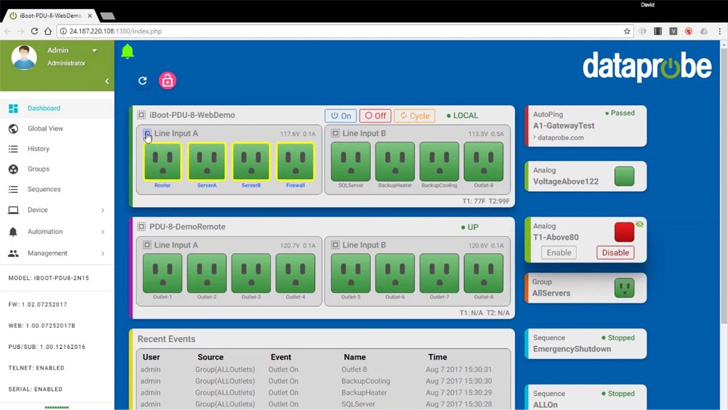
iBoot-PDU[3]
is a power distribution unit (PDU) that provides users with
real-time monitoring capabilities and sophisticated alerting
mechanisms via a web interface so as to control the power supply to
devices and other equipment in an OT environment.
The vulnerabilities assume new significance when taking into
consideration the fact that no fewer than 2,600 PDUs are accessible
on the internet, with Dataprobe devices accounting for nearly a
third of those exposed, according to a 2021 report[4]
from attack surface management platform Censys.
Claroty’s analysis of the PDU firmware shows that the product is
crippled by issues ranging from command injection to path traversal
flaws, exposing customers to severe security risks –
- CVE-2022-3183 (CVSS score: 9.8) – A command injection
vulnerability stemming from a lack of sanitization of user
input - CVE-2022-3184 (CVSS score: 9.8) – A path traversal
vulnerability that enables access to an unauthenticated PHP page,
which could be abused to insert malicious code
Successful remote exploitation of the flaws “puts an attacker
within arm’s length of disrupting critical services by cutting off
electric power to the device and subsequently, anything plugged
into it,” Clarory researcher Uri Katz said.
The other five uncovered vulnerabilities (from CVE-2022-3185
through CVE-2022-3189) could be weaponized by a bad actor to access
the device’s main management page from the cloud and even trick the
server to connect to arbitrary internal or external systems (aka
SSRF[5]), potentially leaking
sensitive information.
“Even an innocuous power distribution unit remotely managed over
the internet or via a cloud-based management platform can provide a
determined attacker to target the network, or with a way to disrupt
essential services by cutting power to devices plugged into a PDU,”
Katz said.
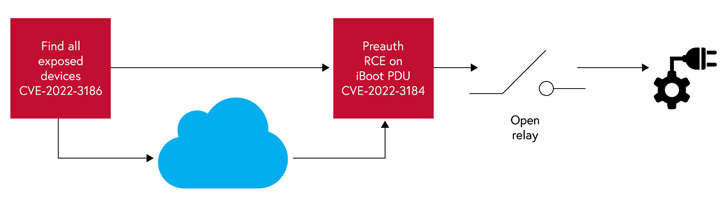
Claroty further disclosed that it found a way to enumerate
cloud-connected iBoot PDU devices by exploiting a combination of a
valid cookie and the device ID (a sequential numeric value that can
be trivially guessed), thereby widening the available attack
surface to all connected devices.
Users of Dataprobe iBoot-PDU are recommended to upgrade to the
latest firmware version[6]
(1.42.06162022) as well as disable SNMP, Telnet, and HTTP, if not
in use, as a mitigation against some of these vulnerabilities.
References
Read more https://thehackernews.com/2022/09/critical-remote-hack-flaws-found-in.html