
Cybersecurity company Imperva has disclosed that it mitigated a
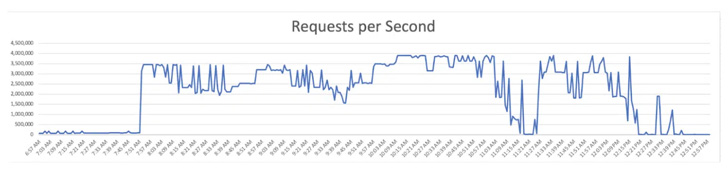
distributed denial-of-service (DDoS) attack with a total of over
25.3 billion requests on June 27, 2022.
The “strong attack,” which targeted an unnamed Chinese
telecommunications company, is said to have lasted for four hours
and peaked at 3.9 million requests per second (RPS).
“Attackers used HTTP/2 multiplexing, or combining multiple
packets into one, to send multiple requests at once over individual
connections,” Imperva said[1]
in a report published on September 19.
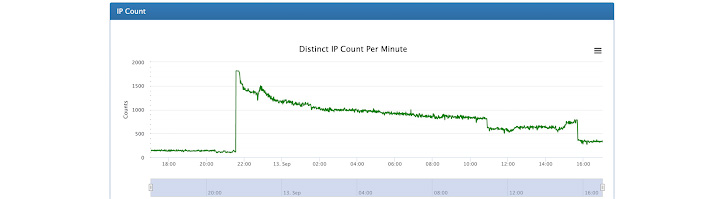
The attack was launched from a botnet that comprised nearly
170,000 different IP addresses spanning routers, security cameras,
and compromised servers located in more than 180 countries,
primarily the U.S., Indonesia, and Brazil.
The disclosure also comes as web infrastructure provider Akamai
said it fielded a new DDoS assault aimed at a customer based in
Eastern Europe on September 12, with attack traffic spiking at
704.8 million packets per second (pps).
The same victim was previously targeted[2]
on July 21, 2022, in a similar fashion in which the attack volume
ramped up to 853.7 gigabits per second (Gbps) and 659.6 million pps
over a period of 14 hours.
Akamai’s Craig Sparling said[3]
the company has been “bombarded relentlessly with sophisticated
distributed denial-of-service (DDoS) attacks,” indicating that the
offensives could be politically motivated in the face of Russia’s
ongoing war against Ukraine.
Both the disruptive attempts were UDP flood attacks[4]
where the attacker targets and overwhelms arbitrary ports on the
target host with User Datagram Protocol (UDP[5]) packets.
UDP, being both connectionless and session-less, makes it an
ideal networking protocol for handling VoIP traffic. But these same
traits can also render it more susceptible to exploitation.
“Without an initial handshake to ensure a legitimate connection,
UDP channels can be used to send a large volume of traffic to any
host,” NETSCOUT says[6].
“There are no internal protections that can limit the rate of a
UDP flood. As a result, UDP flood DoS attacks are exceptionally
dangerous because they can be executed with a limited amount of
resources.”
References
Read more https://thehackernews.com/2022/09/record-ddos-attack-with-253-billion.html