
Agency (CISA) yesterday issued a fresh advisory
alerting organizations to change all their Active Directory
credentials as a defense against cyberattacks trying to leverage a
known remote code execution (RCE) vulnerability in Pulse Secure VPN
servers—even if they have already patched it.
The warning comes three months after another CISA alert[2] urging users and
administrators to patch Pulse Secure
VPN[3] environments to thwart
attacks exploiting the vulnerability.
“Threat actors who successfully exploited CVE-2019-11510 and
stole a victim organization’s credentials will still be able to
access — and move laterally through — that organization’s network
after the organization has patched this vulnerability if the
organization did not change those stolen credentials,” CISA
said.
CISA has also released a tool to
help network administrators look for any indicators of
compromise associated with the flaw.
A Remote Code Execution Flaw
Tracked as CVE-2019-11510, the
pre-authentication arbitrary file read vulnerability could allow
remote unauthenticated attackers to compromise vulnerable VPN
servers and gain access to all active users and their plain-text
credentials, and execute arbitrary commands.
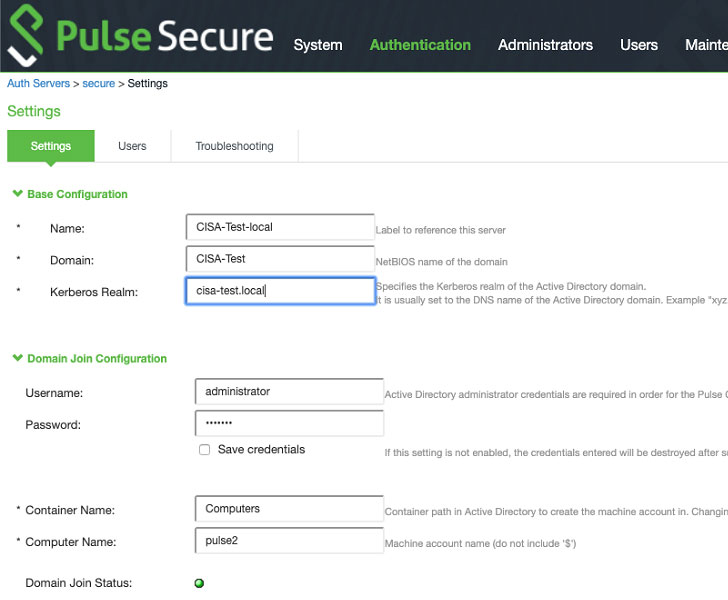
traversal is hard-coded to be allowed if a path contains
“dana/html5/acc,” thus allowing an attacker to send specially
crafted URLs to read sensitive files, such as “/etc/passwd” that
contains information about each user on the system.
To address this issue, Pulse Secure released an out-of-band
patch[7] on April 24, 2019.
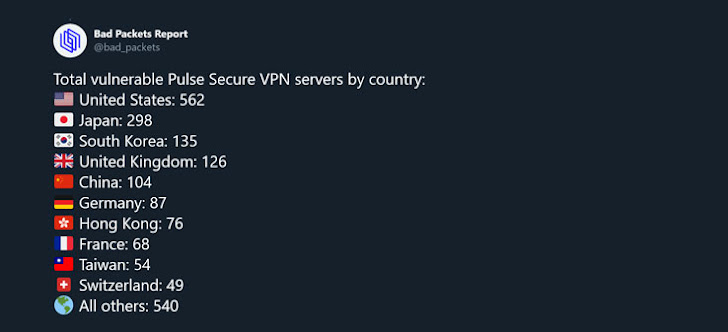
While on August 24, 2019, security intelligence firm Bad Packets
was able to discover 14,528
unpatched[8] Pulse Secure servers, a
subsequent scan as of last month yielded 2,099 vulnerable
endpoints[9], indicating that a vast
majority of organizations have patched their VPN gateways.
Unpatched VPN Servers Become Lucrative Target
The fact that there are still over thousands of unpatched Pulse
Secure VPN servers has made them a lucrative target for bad actors
to distribute malware.
A report from ClearSky found Iranian state-sponsored hackers using
CVE-2019-11510[10], among others, to
penetrate and steal information from target IT and
telecommunication companies across the world.
According to an NSA advisory
from October 2019, the “exploit code is freely available online via
the Metasploit framework, as well as GitHub. Malicious cyber actors
are actively using this exploit code.”
[11]
In a similar alert issued last year, the UK’s National Cyber
Security Centre (NCSC) warned that
advanced threat groups are exploiting the vulnerability to target
government, military, academic, business, and healthcare
organizations.
More recently, Travelex[13], the foreign currency
exchange and travel insurance firm, became a victim after
cybercriminals planted Sodinokibi (REvil) ransomware[14] on the company’s
networks via the Pulse Secure vulnerability. Although the
ransomware operators demanded a ransom of $6 million (£4.6
million), a Wall Street
Journal[15] report last week said
it paid $2.3 million in the form of 285 Bitcoin to resolve its
problem.
In the face of ongoing attacks, it’s recommended that
organizations upgrade their Pulse Secure VPN, reset their
credentials, and scan for unauthenticated log requests and exploit
attempts.
CISA has also suggested removing any unapproved remote access
programs and inspecting scheduled tasks for scripts or executables
that may allow an attacker to connect to an environment.
For more steps to mitigate the flaw, head to NSA’s advisory
here[16].
References
- ^
fresh advisory
(www.us-cert.gov) - ^
CISA alert
(www.us-cert.gov) - ^
patch Pulse Secure VPN
(www.us-cert.gov) - ^
released
a tool to help (github.com) - ^
CVE-2019-11510
(nvd.nist.gov) - ^
directory traversal
(devco.re) - ^
out-of-band patch
(kb.pulsesecure.net) - ^
14,528 unpatched
(badpackets.net) - ^
2,099 vulnerable endpoints
(twitter.com) - ^
hackers using CVE-2019-11510
(thehackernews.com) - ^
NSA advisory
(media.defense.gov) - ^
NCSC
(www.ncsc.gov.uk) - ^
Travelex
(www.bbc.com) - ^
ransomware
(doublepulsar.com) - ^
Wall Street Journal
(www.wsj.com) - ^
NSA’s advisory here
(media.defense.gov)
Read more http://feedproxy.google.com/~r/TheHackersNews/~3/waVavmhAkK8/pulse-secure-vpn-vulnerability.html