Dec 13, 2022Ravie Lakshmanan

A critical security flaw has been disclosed in Amazon Elastic
Container Registry (ECR) Public Gallery that could have been
potentially exploited to stage a multitude of attacks, according to
cloud security firm Lightspin.
“By exploiting this vulnerability, a malicious actor could
delete all images in the Amazon ECR Public Gallery or update the
image contents to inject malicious code,” Gafnit Amiga, director of
security research at Lightspin, said in a report shared with The
Hacker News.
“This malicious code is executed on any machine that pulls and
runs the image, whether on user’s local machines, Kubernetes
clusters or cloud environments.”
ECR is a container image registry service[1] managed by Amazon Web
Services, enabling users to package code as Docker images and
deploy the artifacts in a scalable manner. Public repositories
hosted on ECR are displayed in what’s called the ECR Public
Gallery[2].
“By default, your account has read and write access to the
repositories in your public registry,” Amazon notes[3]
in its documentation. “However, IAM users require permissions to
make calls to the Amazon ECR APIs and to push images to your
repositories.”
But the issue identified by Lightspin meant that it could be
weaponized by external actors to delete, update, and create
poisoned versions of legitimate images in registries and
repositories that belong to other AWS accounts by taking advantage
of undocumented internal ECR Public APIs.
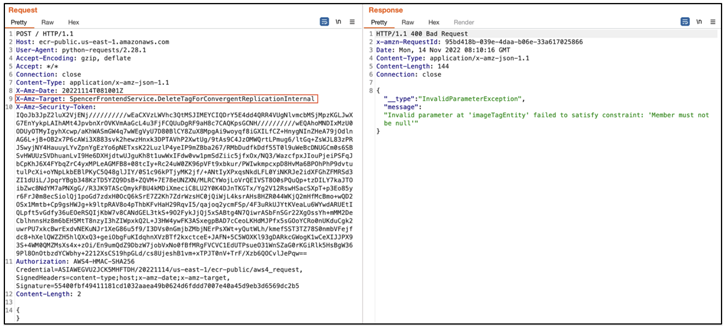
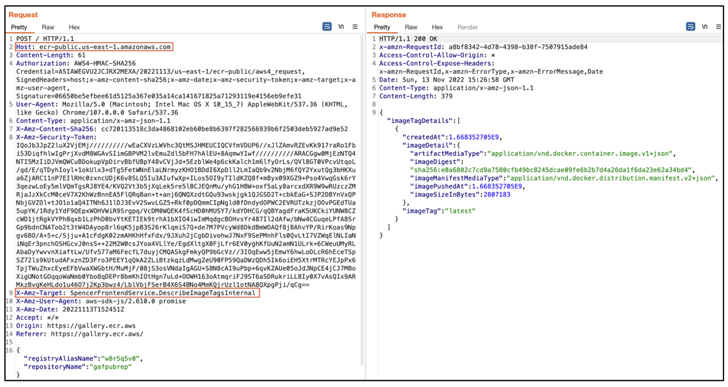
This is achieved by acquiring temporary credentials using
Amazon
Cognito[4] to authorize requests to
the internal APIs and activate the action to delete images using
“DeleteImageForConvergentReplicationInternal,” or alternatively
push a new image via the “PutImageForConvergentReplicationInternal”
action.
Lightspin characterized the flaw as an instance of “deep
software supply chain attack.”
Amazon has since deployed a fix[5]
to resolve the weakness as of November 16, 2022, less than 24 hours
after it was reported, indicative of the severity of the problem.
No customer action is required.
“This vulnerability could potentially lead to denial-of-service,
data exfiltration, lateral movement, privilege escalation, data
destruction, and other multivariate attack paths that are only
limited by the craftiness and goals of the adversary,” Amiga
noted.
“A malicious actor could poison popular images, all while
abusing the trust model of ECR Public as these images would
masquerade as being verified and thus undermine the ECR Public
supply chain.”
Found this article interesting? Follow us on Twitter [6]
and LinkedIn[7]
to read more exclusive content we post.
References
- ^
container image registry service
(aws.amazon.com) - ^
ECR Public Gallery
(gallery.ecr.aws) - ^
notes
(docs.aws.amazon.com) - ^
Amazon Cognito
(aws.amazon.com) - ^
deployed
a fix (aws.amazon.com) - ^
Twitter
(twitter.com) - ^
LinkedIn
(www.linkedin.com)
Read more https://thehackernews.com/2022/12/serious-attacks-could-have-been-staged.html