Dec 13, 2022Ravie Lakshmanan
Google on Tuesday announced the open source availability of
OSV-Scanner, a scanner that aims to offer easy
access to vulnerability information about various projects.
The Go-based tool[1], powered by the Open
Source Vulnerabilities (OSV[2]) database, is designed
to connect “a project’s list of dependencies with the
vulnerabilities that affect them,” Google software engineer Rex Pan
in a post shared with The Hacker News.
“The OSV-Scanner generates reliable, high-quality vulnerability
information that closes the gap between a developer’s list of
packages and the information in vulnerability databases,” Pan
added.
The idea is to identify all the transitive dependencies of a
project and highlight relevant vulnerabilities using data pulled
from OSV.dev database.
Google further stated that the open source platform supports 16
ecosystems, counting all major languages, Linux distributions
(Debian and Alpine), as well as Android, Linux Kernel, and OSS-Fuzz[3].
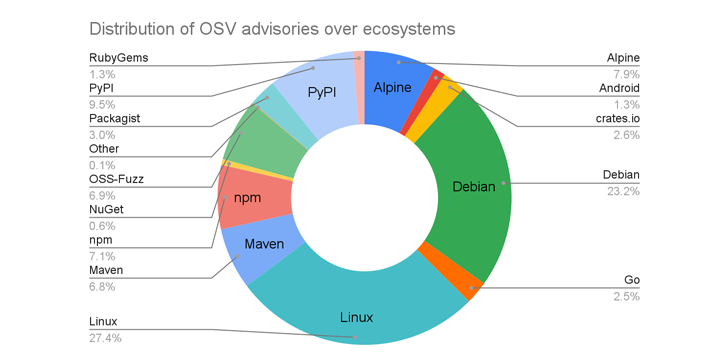
The result of this expansion is that OSV.dev is a repository to
more than 38,000 advisories, up from 15,000 security alerts a year
ago, with Linux (27.4%), Debian (23.2%), PyPI (9.5%), Alpine
(7.9%), and npm (7.1%) taking up the top five slots.
As for the next steps, the internet giant noted it’s working to
incorporate support for C/C++ flaws by building a “high quality
database” that involves adding “precise commit level metadata to
CVEs.”
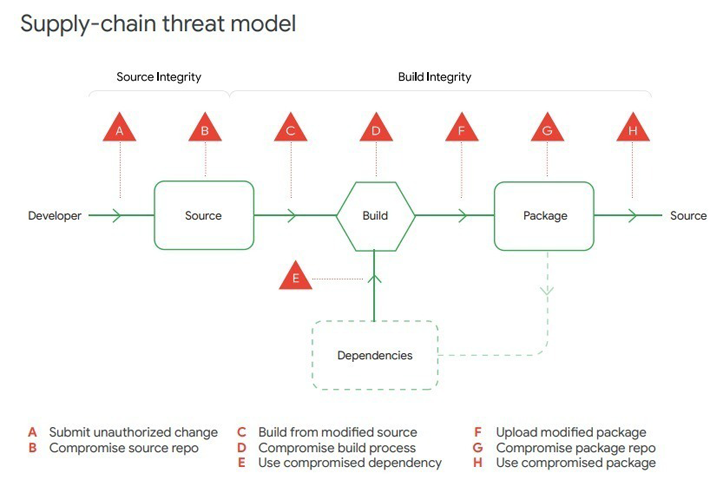
OSV-Scanner arrives nearly two months after Google launched
GUAC[4]
– short for Graph for Understanding Artifact Composition – to
complement Supply chain Levels for Software Artifacts (SLSA[5]
or “salsa”) as part of its efforts to harden software supply chain
security[6].
Last week, Google also published a new “Perspectives on Security[7]” report calling on
organizations to develop and deploy a common SLSA framework to
prevent tampering, improve integrity[8], and secure packages
against potential threats.
Other recommendations laid out by the company include taking on
additional open source security responsibilities and adopting a
more holistic approach to addressing risks such as those presented
by the Log4j vulnerability[9]
and the SolarWinds incident[10] in recent years.
“Software supply chain attacks typically require strong
technical aptitude and long-term commitment to pull off,” the
company said. “Sophisticated actors are more likely to have both
the intent and capability to conduct these types of attacks.”
“Most organizations are vulnerable to software supply chain
attacks because attackers take the time to target third-party
providers with trusted connections to their customers’ networks.
They then use that trust to burrow deeper into the networks of
their ultimate targets.”
Found this article interesting? Follow us on Twitter [11] and LinkedIn[12] to read more exclusive
content we post.
References
- ^
Go-based
tool (github.com) - ^
OSV (osv.dev) - ^
OSS-Fuzz
(github.com) - ^
GUAC
(thehackernews.com) - ^
SLSA (slsa.dev) - ^
harden
software supply chain security
(thehackernews.com) - ^
Perspectives on Security
(blog.google) - ^
improve integrity
(www.sigstore.dev) - ^
Log4j
vulnerability (thehackernews.com) - ^
SolarWinds incident
(thehackernews.com) - ^
Twitter
(twitter.com) - ^
LinkedIn
(www.linkedin.com)
Read more https://thehackernews.com/2022/12/google-launches-largest-distributed.html