Dec 13, 2022Ravie Lakshmanan

Cybersecurity researchers have published the inner workings of a
new wiper called Azov Ransomware that’s
deliberately designed to corrupt data and “inflict impeccable
damage” to compromised systems.
Distributed through another malware loader known as SmokeLoader[1], the malware has been
described[2]
as an “effective, fast, and unfortunately unrecoverable data
wiper,” by Israeli cybersecurity company Check Point. Its origins
have yet to be determined.
The wiper routine is set to overwrite a file’s contents in
alternating 666-byte chunks with random noise, a technique referred
to as intermittent encryption[3]
that’s being increasingly leveraged by ransomware operators to
evade detection and encrypt victims’ files faster.
“One thing that sets Azov apart from your garden-variety
ransomware is its modification of certain 64-bit executables to
execute its own code,” threat researcher Jiří Vinopal said. “The
modification of executables is done using polymorphic code, so as
not to be potentially foiled by static signatures.”
Azov Ransomware also incorporates a logic bomb – a set of
conditions that should be met before activating a malicious action
– to detonate the execution of the wiping and backdooring functions
at a predetermined time.
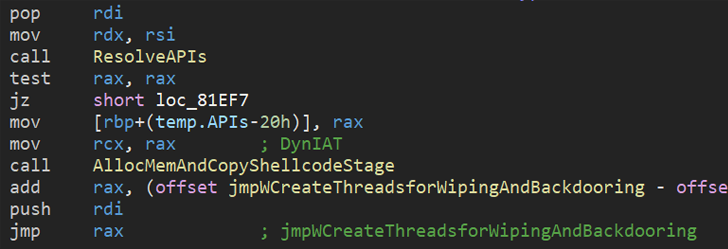
“Although the Azov sample was considered skidsware when first
encountered […], when probed further one finds very advanced
techniques — manually crafted assembly, injecting payloads into
executables in order to backdoor them, and several anti-analysis
tricks usually reserved for security textbooks or high-profile
brand-name cybercrime tools,” Vinopal added.
The development comes amid a profusion of destructive wiper
attacks since the start of the year. This includes WhisperGate[4], HermeticWiper[5], AcidRain[6], IsaacWiper[7], CaddyWiper[8], Industroyer2[9], DoubleZero[10], RURansom[11], and CryWiper[12].
Last week, security firm ESET disclosed another previously
unseen wiper called Fantasy[13] that’s spread using a
supply chain attack targeting an Israeli software company to target
customers in the diamond industry. The malware has been linked to a
threat actor called Agrius.
Found this article interesting? Follow us on Twitter [14] and LinkedIn[15] to read more exclusive
content we post.
References
- ^
SmokeLoader
(thehackernews.com) - ^
described
(research.checkpoint.com) - ^
intermittent encryption
(www.sentinelone.com) - ^
WhisperGate
(thehackernews.com) - ^
HermeticWiper
(thehackernews.com) - ^
AcidRain
(thehackernews.com) - ^
IsaacWiper
(thehackernews.com) - ^
CaddyWiper
(thehackernews.com) - ^
Industroyer2
(thehackernews.com) - ^
DoubleZero
(thehackernews.com) - ^
RURansom
(thehackernews.com) - ^
CryWiper
(thehackernews.com) - ^
Fantasy
(thehackernews.com) - ^
Twitter
(twitter.com) - ^
LinkedIn
(www.linkedin.com)
Read more https://thehackernews.com/2022/12/cybersecurity-experts-uncover-inner.html