Dec 13, 2022Ravie Lakshmanan
An active malware campaign is targeting the Python Package Index
(PyPI) and npm repositories for Python and JavaScript with
typosquatted and fake modules that deploy a ransomware strain,
marking the latest security issue to affect software supply
chains.
The typosquatted Python packages all impersonate the popular
requests library[1]: dequests, fequests,
gequests, rdquests, reauests, reduests, reeuests, reqhests,
reqkests, requesfs, requesta, requeste, requestw, requfsts,
resuests, rewuests, rfquests, rrquests, rwquests, telnservrr, and
tequests.
According to Phylum[2], the rogue packages
embed source code that retrieves Golang-based ransomware binary
from a remote server depending on the victim’s operating system and
microarchitecture.
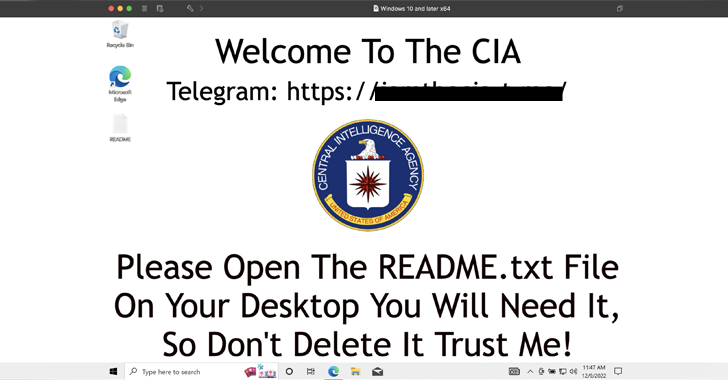
Successful execution causes the victim’s desktop background to
be changed to an actor-controlled image that claims to the U.S.
Central Intelligence Agency (CIA). It’s also designed to encrypt
files and demand a $100 ransom in cryptocurrency.
In a sign that the attack is not limited to PyPI, the adversary
has been spotted publishing five different modules in npm:
discordallintsbot, discordselfbot16, discord-all-intents-bot,
discors.jd, and telnservrr.
“The attacker has also published several npm packages that
behave in a similar manner,” Phylum CTO Louis Lang said, adding
each of the libraries contain the JavaScript equivalent of the same
code to deploy the ransomware.
The findings come as ReversingLabs uncovered[3]
a tranche of 10 additional PyPI packages pushing modified versions
of the W4SP Stealer malware as part of an ongoing supply chain attack[4] aimed at software
developers that’s believed to have started around September 25,
2022.
That’s not all. Earlier this month, Israel-based software supply
chain security firm Legit Security demonstrated a new attack
technique against a Rust repository (“rust-lang”) that abuses
GitHub Actions[5]
to poison legitimate artifacts.
Build artifacts are the files created by the build process, such
as distribution packages, WAR files, logs, and reports. By
replacing the actual modules with trojanized versions, an actor
could steal sensitive information or deliver additional payloads to
all its downstream users.
“The vulnerability was found in a workflow called ‘ci.yml’ which
is responsible for building and testing the repository’s code,”
Legit Security researcher Noam Dotan said[6]
in a technical write-up.
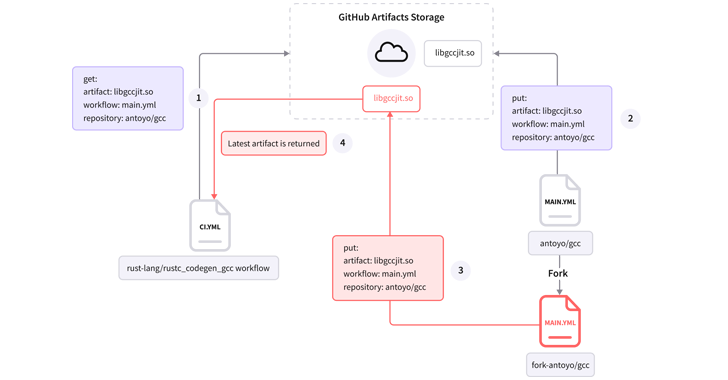
By exploiting this weakness, an attacker could trick the GitHub
workflow into executing a malware-laced artifact, effectively
making it possible to tamper with repository branches, pull
requests, issues, and releases.
The maintainers of the Rust programming language addressed[7]
the issue on September 26, 2022, following responsible disclosure
on September 15, 2022.
Found this article interesting? Follow us on Twitter [8]
and LinkedIn[9]
to read more exclusive content we post.
References
Read more https://thehackernews.com/2022/12/malware-strains-targeting-python-and.html