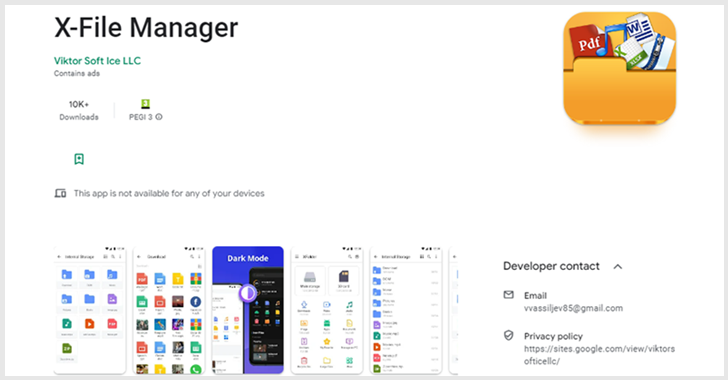
The Android banking fraud malware known as SharkBot has
reared its head once again on the official Google Play Store,
posing as file managers to bypass the app marketplace’s
restrictions.
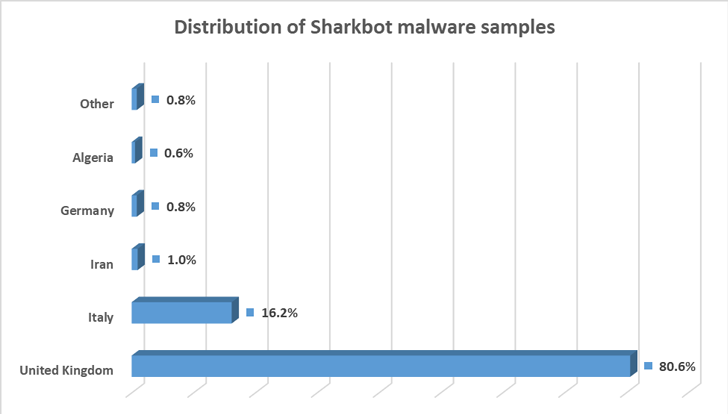
A majority of the users who downloaded the rogue apps are
located in the U.K. and Italy, Romanian cybersecurity company
Bitdefender said[1]
in an analysis published this week.
SharkBot, first discovered[2]
towards the end of 2021 by Cleafy, is a recurring[3]
mobile[4]
threat[5]
distributed both on the Google Play Store and other third-party app
stores.
One of the trojan’s primary goals is to initiate money transfers
from compromised devices via a technique called “Automatic Transfer
System” (ATS[6]), in which a transaction
triggered via a banking app is intercepted to swap the payee
account with an actor-controlled account in the background.
It’s capable of serving a fake login overlay when users attempt
to open legitimate banking apps, stealing the credentials in the
process.
Often, such apps offer seemingly harmless functionality,
masquerading as antivirus software and cleaners to sneak into
Google Play Store. But they also double up as droppers that, once
installed on the device, can fetch the malware payload.
The dropper apps, now taken down, are below –
- X-File Manager (com.victorsoftice.llc) – 10,000+ downloads
- FileVoyager (com.potsepko9.FileManagerApp) – 5,000+
downloads - LiteCleaner M (com.ltdevelopergroups.litecleaner.m) – 1,000+
downloads
LiteCleaner M is still available for download from a third-party
app store called Apksos, which also houses a fourth SharkBot
artifact by the name “Phone AID, Cleaner, Booster”
(com.sidalistudio.developer.app).
The X-File Manager app, which is only accessible to users in
Italy, attracted over 10,000 downloads before it was removed. With
Google steadily clamping down on permission abuse, the threat
actor’s choice of using a file manager as a lure is not
surprising.
That’s because Google’s Developer Program Policy restricts[7]
the permission to install external packages
(REQUEST_INSTALL_PACKAGES) to a handful of app categories: web
browsers, instant messengers that support attachments, file
managers, enterprise device management, backup and restore, and
device transfer.
Invariably, this permission is abused to download and install
malware from a remote server. Some of the targeted bank apps
include Bank of Ireland, Bank of Scotland, Barclays, BNL, HSBC
U.K., Lloyds Bank, Metro Bank, and Santander.
“The application [i.e., the dropper] performs anti-emulator
checks and targets users from Great Britain and Italy by verifying
if the SIM ISO corresponds with IT or GB,” Bitdefender researchers
said.
Users who have installed the aforementioned apps are recommended
to delete them and change their bank account passwords immediately.
Users are also advised to enable Play Store Protect[8], and scrutinize app
ratings and reviews before downloading them.
References
Read more https://thehackernews.com/2022/11/this-android-file-manager-app-infected.html