Companies based in the U.S. have been at the receiving end of an
“aggressive” Qakbot malware campaign that leads to Black Basta
ransomware infections on compromised networks.
“In this latest campaign, the Black Basta ransomware gang is
using QakBot malware to create an initial point of entry and move
laterally within an organization’s network,” Cybereason researchers
Joakim Kandefelt and Danielle Frankel said[1]
in a report shared with The Hacker News.
Black Basta, which emerged in April 2022, follows the
tried-and-tested approach of double extortion to steal sensitive
data from targeted companies and use it as leverage to extort
cryptocurrency payments by threatening to release the stolen
information.
This is not the first time the ransomware crew has been observed
using Qakbot (aka QBot, QuackBot, or Pinkslipbot). Last month,
Trend Micro disclosed[2]
similar attacks that entailed the use of Qakbot to deliver the
Brute Ratel C4[3]
framework, which, in turn, was leveraged to drop Cobalt Strike.
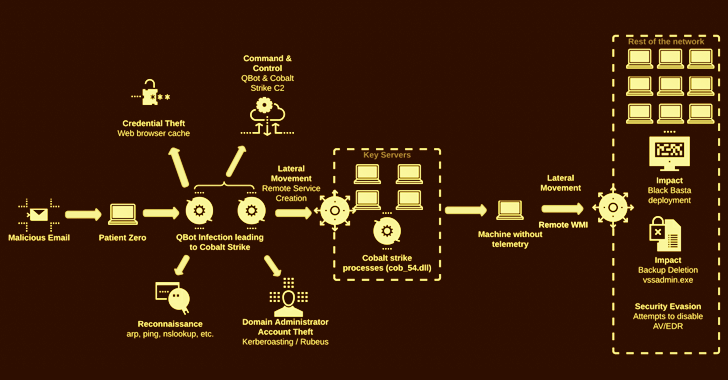
The intrusion activity observed by Cybereason cuts out Brute
Ratel C4 from the equation, instead using Qakbot to directly
distribute Cobalt Strike on several machines in the infected
environment.
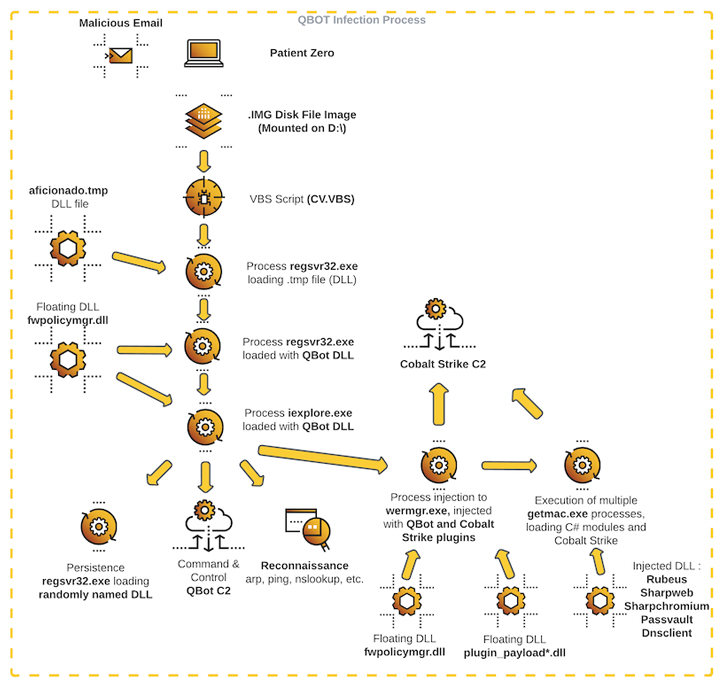
The attack chain commences with a spear-phishing email bearing a
malicious disk image file that, when opened, kickstarts the
execution of Qbot, which, for its part, connects to a remote server
to retrieve the Cobalt Strike payload.
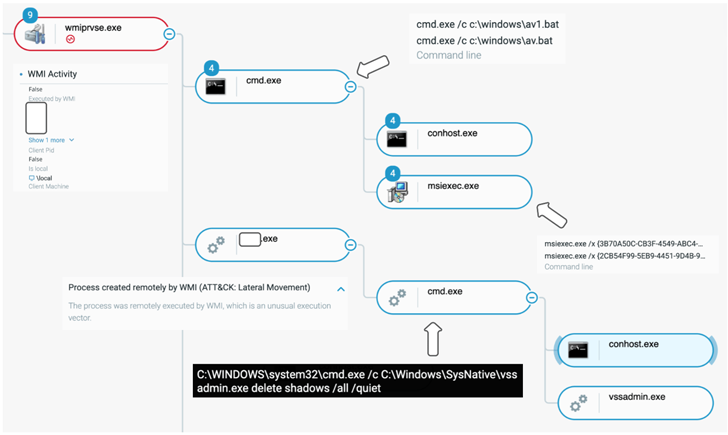
At this stage, credential harvesting and lateral movement
activities are carried out to place the red team framework on
several servers, before breaching as many endpoints as possible
using the collected passwords and launching the Black Basta
ransomware.
“The threat actor obtained domain administrator privileges in
less than two hours and moved to ransomware deployment in less than
12 hours,” the researchers noted, adding over 10 different
customers were impacted by the fresh set of attacks in the past two
weeks.
In two instances spotted by the Israeli cybersecurity company,
the intrusions not only deployed the ransomware but also locked the
victims out of their networks by disabling the DNS service in a bid
to make a recovery more challenging.
Black Basta remains a highly active ransomware actor. According
to data gathered by Malwarebytes[4], Black Basta
successfully targeted 25 companies in October 2022 alone, putting
it behind LockBit[5], Karakurt[6], and BlackCat[7].
References
Read more https://thehackernews.com/2022/11/black-basta-ransomware-gang-actively.html