
Malicious actors are resorting to voice phishing (vishing)
tactics to dupe victims into installing Android malware on their
devices, new research[1]
from ThreatFabric reveals.
The Dutch mobile security company said it identified a network
of phishing websites targeting Italian online-banking users that
are designed to get hold of their contact details.
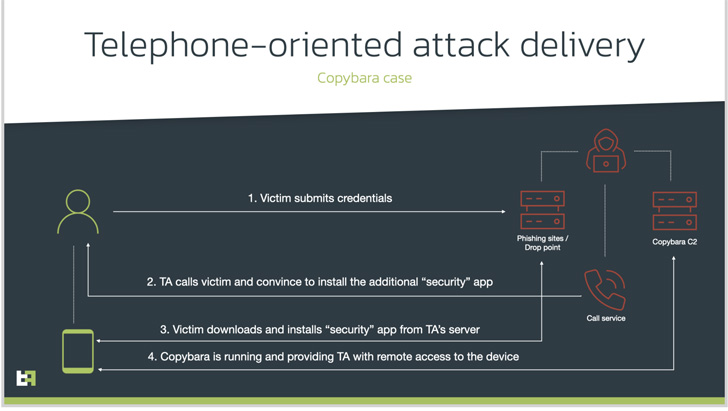
Telephone-oriented attack delivery (TOAD), as the social
engineering technique is called, involves calling the victims using
previously collected information from fraudulent websites.
The caller, who purports to be a support agent for the bank,
instructs the individual, on the other hand, to install a security
app and grant it extensive permissions, when, in reality, it’s
malicious software intended to gain remote access or conduct
financial fraud.
In this case, it leads to the deployment of an Android malware
dubbed Copybara[2], a mobile trojan first
detected in November 2021 and is primarily used to perform
on-device fraud via overlay attacks targeting Italian users.
Copybara has also been confused with another malware family known
as BRATA[3].
ThreatFabric assessed the TOAD-based campaigns to have commenced
around the same time, indicating that the activity has been ongoing
for nearly a year.
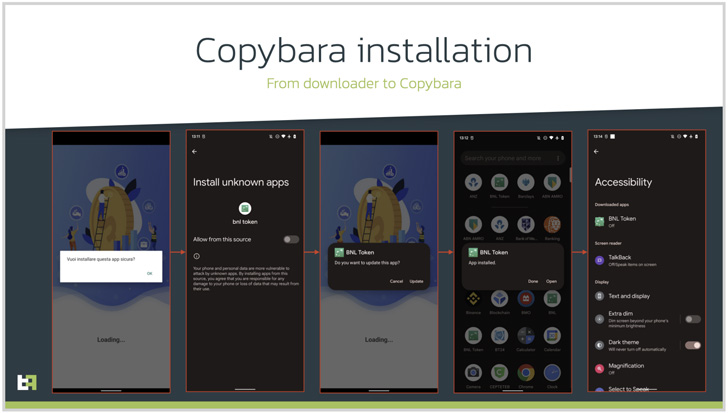
Like any other Android-based malware, Copybara’s RAT
capabilities are powered by abusing the operating system’s
accessibility services API to gather sensitive information and even
uninstall the downloader app to reduce its forensic footprint.

What’s more, the infrastructure utilized by the threat actor has
been found to deliver a second malware named SMS Spy that enables
the adversary to gain access to all incoming SMS messages and
intercept one-time passwords (OTPs) sent by banks.
The new wave of hybrid fraud attacks presents a new dimension
for scammers to mount convincing Android malware campaigns that
have otherwise relied on traditional methods such as Google Play
Store droppers, rogue ads, and smishing.
“Such attacks require more resources on [threat actors’] side
and are more sophisticated to perform and maintain,” ThreatFabric’s
Mobile Threat Intelligence (MTI) team told The Hacker News.
“We also like to point out that targeted attacks from a fraud
success perspective are unfortunately more successful, at least in
this specific campaign.”
This is not the first time TOAD tactics are being employed to
orchestrate banking malware campaigns. Last month, the
MalwareHunterTeam detailed[4]
a similar attack aimed at users of the Indian bank Axis Bank in a
bid to install an info-stealer that impersonates a credit card
rewards app.
“Any suspicious call should be double checked by calling your
financial organization,” the MTI team said, adding “financial
organizations should provide their customers with knowledge about
ongoing campaigns and enhance the client apps with mechanisms to
detect suspicious activity.”
References
Read more https://thehackernews.com/2022/10/hackers-using-vishing-tactics-to-trick.html