A threat actor tracked as Polonium has been linked to over a
dozen highly targeted attacks aimed at Israelian entities with
seven different custom backdoors since at least September 2021.
The intrusions were aimed at organizations in various verticals,
such as engineering, information technology, law, communications,
branding and marketing, media, insurance, and social services,
cybersecurity firm ESET said.
Polonium[1]
is the chemical element-themed moniker given by Microsoft to a
sophisticated operational group that’s believed to be based in
Lebanon and is known to exclusively strike Israeli targets.
Activities undertaken by the group first came to light earlier
this June when the Windows maker disclosed it suspended more than
20 malicious OneDrive accounts created by the adversary for
command-and-control (C2) purposes.
Core to the attacks has been the use of implants coined
CreepyDrive and CreepyBox for their ability to exfiltrate sensitive
data to actor-controlled OneDrive and Dropbox accounts. Also
deployed is a PowerShell backdoor dubbed CreepySnail.
ESET’s latest discovery of five more previously undocumented
backdoors brings into focus an active espionage-oriented threat
actor that’s constantly refining and retooling its malware
arsenal.
“The numerous versions and changes Polonium introduced into its
custom tools show a continuous and long-term effort to spy on the
group’s targets,” ESET researcher Matías Porolli said[2]. “The group doesn’t seem
to engage in any sabotage or ransomware actions.”
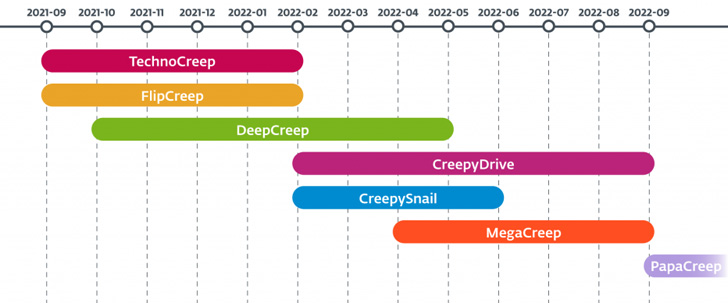
The list of bespoke hacking tools is as follows –
- CreepyDrive/CreepyBox – A PowerShell backdoor
that reads and executes commands from a text file stored on
OneDrive or Dropbox. - CreepySnail – A PowerShell backdoor that
receives commands from the attacker’s own C2 server - DeepCreep – A C# backdoor that reads commands
from a text file stored in Dropbox accounts and exfiltrates
data - MegaCreep – A C# backdoor that reads commands
from a text file stored in Mega cloud storage service - FlipCreep – A C# backdoor that reads commands
from a text file stored in an FTP server and exfiltrates data - TechnoCreep – A C# backdoor that communicates
with the C2 server via TCP sockets to execute commands and
exfiltrate data - PapaCreep – A C++ backdoor that can receive
and execute commands from a remote server via TCP sockets
PapaCreep, spotted as recently as September 2022, is a modular
malware that contains four different components that are designed
to run commands, receive and send commands and their outputs, and
upload and download files.
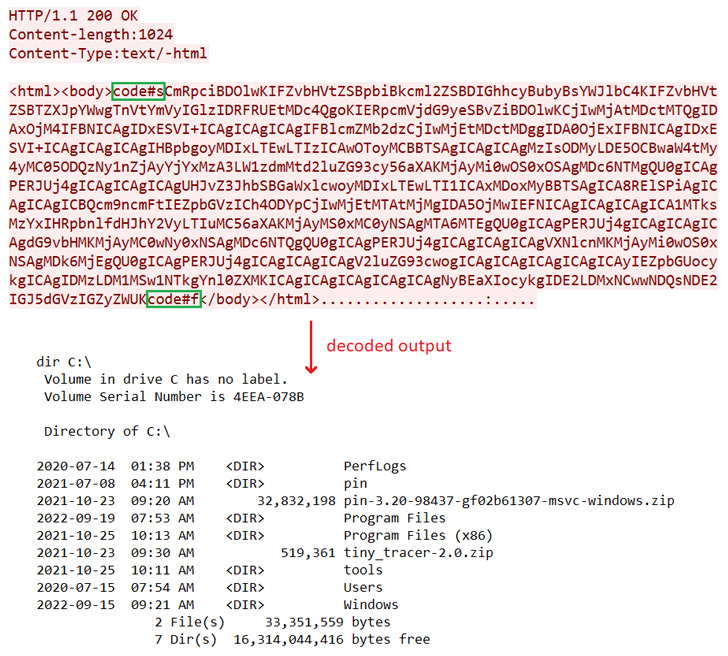
The Slovak cybersecurity firm said it also uncovered several
other modules responsible for logging keystrokes, capturing
screenshots, taking photos via webcam, and establishing a reverse
shell on the compromised machine.
Despite the abundance of malware utilized in the attacks, the
initial access vector used to breach the networks is currently
unknown, although it’s suspected that it may have involved the
exploitation of VPN flaws.
“Most of the group’s malicious modules are small, with limited
functionality,” Porolli said[3]. “They like to divide
the code in their backdoors, distributing malicious functionality
into various small DLLs, perhaps expecting that defenders or
researchers will not observe the complete attack chain.”
Read more https://thehackernews.com/2022/10/researchers-uncover-custom-backdoors.html