Major financial and insurance companies located in
French-speaking nations in Africa have been targeted over the past
two years as part of a persistent malicious campaign codenamed
DangerousSavanna.
Countries targeted include Ivory Coast, Morocco, Cameroon,
Senegal, and Togo, with the spear-phishing attacks heavily focusing
on Ivory Coast in recent months, Israeli cybersecurity firm Check
Point said[1]
in a Tuesday report.
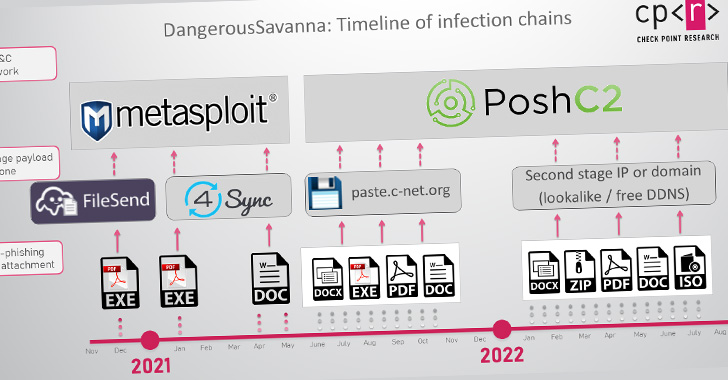
Infection chains entail targeting employees of financial
institutions with social engineering messages containing malicious
attachments as a means of initial access, ultimately leading to the
deployment of off-the-shelf malware such as Metasploit[2], PoshC2[3], DWservice[4], and AsyncRAT[5].
“The threat actors’ creativity is on display in the initial
infection stage, as they persistently pursue the employees of the
targeted companies, constantly changing infection chains that
utilize a wide range of malicious file types, from self-written
executable loaders and malicious documents, to ISO, LNK, JAR and
VBE files in various combinations,” the company said.
The phishing emails are written in French and sent using Gmail
and Hotmail services, with the messages also impersonating other
financial institutions in Africa to boost their credibility.
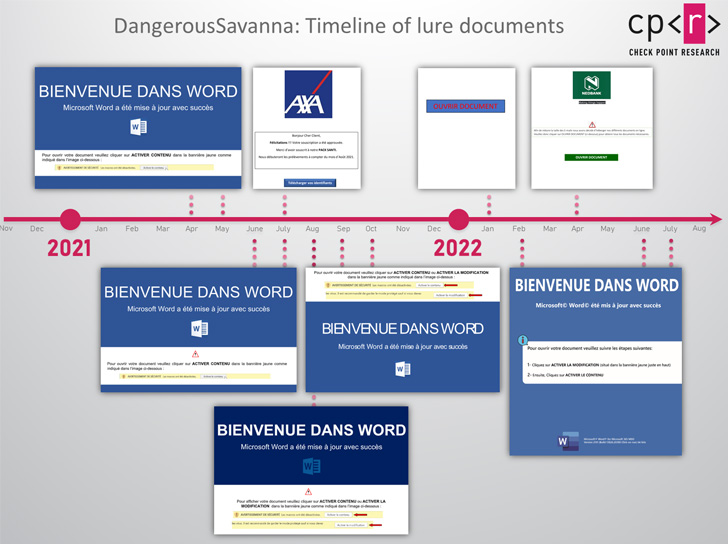
While attacks in 2021 leveraged macro-laced Microsoft Word
documents as lures, the company’s decision to block macros[6]
in files downloaded from the internet by default earlier this year
has led the DangerousSavanna actors to pivot to PDF and ISO
files.
Furthermore, the first wave of attacks from the end of 2020 to
the beginning of 2021 involved the use of bespoke .NET-based tools,
which came disguised as PDF files attached to phishing emails, to
retrieve next-stage droppers and loaders from remote servers.
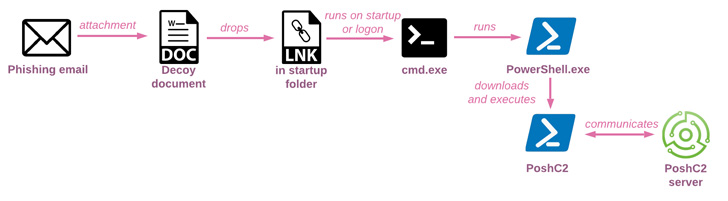
Regardless of the method used, post-exploitation activities
carried out after obtaining an initial foothold include
establishing persistence, performing reconnaissance, and delivering
additional payloads to remotely control the host, kill anti-malware
processes, and log keystrokes.
The exact provenance of the threat actor remains unclear, but
the frequent shift in its tools and methods demonstrates their
knowledge of open-source software and their ability to fine-tune
their tactics for maximizing financial gain.
“If one infection chain didn’t work out, they changed the
attachment and the lure and tried targeting the same company again
and again trying to find an entry point,” Check Point said. “With
social engineering via spear-phishing, all it takes is one
incautious click by an unsuspecting user.”
References
Read more https://thehackernews.com/2022/09/hackers-repeatedly-targeting-financial.html