
Microsoft’s threat intelligence division on Wednesday assessed
that a subgroup of the Iranian threat actor tracked as Phosphorus[1]
is conducting ransomware attacks as a “form of moonlighting” for
personal gain.
The tech giant, which is monitoring the activity cluster under
the moniker DEV-0270 (aka Nemesis Kitten), said
it’s operated by a company that functions under the public aliases
Secnerd and Lifeweb, citing infrastructure overlaps between the
group and the two organizations.
“DEV-0270 leverages exploits for high-severity vulnerabilities
to gain access to devices and is known for the early adoption of
newly disclosed vulnerabilities,” Microsoft said[2].
“DEV-0270 also extensively uses living-off-the-land binaries
(LOLBINs) throughout the attack chain for discovery and credential
access. This extends to its abuse of the built-in BitLocker tool to
encrypt files on compromised devices.”
The use of BitLocker and DiskCryptor by Iranian actors for
opportunistic ransomware attacks came to light earlier this May,
when Secureworks disclosed[3]
a set of intrusions mounted by a threat group it tracks under the
name Cobalt Mirage with ties to Phosphorus[4]
(aka Cobalt Illusion) and TunnelVision[5].
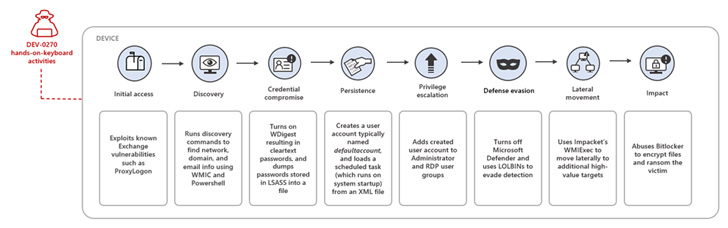
DEV-0270 is known to scan the internet to find servers and
devices susceptible to flaws in Microsoft Exchange Server, Fortinet
FortiGate SSL-VPN, and Apache Log4j for obtaining initial access,
followed by network reconnaissance and credential theft
activities.
Access to the compromised network is achieved by establishing
persistence via a scheduled task. DEV-0270 then escalates
privileges to the system level, allowing it to conduct
post-exploitation actions such as disabling Microsoft Defender
Antivirus to evade detection, lateral movement, and file
encryption.
“The threat group commonly uses native WMI, net, CMD, and
PowerShell commands and registry configurations to maintain stealth
and operational security,” Microsoft said. “They also install and
masquerade their custom binaries as legitimate processes to hide
their presence.”
Users are recommended to prioritize patching of internet-facing
Exchange servers to mitigate risk, restrict network appliances like
Fortinet SSL-VPN devices from making arbitrary connections to the
internet, enforce strong passwords, and maintain regular data
backups.
References
- ^
Phosphorus
(thehackernews.com) - ^
said
(www.microsoft.com) - ^
disclosed
(thehackernews.com) - ^
Phosphorus
(thehackernews.com) - ^
TunnelVision
(thehackernews.com)
Read more https://thehackernews.com/2022/09/microsoft-warns-of-ransomware-attacks.html