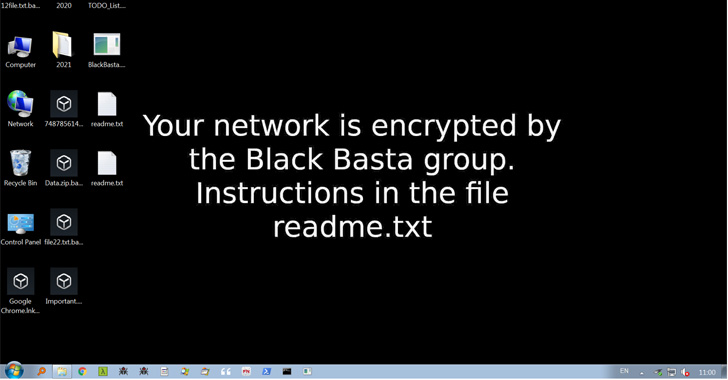
The Black Basta ransomware-as-a-service (RaaS) syndicate has
amassed nearly 50 victims in the U.S., Canada, the U.K., Australia,
and New Zealand within two months of its emergence in the wild,
making it a prominent threat in a short window.
“Black Basta has been observed targeting a range of industries,
including manufacturing, construction, transportation, telcos,
pharmaceuticals, cosmetics, plumbing and heating, automobile
dealers, undergarments manufacturers, and more,” Cybereason
said[1]
in a report.
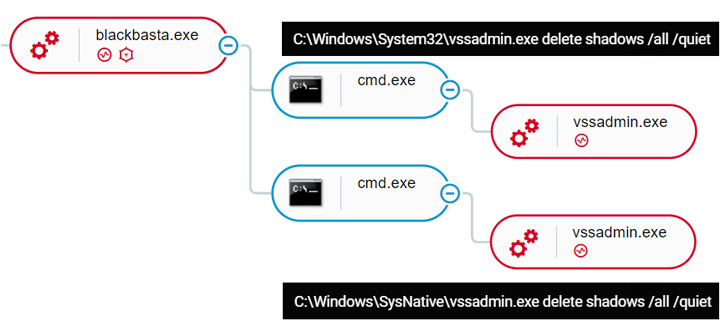
Similar to other ransomware operations, Black Basta is known to
employ the tried-and-tested tactic of double extortion to plunder
sensitive information from the targets and threaten to publish the
stolen data unless a digital payment is made.
A new entrant in the already crowded ransomware landscape,
intrusions involving the threat have leveraged QBot[2]
(aka Qakbot[3]) as a conduit to
maintain persistence on the compromised hosts and harvest
credentials, before moving laterally across the network and
deploying the file-encrypting malware.
Furthermore, the actors behind Black Basta have developed[4]
a Linux variant designed to strike VMware ESXi virtual machines
(VMs) running on enterprise servers, putting it on par with other
groups such as LockBit, Hive, and Cheerscrypt.
The findings come as the cybercriminal syndicate added Elbit
Systems of America, a manufacturer of defense, aerospace, and
security solutions, to the list of its victims over the weekend,
according[5]
to security researcher Ido Cohen.
Black Basta is said to be comprised of members belonging to the
Conti group[6]
after the latter shuttered its operations[7] in response to increased
law enforcement scrutiny and a major leak that saw its tools and
tactics entering the public domain after siding with Russia in the
country’s war against Ukraine.
“I cannot shoot anything, but I can fight with a keyboard and
mouse,” the Ukrainian computer specialist behind the leak, who goes
by the pseudonym Danylo and released the treasure trove of data as
a form of digital retribution, told CNN[8]
in March 2022.
The Conti team has since refuted that it’s associated with Black
Basta. Last week, it decommissioned[9]
the last of its remaining public-facing infrastructure, including
two Tor servers used to leak data and negotiate with victims,
marking an official end to the criminal enterprise.
In the interim, the group continued to maintain the facade of an
active operation by targeting the Costa Rican
government[10], while some members
transitioned to other ransomware outfits and the brand underwent a
organizational revamp that has seen it devolve into smaller
subgroups with different motivations and business models ranging
from data theft to working as independent affiliates.
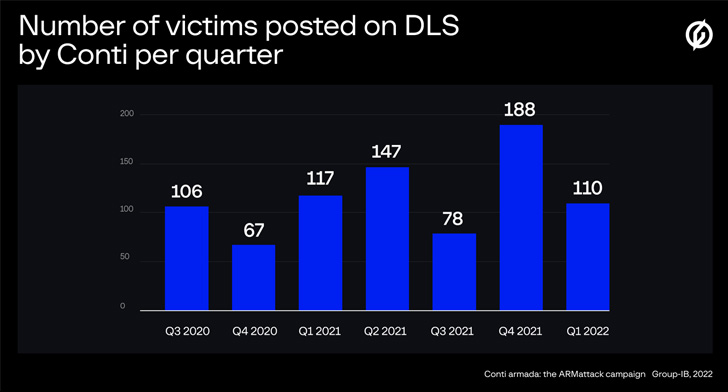
According to a comprehensive report[11] from Group-IB detailing
its activities, the Conti group is believed to have victimized more
than 850 entities since it was first observed in February 2020,
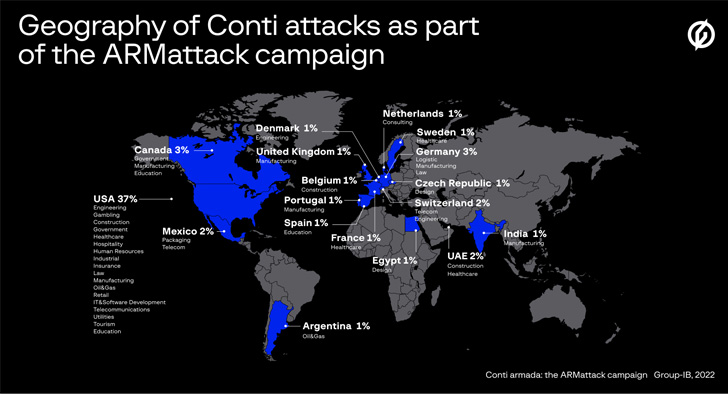
compromising over 40 organizations worldwide as part of a
“lightning-fast” hacking spree that lasted from November 17 to
December 20, 2021.
Dubbed “ARMattack” by the Singapore-headquartered
company, the intrusions were primarily directed against U.S.
organizations (37%), followed by Germany (3%), Switzerland (2%),
the U.A.E. (2%), the Netherlands, Spain, France, the Czech
Republic, Sweden, Denmark, and India (1% each).
The top five sectors historically targeted by Conti have been
manufacturing (14%), real estate (11.1%), logistics (8.2%),
professional services (7.1%), and trade (5.5%), with the operators
specifically singling out companies in the U.S. (58.4%), Canada
(7%), the U.K. (6.6%), Germany (5.8%), France (3.9%), and Italy
(3.1%).
“Conti’s increased activity and the data leak suggest that
ransomware is no longer a game between average malware developers,
but an illicit RaaS industry that gives jobs to hundreds of
cybercriminals worldwide with various specializations,” Group-IB’s
Ivan Pisarev said.
“In this industry, Conti is a notorious player that has in fact
created an ‘IT company’ whose goal is to extort large sums. It is
clear […] that the group will continue its operations, either on
its own or with the help of its ‘subsidiary’ projects.”
References
- ^
said
(www.cybereason.com) - ^
leveraged QBot
(research.nccgroup.com) - ^
Qakbot
(thehackernews.com) - ^
developed
(www.uptycs.com) - ^
according
(twitter.com) - ^
Conti
group (thehackernews.com) - ^
shuttered its operations
(thehackernews.com) - ^
CNN
(edition.cnn.com) - ^
decommissioned
(www.bleepingcomputer.com) - ^
targeting the Costa Rican
government (thehackernews.com) - ^
comprehensive report
(www.group-ib.com)
Read more https://thehackernews.com/2022/06/cybersecurity-experts-warn-of-emerging.html