Just before last Christmas, in a first-of-a-kind case, JPMorgan
was fined $200M for employees using non-sanctioned applications for
communicating about financial strategy. No mention of insider
trading, naked shorting, or any malevolence. Just employees
circumventing regulation using, well, Shadow IT. Not because they
tried to obfuscate or hide anything, simply because it was a
convenient tool that they preferred over any other sanctioned
products (which JPMorgan certainly has quite a few of.)
Visibility into unknown and unsanctioned applications has been
required by regulators and also recommended by the Center for
Internet Security community for a long time. Yet it seems like new
and better approaches are still in demand. Gartner has identified
External Attack Surface Management, Digital Supply Chain Risk, and
Identity Threat Detection as the top three trends to focus on in
2022, all of which are closely intertwined with Shadow IT.
“Shadow IDs,” or in other words, unmanaged employee identities
and accounts in third-party services are often created using a
simple email-and-password-based registration. CASBs and corporate
SSO solutions are limited to a few sanctioned applications and are
not widely adopted on most websites and services either. This
means, that a large part of an organization’s external surface –as
well as its user identities– may be completely invisible.
Above all, these Shadow IDs remain unmanaged even after
employees leave the organization. This may result in unauthorized
access to sensitive customer data or other cloud-based services.
Employee-created, but business-related identities are unseen for
most IDM/IAM tools also. The graveyard of forgotten accounts
belonging to ex-employees or abandoned applications is growing
every day, to infinity.
And sometimes, the dead rise from their graves, as with the
Joint Commission On Public Ethics, whose legacy system was breached
this year, even though it’s been out of use since 2015. They
rightfully notified their legacy users because they understand that
password reuse may stretch over several years, and according to
Verizon, stolen credentials are still the top contributor to all
sorts of breaches and attacks. So when Shadow IDs are left behind,
they create an everlasting risk unseen and unmanaged by anyone.
How to Report on Shadow IT and Shadow
IDs?
Unfortunately, network monitoring misses the mark, as those
tools are designed to filter malicious traffic, provide data
leakage protection and create category-based rules for browsing.
However, they are completely blind to actual logins, and thus
cannot differentiate browsing, private accounts, and corporate
application signups, (or phishing sites for that matter). To
discover and manage Shadow IDs and Shadow IT, there needs to be
application and account-level monitoring in place, that can create
a trusted, global source of truth across the organization.
Discovering these assets via monitoring business-related
credential usage on any website enables a unified view of
unsanctioned or unwanted applications. Inventories of apps and
accounts provide visibility of the true scope of external services
and identities used across the organization. Also, they allow the
reviewing of third-party providers about their policies, security
and authentication measures, and how they are managing and
maintaining your data.
It is impossible to properly categorize all of the
quarter-million new domains that are registered each day across the
globe, so monitoring those that show up on our endpoints is the
right approach. As a side-effect, revealing logins on suspicious or
new apps will give visibility into successful
phishing attacks[1]
that were not prevented on a gateway or client-side, and where
employees gave away important credentials.
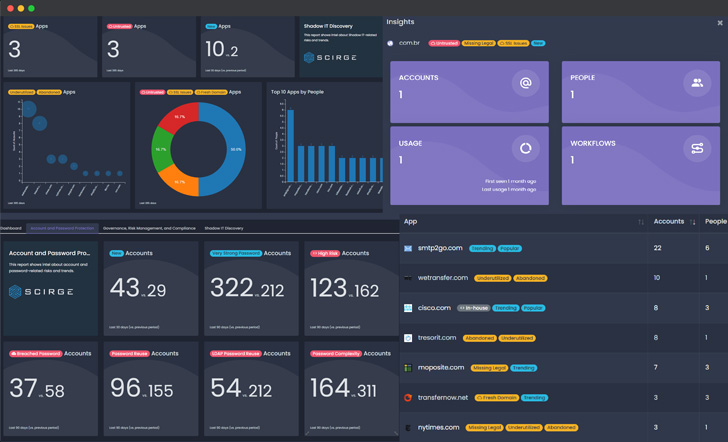
Scirge is a browser-based
tool[2]
that provides complete visibility into Shadow IDs and Shadow IT,
password hygiene for corporate and third-party business web
accounts, and even real-time employee education and awareness. And
it also has a completely free
version[3]
for auditing your cloud footprint, so you can get an immediate view
of the extent of Shadow IT amongst your employees.
References
- ^
give visibility into successful
phishing attacks (thn.scirge.com) - ^
Scirge is a browser-based tool
(thn.scirge.com) - ^
a completely free version
(thn.scirge.com)
Read more https://thehackernews.com/2022/06/what-are-shadow-ids-and-how-are-they.html