
You don’t like having the FBI knocking on your door at 6 am in
the morning. Surprisingly, nor does your usual cybercriminal. That
is why they hide (at least the good ones), for example, behind
layers of proxies, VPNs, or TOR nodes.
Their IP address will never be exposed directly to the target’s
machine. Cybercriminals will always use third-party IP addresses to
deliver their attacks.
There are countless ways to deliver cyberattacks. But one thing
is common to all of them. The need for a pool of IP addresses to
serve as a medium. Criminals need IP addresses to deliver
distributed denial of service attacks.
Criminals need IP addresses to hide behind when probing
services. Criminals need IP addresses to attempt brute force
attacks. Criminals need IP addresses to run bot networks and
services. In a nutshell, criminals need to maintain IP addresses
under their control for pretty much anything. It is their most
important asset and is the ammo they need to deliver attacks.
So how do cybercriminals get their hand on those infamous IP
addresses, and what does this cost them? Here are some
examples.
“admin/admin”
Hijacking machines and more specifically networks of IoT
devices. Poorly secured and managed fleets of IoT devices left with
default access credentials and outdated firmware are the perfect
target for that. Easy way to zombify a large number of devices,
freshly served for DDoS attacks…hey “smart” security cameras…we are
watching you!
“VPS are cheap”
Take any cloud provider, fire up some instances, install bots to
scan & attempt Log4j injections. At a limited cost, you have your
bot network to scan targets for vulnerabilities. Of course, at some
point, you will get flagged or the provider might catch you. But
you can replicate your approach with cloud providers in other
countries, maybe less regarding the usage of those VPS…
‘Into darkness”
They can also go to the supermarket for criminals, aka. “dark
web” and acquire a network of bots to deliver attacks like DDoS for
a couple of hundred dollars. Script kiddies, welcome.
Two take-aways from these approaches :
Acquiring IP addresses, although not impossible, costs money,
time, and resources. Tamper with that, you tamper with a criminal’s
ability to do his job efficiently. Ban known IPs used by criminals
and you might just drastically increase the security of your online
assets.
Those bots and scan automation activities generate a lot of
internet background noise. Imagine all those countless botnets
scanning the IP space for different nefarious purposes. This is
well known by SOC analysts as “alert fatigue”, meaning, this
generates a large amount of data, without much-added value, but
that analysts still need to take into account.
But good news everyone, there are solutions to make life more
difficult for cybercriminals.
IP reputation is part of the solution. Suppose users can
preventively evaluate the risk of an IP connecting to a service. In
that case, it can lock out known malicious users and make sure
those IPs can not hurt anyone anymore, de-facto taking away the IP
address pool criminals spent time and money to build.
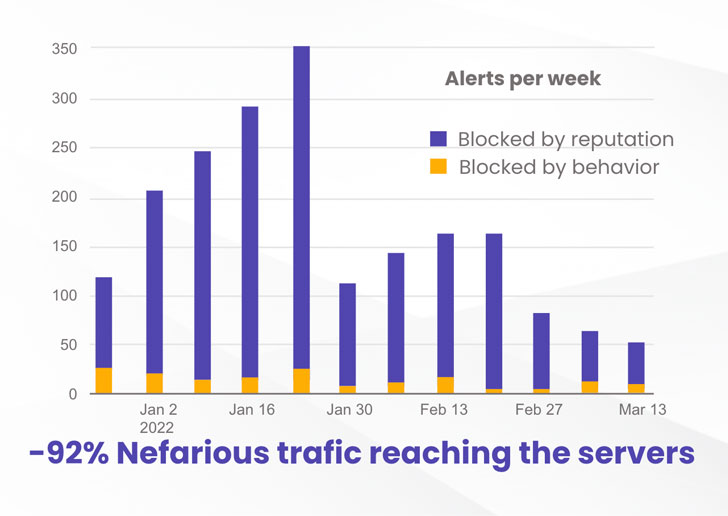
At CrowdSec, we did fun experimenting: we set up two identical
VPSs on a well-known cloud provider, with two simple services, SSH
and Nginx. Nothing fancy, just like millions of machines out there
in the wild. CrowdSec was installed on both to detect intrusion
attempts. Still, one machine had the remediation agent (IPS),
receiving IP reputation information from the CrowdSec community
(daily 1 million signals shared) and preventively banning flagged
IPs.
The result was quite stunning.
Thanks to the community blocklist, the machine with the IPS
preventively blocked 92% of the attacks compared to the machine
without the IPS. That is a notable increase in security level.
You can read more about the methodology and detailed results at:
https://crowdsec.net/[1]
 |
| Source: crowdsec.net |
Community IP blocklists – with the previous curation – take care
of both challenges.
It cripples criminals by nullifying their IP address pool. They
spent time, money, resources to build them, and we, as a community,
simply take them away in the blink of an eye. Take that scum!
But it also makes the life of analysts and cybersecurity experts
much easier. By preventively blocking those nefarious IPs, the
background noise is significantly reduced. We are talking about
reducing by 90% the alerts that need to be analyzed by SOC people.
That is much more time to focus on more significant alerts and
topics. Alert fatigue? – bye-bye.
If you wish to partake in the biggest IP reputation community
and hunt nefarious IP addresses while effectively protecting your
online assets, join us at crowdsec.net
References
- ^
https://crowdsec.net/
(crowdsec.net)
Read more https://thehackernews.com/2022/03/of-cybercriminals-and-ip-addresses.html