
The operators of the Purple Fox malware[1]
have retooled their malware arsenal with a new variant of a remote
access trojan called FatalRAT, while also simultaneously upgrading
their evasion mechanisms to bypass security software.
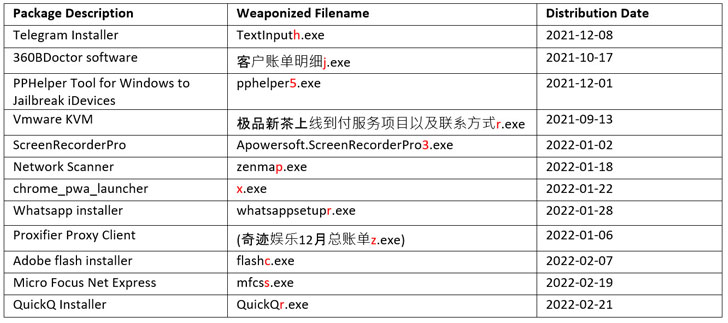
“Users’ machines are targeted via trojanized software packages
masquerading as legitimate application installers,” Trend Micro
researchers said[2]
in a report published on March 25, 2022. “The installers are
actively distributed online to trick users and increase the overall
botnet infrastructure.”
The findings follow prior research[3]
from Minerva Labs that shed light on a similar modus operandi of
leveraging fraudulent Telegram applications to distribute the
backdoor. Other disguised software installers include WhatsApp,
Adobe Flash Player, and Google Chrome.
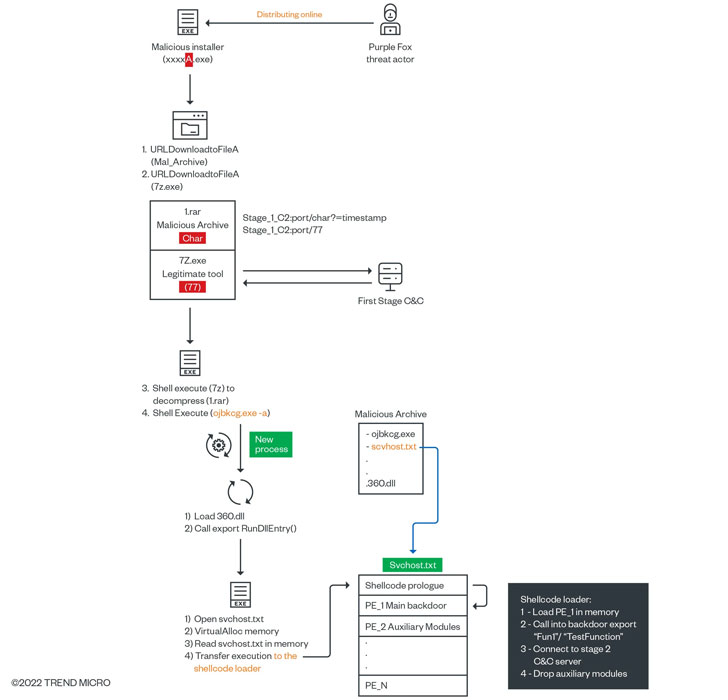
These packages act as a first-stage loader, triggering an
infection sequence that leads to the deployment of a second-stage
payload from a remote server and culminating in the execution of a
binary that inherits its features from FatalRAT.
FatalRAT[4]
is a C++-based implant designed to run commands and exfiltrate
sensitive information back to a remote server, with the malware
authors incrementally updating the backdoor with new
functionality.
“The RAT is responsible for loading and executing the auxiliary
modules based on checks performed on the victim systems,” the
researchers said. “Changes can happen if specific [antivirus]
agents are running or if registry keys are found. The auxiliary
modules are intended as support for the group’s specific
objectives.”
Furthermore, Purple Fox, which comes with a rootkit module,
comes with support for five different commands, including copying
and deleting files from the kernel as well as evading antivirus
engines by intercepting calls sent to the file system.
The findings also follow recent disclosures from cybersecurity
firm Avast, which detailed a new campaign that involved the Purple
Fox exploitation framework acting as a deployment channel for
another botnet called DirtyMoe[5].
“Operators of the Purple Fox botnet are still active and
consistently updating their arsenal with new malware, while also
upgrading the malware variants they have,” the researchers said.
“They are also trying to improve their signed rootkit arsenal for
[antivirus] evasion and trying to bypass detection mechanisms by
targeting them with customized signed kernel drivers.”
References
- ^
Purple
Fox malware (thehackernews.com) - ^
said
(www.trendmicro.com) - ^
prior
research (thehackernews.com) - ^
FatalRAT
(cybersecurity.att.com) - ^
DirtyMoe
(thehackernews.com)
Read more https://thehackernews.com/2022/03/purple-fox-hackers-spotted-using-new.html