A new email phishing campaign has been spotted leveraging the
tactic of conversation hijacking to deliver the IceID info-stealing malware[1] onto infected machines
by making use of unpatched and publicly-exposed Microsoft Exchange
servers.
“The emails use a social engineering technique of conversation
hijacking (also known as thread hijacking),” Israeli company
Intezer said in a report[2]
shared with The Hacker News. “A forged reply to a previous stolen
email is being used as a way to convince the recipient to open the
attachment. This is notable because it increases the credibility of
the phishing email and may cause a high infection rate.”
The latest wave of attacks, detected in mid-March 2022, is said
to have targeted organizations within energy, healthcare, law, and
pharmaceutical sectors.
IceID, aka BokBot, like its counterparts TrickBot and Emotet[3], is a banking trojan[4]
that has evolved to become an entry point for more sophisticated
threats, including human-operated ransomware and the Cobalt Strike[5]
adversary simulation tool.
It’s capable of connecting to a remote server and downloading
next-stage implants and tools that allow attackers to carry out
follow-on activities and move laterally across affected networks to
distribute additional malware.
In June 2021, enterprise security firm Proofpoint disclosed[6]
an evolving tactic in the cybercrime landscape wherein initial
access brokers were observed infiltrating target networks via
first-stage malware payloads such as IcedID to deploy Egregor,
Maze, and REvil ransomware payloads.
While earlier IcedID campaigns have taken advantage of website contact forms[7]
to send malware-laced links to organizations, the current version
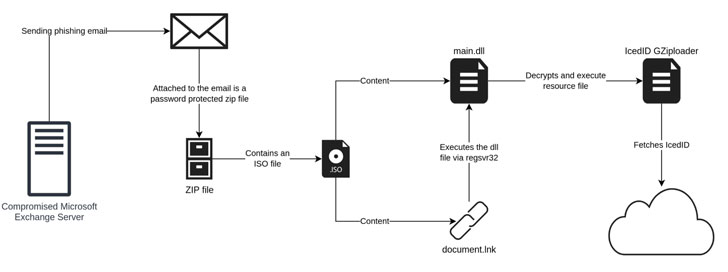
of the attacks bank on vulnerable Microsoft Exchange servers to
send the lure emails from a hijacked account, indicating a further
evolution of the social engineering scheme.
“The payload has also moved away from using Office documents to
the use of ISO files with a Windows LNK file and a DLL file,”
researchers Joakim Kennedy and Ryan Robinson said. “The use of ISO
files allows the threat actor to bypass the Mark-of-the-Web controls[8], resulting in execution
of the malware without warning to the user.”
The idea is to send fraudulent replies to an already existing
email thread plundered from the victim’s account by using the
compromised individual’s email address to make the phishing emails
appear more legitimate.
“The use of conversation hijacking is a powerful social
engineering technique that can increase the rate of a successful
phishing attempt,” the researchers concluded. “By using this
approach, the email appears more legitimate and is transported
through the normal channels which can also include security
products.”
References
- ^
IceID
info-stealing malware
(malpedia.caad.fkie.fraunhofer.de) - ^
report
(www.intezer.com) - ^
Emotet
(www.trendmicro.com) - ^
banking
trojan (blogs.vmware.com) - ^
Cobalt
Strike (www.cybereason.com) - ^
disclosed
(thehackernews.com) - ^
website
contact forms (www.microsoft.com) - ^
Mark-of-the-Web controls
(attack.mitre.org)
Read more https://thehackernews.com/2022/03/hackers-hijack-email-reply-chains-on.html