
As many as 11 security vulnerabilities have been disclosed in
Nagios network management systems, some of which could be chained
to achieve pre-authenticated remote code execution with the highest
privileges, as well as lead to credential theft and phishing
attacks.
Industrial cybersecurity firm Claroty, which discovered the
flaws, said flaws in tools such as Nagios make them an attractive
target owing to their “oversight of core servers, devices, and
other critical components in the enterprise network.” The issues
have since been fixed in updates released in August with Nagios XI
5.8.5 or above, Nagios XI Switch Wizard 2.5.7 or above, Nagios XI
Docker Wizard 1.13 or above, and Nagios XI WatchGuard 1.4.8 or
above.
“SolarWinds[1]
and Kaseya[2]
were likely targeted not only because of their large and
influential customer bases, but also because of their respective
technologies’ access to enterprise networks, whether it was
managing IT, operational technology (OT), or internet of things
(IoT) devices,” Claroty’s Noam Moshe said[3]
in a write-up published Tuesday, noting how the intrusions
targeting the IT and network management supply chains emerged as a
conduit to compromise thousands of downstream victims.
Nagios Core is a popular open-source network health tool
analogous to SolarWinds Network Performance Monitor (NPM) that’s
used for keeping tabs on IT infrastructure for performance issues
and sending alerts following the failure of mission-critical
components. Nagios XI, a proprietary web-based platform built atop
Nagios Core, provides organizations with extended insight into
their IT operations with scalable monitoring and a customizable
high-level overview of hosts, services, and network devices.
Chief among the issues are two remote code execution flaws
(CVE-2021-37344, CVE-2021-37346) in Nagios XI Switch Wizard and
Nagios XI WatchGuard Wizard, an SQL injection vulnerability
(CVE-2021-37350) in Nagios XI, and a server-side request forgery
(SSRF) affecting Nagios XI Docker Wizard, as well as a
post-authenticated RCE in Nagios XI’s Auto-Discovery tool. The
complete list of 11 flaws[4] is as follows –
- CVE-2021-37343 (CVSS score: 8.8) – A path
traversal vulnerability exists in Nagios XI below version 5.8.5
AutoDiscovery component and could lead to post-authenticated RCE
under the security context of the user running Nagios. - CVE-2021-37344 (CVSS score: 9.8) – Nagios XI
Switch Wizard before version 2.5.7 is vulnerable to remote code
execution through improper neutralization of special elements used
in an OS Command (OS Command injection). - CVE-2021-37345 (CVSS score: 7.8) – Nagios XI
before version 5.8.5 is vulnerable to local privilege escalation
because xi-sys.cfg is being imported from the var directory for
some scripts with elevated permissions. - CVE-2021-37346 (CVSS score: 9.8) – Nagios XI
WatchGuard Wizard before version 1.4.8 is vulnerable to remote code
execution through Improper neutralization of special elements used
in an OS Command (OS Command injection). - CVE-2021-37347 (CVSS score: 7.8) – Nagios XI
before version 5.8.5 is vulnerable to local privilege escalation
because getprofile.sh does not validate the directory name it
receives as an argument. - CVE-2021-37348 (CVSS score: 7.5) – Nagios XI
before version 5.8.5 is vulnerable to local file inclusion through
an improper limitation of a pathname in index.php. - CVE-2021-37349 (CVSS score: 7.8) – Nagios XI
before version 5.8.5 is vulnerable to local privilege escalation
because cleaner.php does not sanitize input read from the
database. - CVE-2021-37350 (CVSS score: 9.8) – Nagios XI
before version 5.8.5 is vulnerable to SQL injection vulnerability
in Bulk Modifications Tool due to improper input sanitization. - CVE-2021-37351 (CVSS score: 5.3) – Nagios XI
before version 5.8.5 is vulnerable to insecure permissions and
allows unauthenticated users to access guarded pages through a
crafted HTTP request to the server. - CVE-2021-37352 (CVSS score: 6.1) – An open
redirect vulnerability exists in Nagios XI before version 5.8.5
that could lead to spoofing. To exploit the vulnerability, an
attacker could send a link that has a specially-crafted URL and
convince the user to click the link. - CVE-2021-37353 (CVSS score: 9.8) – Nagios XI
Docker Wizard before version 1.1.3 is vulnerable to SSRF due to
improper sanitization in table_population.php
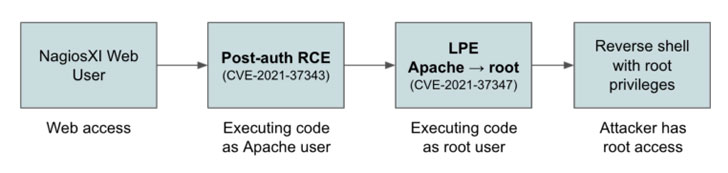
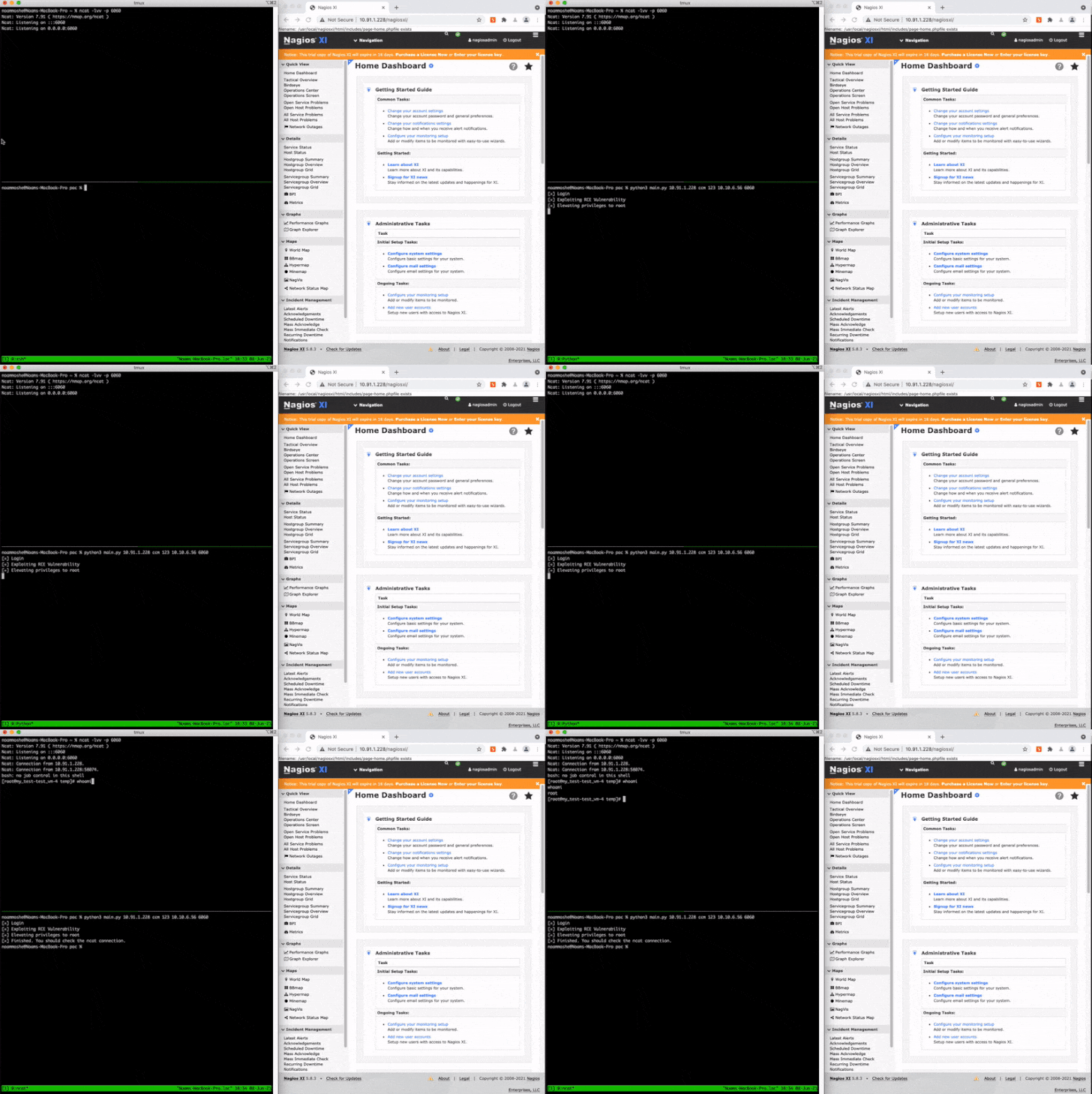
In a nutshell, the flaws could be combined by attackers to drop
a web shell or execute PHP scripts and elevate their privileges to
root, thus achieving arbitrary command execution in the context of
the root user. As a proof-of-concept, Claroty chained
CVE-2021-37343 and CVE-2021-37347 to gain a write-what-where
primitive, allowing an attacker to write content to any file in the
system.
“[Network management systems] require extensive trust and access
to network components in order to properly monitor network
behaviors and performance for failures and poor efficiency,” Moshe
said.
“They may also extend outside your network through the firewall
to attend to remote servers and connections. Therefore, these
centralized systems can be a tasty target for attackers who can
leverage this type of network hub, and attempt to compromise it in
order to access, manipulate, and disrupt other systems.”
The disclosure is the second time nearly dozen vulnerabilities
have been disclosed in Nagios. Earlier this May, Skylight Cyber
revealed 13
security weaknesses[5]
in the network monitoring application that could be abused by an
adversary to hijack the infrastructure without any operator
intervention.
References
- ^
SolarWinds
(thehackernews.com) - ^
Kaseya
(thehackernews.com) - ^
said
(claroty.com) - ^
complete
list of 11 flaws (www.nagios.com) - ^
13 security weaknesses
(thehackernews.com)
Read more http://feedproxy.google.com/~r/TheHackersNews/~3/xeFHS3DnjBY/new-nagios-software-bugs-could-let.html