Microsoft has opened the lid on a large-scale
phishing-as-a-service (PHaaS) operation that’s involved in selling
phishing kits and email templates as well as providing hosting and
automated services at a low cost, thus enabling cyber actors to
purchase phishing campaigns and deploy them with minimal
efforts.
“With over 100 available phishing templates that mimic known
brands and services, the BulletProofLink operation is responsible
for many of the phishing campaigns that impact enterprises today,”
Microsoft 365 Defender Threat Intelligence Team said[1]
in a Tuesday report.
“BulletProofLink (also referred to as BulletProftLink or Anthrax
by its operators in various websites, ads, and other promotional
materials) is used by multiple attacker groups in either one-off or
monthly subscription-based business models, creating a steady
revenue stream for its operators.”
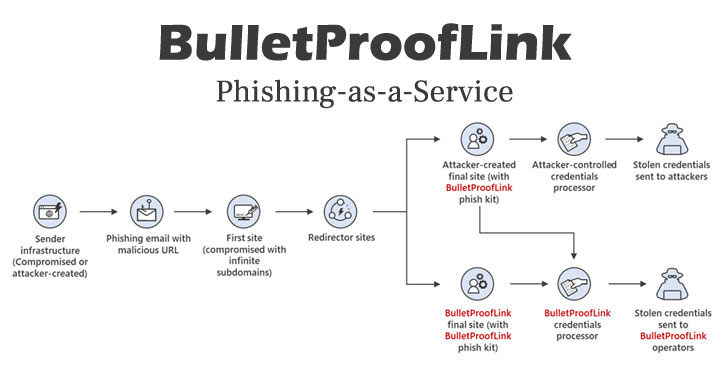
The tech giant said it uncovered the operation during its
investigation of a credential phishing campaign that used the
BulletProofLink phishing kit on either on attacker-controlled sites
or sites provided by BulletProofLink as part of their service. The
existence of the operation was first made public by OSINT Fans[2]
in October 2020.
Phishing-as-a-service differs from traditional phishing kits in
that unlike the latter, which are sold as one-time payments to gain
access to packaged files containing ready-to-use email phishing
templates, they are subscription-based and follow a
software-as-a-service model, while also expanding on the
capabilities to include built-in site hosting, email delivery, and
credential theft.
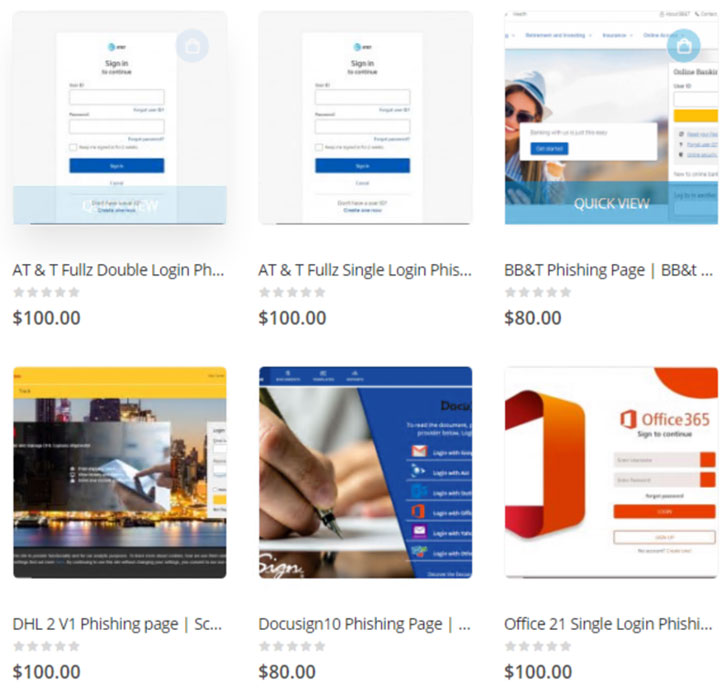
Believed to have been active since at least 2018,
BulletProofLink is known to operate an online portal to advertise
their toolset for as much as $800 a month and allow cybercrime
gangs to register and pay for the service. Customers can also avail
of a 10% discount should they opt to subscribe to their newsletter,
not to mention pay anywhere between $80 to $100 for credential
phishing templates that allow them to steal credentials entered by
unsuspected victims upon clicking a malicious URL in the email
message.
Troublingly, the stolen credentials are not only sent to the
attackers but also to the BulletProofLink operators using a
technique called “double theft” in a modus operandi that mirrors
the double extortion[3]
attacks employed by ransomware gangs.
“With phishing kits, it is trivial for operators to include a
secondary location for credentials to be sent to and hope that the
purchaser of the phish kit does not alter the code to remove it,”
the researchers said. “This is true for the BulletProofLink
phishing kit, and in cases where the attackers using the service
received credentials and logs at the end of a week instead of
conducting campaigns themselves, the PhaaS operator maintained
control of all credentials they resell.”
References
- ^
said
(www.microsoft.com) - ^
OSINT
Fans (osint.fans) - ^
double
extortion (thehackernews.com)