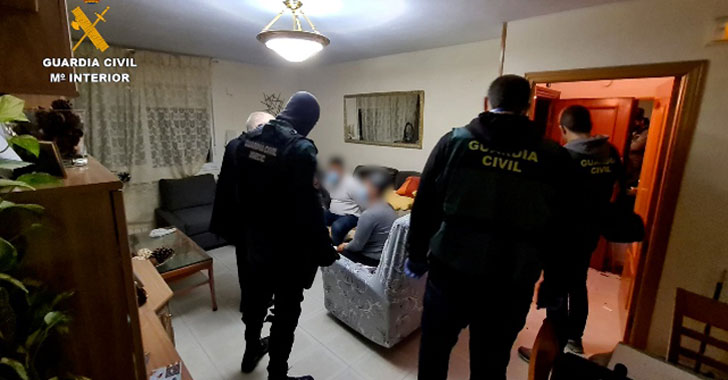
Spanish law enforcement agencies on Wednesday arrested 16
individuals belonging to a criminal network in connection with
operating two banking trojans as part of a social engineering
campaign targeting financial institutions in Europe.
The arrests were made in Ribeira (A Coruña), Madrid, Parla and
Móstoles (Madrid), Seseña (Toledo), Villafranca de los barros
(Badajoz), and Aranda de Duero (Burgos) following a year-long
investigation, the Civil Guard said in a statement.
“Through malicious software, installed on the victim’s computer
by the technique known as ’email spoofing’, [the group] would have
managed to divert large amounts of money to their accounts,”
authorities noted[1].
Computer equipment, mobile phones, and documents were
confiscated, and more than 1,800 spam emails were analyzed,
enabling law enforcement to block transfer attempts totaling €3.5
million successfully. The campaign is said to have netted the
actors €276,470, of which €87,000 has been successfully
recovered.
As part of an effort to lend credibility to their phishing
attacks, the operators worked by sending emails under the guise of
legitimate package delivery services and government entities such
as the Treasury, urging the recipients to click on a link that
stealthily downloaded malicious software onto the systems.
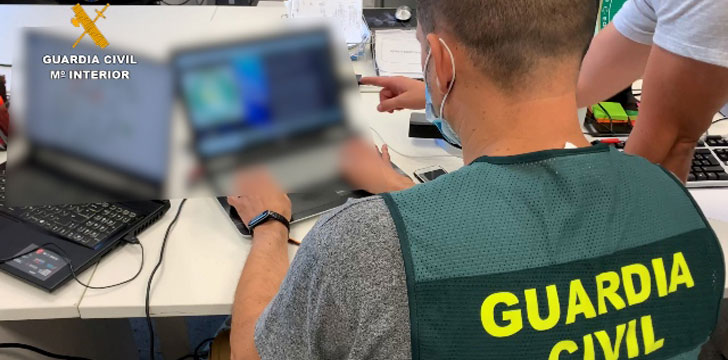
The malware — dubbed “Mekotio” and “Grandoreiro” —
functioned by intercepting transactions on a banking website to
unauthorizedly siphon funds to accounts under the attackers’
control. At least 68 email accounts belonging to official bodies
were infected to facilitate such fraudulent transfers.
“After that, the money was diversified by sending it to other
accounts, or by withdrawing cash at ATMs, transfers by BIZUM,
REVOLUT cards, etc., in order to hinder the possible police
investigation,” the Civil Guard said.
Grandoreiro is part of a Tetrade[2]
of Brazilian banking trojans as detailed by cybersecurity firm
Kaspersky in July 2020, while Mekotio[3]‘s evolving tactics were
disclosed by ESET in August 2020, which involved displaying fake
pop-up windows to its victims in an attempt to entice them into
divulging sensitive information.
“These windows are carefully designed to target Latin American
banks and other financial institutions,” the Slovak cybersecurity
company had noted.
To avoid falling prey to such attacks, the agency is
recommending that email and SMS recipients scrutinize messages
carefully, particularly if it is about entities with urgent
requests, promotions, or very attractive bargains, while also
taking steps to be on the lookout for grammatical errors and ensure
the authenticity of the sender of the message.