
REvil, the infamous ransomware cartel behind some of the biggest
cyberattacks targeting JBS and Kaseya, has mysteriously disappeared
from the dark web, leading to speculations that the criminal
enterprise may have been taken down.
Multiple darknet and clearnet sites maintained by the
Russia-linked cybercrime syndicate, including the data leak,
extortion, and payment portals, remained inaccessible, displaying
an error message “Onionsite not found.”
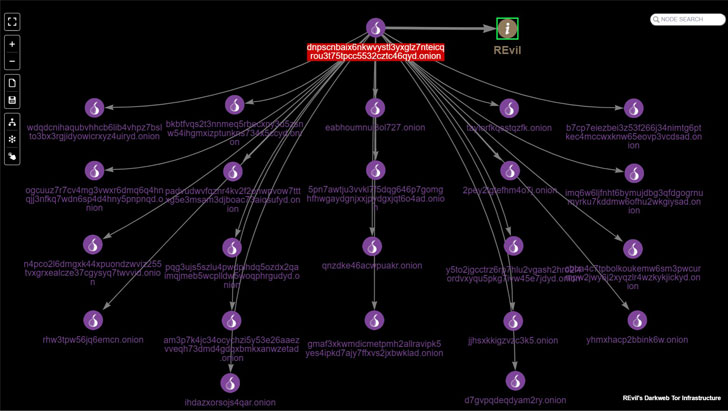
The group’s Tor network infrastructure[1] on the dark web consists
of one data leak blog site and 22 data hosting sites. It’s not
immediately clear what prompted the infrastructure to be knocked
offline.
REvil is one of the most prolific ransomware-as-a-service (RaaS)
groups that first appeared on the threat landscape in April 2019.
It’s an evolution of the GandCrab[2]
ransomware, which hit the underground markets in early 2018.
“If REvil has been permanently disrupted, it’ll mark the end of
a group which has been responsible for >360 attacks on the U.S.
public and private sectors this year alone,” Emsisoft’s Brett
Callow tweeted[3].
The sudden development comes close on the heels of a wide-scale
supply chain ransomware attack[4] aimed at technology
services provider Kaseya, for which REvil (aka Sodinokibi) took
responsibility for and demanded a $70 million ransom to unlock
access to encrypted systems in exchange for a universal decryption
key that would unlock all victims data.
The disastrous attack saw the ransomware gang encrypting
approximately 60 managed service providers (MSPs) and over 1,500
downstream businesses using a zero-day vulnerability in the Kaseya
VSA remote management software. In late May, REvil also
masterminded the attack on the world’s largest meat producer JBS,
which ended up paying $11 million[5]
to the extortionists to recover from the incident.
The outage also coincides with U.S. President Joe Biden’s
phone
call[6] with Russian President
Vladimir Putin last week, pressing the latter to take steps to
disrupt ransomware groups operating in the country, while warning
of retaliatory action to defend critical infrastructure.
“The situation is still unfolding, but evidence suggests REvil
has suffered a planned, concurrent takedown of their
infrastructure, either by the operators themselves or via industry
or law enforcement action,” FireEye Mandiant’s John Hultquist
told[7]
CNBC.
It appears that REvil’s Happy Blog was taken offline around 1 AM
EST on Tuesday, with vx-underground noting[8]
that the group’s public-facing representative, Unknown, has not
posted on popular hacking forums such as Exploit and XSS since July
8.
Subsequently, a representative for LockBit ransomware posted[9]
to the XSS Russian-speaking hacking
forum[10] that REvil’s attack
infrastructure received a government legal request, causing the
servers to be dismantled. “REvil is banned from XSS,”
vx-underground later added[11].
It’s not uncommon for ransomware groups to go under the ground
following highly publicized incidents. After the DarkSide gang
targeted Colonial Pipeline in May, the operators announced[12] plans to wind up its
RaaS affiliate program for good, claiming that its servers had been
seized by an unknown law enforcement agency, raising questions as
to whether the group actually retired, or rebranded under a new
name.
This theory was eventually validated when the U.S. Department of
Justice revealed[13] last month that it was
able to recover most of the money paid by Colonial Pipeline to the
DarkSide group through an analysis of the bitcoin trails.
REvil’s unexplained shutdown, in a similar fashion, may as well
be a case of planned retirement, or a temporary setback, forcing it
to seemingly disband only to eventually reassemble under a new
identity so as to attract less attention, or may have been the
consequence of increased international scrutiny in the wake of the
global ransomware crisis.
If it indeed turns out that the group has permanently shuttered
operations, the move is bound to leave the group’s targets in the
lurch, with no viable means to negotiate ransoms and get hold of
the decryption keys necessary to regain control of their systems,
thus permanently locking them out of their data.
“I don’t know what this means, but regardless, I’m happy!”
tweeted[14] Katie Nickels, director
of intelligence at Red Canary. “If it’s a government takedown –
awesome, they’re taking action. If the actors voluntarily went
quiet – excellent, maybe they’re scared.”
References
- ^
Tor
network infrastructure (twitter.com) - ^
GandCrab
(www.crowdstrike.com) - ^
tweeted
(twitter.com) - ^
supply
chain ransomware attack (thehackernews.com) - ^
paying
$11 million (thehackernews.com) - ^
phone call
(www.whitehouse.gov) - ^
told
(www.cnbc.com) - ^
noting
(twitter.com) - ^
posted
(twitter.com) - ^
XSS
Russian-speaking hacking forum
(twitter.com) - ^
later
added (twitter.com) - ^
announced
(thehackernews.com) - ^
revealed
(thehackernews.com) - ^
tweeted
(twitter.com)
Read more http://feedproxy.google.com/~r/TheHackersNews/~3/d7Z5Ja2uaL4/revil-ransomware-gang-mysteriously.html